

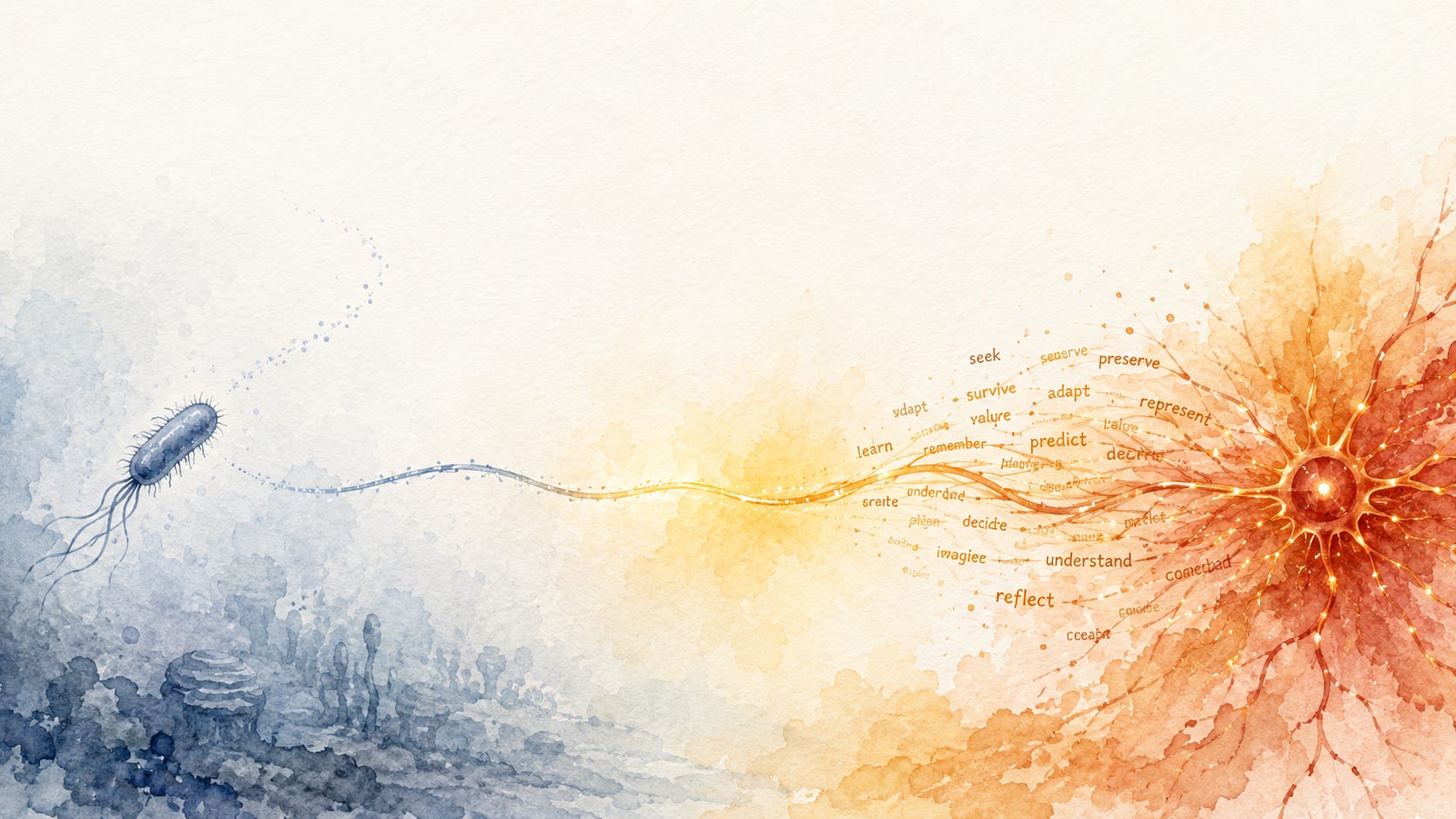
Intelligence did not begin with brains. It did not begin with humans, and it did not begin with computers. The specific thing a language model does when it reads half a sentence and commits to the next word, a single cell was already doing in the shallow water of a young planet, almost four billion years before anyone built a machine to do it on purpose.
That is not a figure of speech. It is the claim this whole series rests on. Life, mind, and machine are three solutions to one problem: how to model a structured world well enough to stay ahead of it. The material that does the modeling changes across the story, from proteins to neurons to numbers in a data center. The problem being solved does not change at all.
So begin with the oldest solution we know of.
A cell that predicts
Picture a single bacterium, Escherichia coli, a rod about two micrometers long, adrift in a drop of water. Somewhere in that drop there is sugar, and the sugar is not evenly spread. It is denser in one direction and thinner in the other. The cell has no eyes, no brain, no nervous system of any kind. It has a job anyway: get to the sugar.
Here is the difficulty. The cell is far too small to tell which way to go. A gradient of sugar does exist across the width of its own body, but the difference between the concentration at its front and the concentration at its back is so slight that no molecular machinery could reliably read it. The cell cannot compare here to there. It is not big enough to hold a “here” and a “there” apart.
So it does something else. It compares now to then.
The bacterium swims in more or less straight lines, called runs, punctuated by brief chaotic spins, called tumbles, that fling it off in a new random direction. Run, tumble, run, tumble. On its own this is a drunkard’s walk, a path that goes nowhere in particular. What turns the walk into a search is a single trick. While it swims, the cell keeps a chemical record of how much sugar it encountered a moment ago, and it checks that record against how much sugar it is encountering right now. If conditions are improving, if now is sweeter than a second ago, it suppresses the next tumble and keeps going straight. If conditions are flat or worsening, it tumbles sooner and tries a new heading.
That is the entire strategy. Swim, and if the world is getting better, keep doing what you are doing. The cell has no map. It has a memory a few seconds long and a rule for what to do with it. And the rule works: over many runs and tumbles, the random walk bends, statistically, up the gradient, and the bacterium arrives at the food.
Stop and notice what just happened, because everything else in this series is a variation on it. The cell held a tiny piece of the recent past. It used that piece to guess whether the immediate future was worth swimming into. Then it acted on the guess. A system too small to perceive space solved its problem by perceiving time instead, by carrying a short internal record of the world and betting on what came next.
That is prediction. That is the thinnest possible version of a mind, and it is running on a few proteins.
The three questions
There is a way of looking at that bacterium that will follow us all the way to the present, so it is worth making explicit now. At every stop in this history, from the cell to the cortex to the transformer, we will ask the same three questions.
First: which regularity in the world does this system latch onto? The bacterium latches onto a simple one, that sugar concentration tends to change smoothly across space, so a change over time as you swim is a reliable clue to a change over distance. The world happens to be structured that way, and the cell exploits the structure.
Second: what does the system compress that regularity into? For the bacterium, the answer is almost comically small: a chemical memory of the last second or two, stored in the state of a few receptor molecules. That memory is its model of the world. It is a lossy, fleeting, one-dimensional model, but it is a model, and the cell’s behavior depends on it.
Third: what does the model buy? For the bacterium it buys the most valuable thing there is: food, and therefore another few hours of being alive. A cell that models the gradient eats. A cell that does not starves. The ledger is that direct.
Which regularity, what model, what does it buy. Hold those three questions. They are the instrument this series measures with, and their units, whether we say so out loud or not, are the units of information: surprise, prediction, the number of bits you need to describe a thing you could otherwise be fooled by.
The same three questions, four billion years later
Now cut forward almost the entire history of the planet, to a machine trained on a large fraction of everything humans have ever written.
Give it the words the cat sat on the. It answers mat, or floor, or couch, with a confidence assigned to each. Ask the three questions again.
Which regularity does it latch onto? That language is not random, that words carry information about the words around them, that after the cat sat on the the space of sensible continuations is narrow and the space of nonsense is vast. Second: what does it compress that regularity into? Billions of numbers, adjusted over the course of training until they encode, in a form no human can read directly, the statistical shape of human text. That is its model of the world, or at least of the slice of the world that reaches it through language. Third: what does the model buy? A good next guess. And a system that reliably guesses the next word turns out to be able to answer questions, write code, summarize a contract, and hold a conversation, because so much of what we want from intelligence is, underneath, a very good prediction about what should come next.
A bacterium comparing now to then in a drop of water. A model comparing this word to the billions of words it was shown. Different in almost every way that a biologist or an engineer would care about, and identical in the one way this series cares about most: both are systems that survive, or succeed, by carrying an internal model of a structured world and using it to bet on what happens next.
Four billion years apart. The same problem, solved again.
What the claim is not
A claim this large collects misreadings, so let me disarm the two most likely ones before they take hold.
The first misreading is that a bacterium and a language model are, at bottom, the same kind of thing. They are not. The differences are enormous and they are the whole reason this history has more than one chapter. A cell’s model lasts two seconds; a mammal’s lasts a lifetime; a culture’s lasts millennia. A bacterium cannot imagine the gradient it is climbing, cannot ask why the sugar is there, cannot tell another bacterium about it in a way that accumulates. Sameness of problem does not imply sameness of solution, and across this series the differences between the solutions will matter exactly as much as the thread that connects them. When we reach language, or consciousness, or the strange partial minds we are building now, the interesting question will not be “is this the same as the bacterium” but “what did this solution add that the bacterium never had.”
The second misreading is that “it’s all just information” is a statement about what these things really are, deep down, in some final metaphysical sense. It is not. Information is a lens, not a verdict. Looking at a bacterium, a brain, and a model through the single question “what is being predicted, and at what cost” reveals a real and continuous structure that other lenses miss. That is the justification for the lens, and it is enough. It does not require us to say that a mind is nothing but a prediction machine, any more than viewing a cathedral through the lens of load and stress requires us to say a cathedral is nothing but a pile of forces. The lens shows you something true. It does not show you everything.
Keep both of these in a back pocket. This series makes a strong claim about a shared problem, and a deliberately modest claim about what that sharing means.
The physicist who saw it first
The idea that life itself is, at root, an information problem did not arrive with computers. It arrived, in its clearest early form, from a physicist working out what it would take for anything to be alive at all.
In 1943, Erwin Schrödinger, already famous for the wave equation at the heart of quantum mechanics, gave a series of public lectures in Dublin under a plain and enormous title: What Is Life? The lectures became a short book in 1944, and it is one of the most consequential small books of the century. Schrödinger asked a question that sounds childish until you sit with it. The universe as a whole runs downhill, from order toward disorder, from difference toward sameness, from a hot cup of coffee toward a room full of lukewarm air. Physicists call the downhill direction the increase of entropy, and it is as close to an ironclad law as physics has. So how does a living thing, which is exquisitely ordered and stays that way for years, get away with running against the current for as long as it does?
Schrödinger’s answer was that a living thing does not break the law. It pays for its order by exporting disorder to its surroundings. It feeds, in his arresting phrase, on “negative entropy”: it pulls order in from its environment and pushes the resulting disorder back out. The phrase confused even physicists at the time, and today we would speak of free energy instead, but the intuition was exactly right. Life is the local, temporary, expensive maintenance of structure inside a universe that is losing structure everywhere else. To stay ordered, a living thing has to keep working, and to keep working, it has to keep drawing usable order in and pushing waste out. Death is what happens when it stops and slides, finally, into equilibrium with the room.
He did not stop there. In the same lectures he argued that heredity had to be carried by something he called an aperiodic crystal, a molecule regular enough to be stable but irregular enough to spell out a long, specific message. He was describing, a decade early and without knowing it, what DNA would turn out to be: a physical code, a compression of four billion years of what worked into a chemical string. Two young researchers named Watson and Crick both later pointed to that little book as part of what set them looking.
Here is why Schrödinger stands at the head of this series and not merely at the head of a chapter on biology. Put his answer next to the bacterium and a single thread appears. To hold off the slide into equilibrium, a living system has to act on its environment. To act well rather than at random, it has to predict which actions will pay. To predict, it has to carry a model of the regularities around it. And the better and cheaper that model, the longer the system holds its structure against the current. Staying alive, staying ordered, and modeling the world are not three separate achievements. They are the same achievement, described at three levels. The bacterium climbing its gradient is doing thermodynamics with a memory.
That is the narrator of this book. Not an evolutionary biologist asking how nature built each new organ, and not a mathematician deriving one clean equation, but an information theorist asking, at every turn: what is being predicted here, what model makes the prediction, and what does the prediction buy in the only currency that ever ultimately matters, which is persistence.
Why tell it again
There is already a superb book that tells the story of intelligence, and if you have not read Max Bennett’s A Brief History of Intelligence, you should. Bennett narrates the rise of the mind through evolution, as a sequence of five breakthroughs unfolding across roughly the last six hundred million years, from the first animals that could steer toward good and away from bad, up through the human capacity for language. He is a wonderful guide, and this series is in his debt.
But Bennett is telling an evolutionary story, and in it the brain is the protagonist. Artificial intelligence appears on nearly every page, yet it appears as a mirror: each time evolution invents a new capability, Bennett turns to AI to ask what that capability accomplished and what today’s machines still cannot do. The brain leads and the machine reflects. And the account arrives, as an evolutionary one must, at the human brain, the most recent and most elaborate organ evolution has produced.
This series changes the protagonist. The lead role belongs not to the brain and not to the machine but to the problem they both solve, the modeling of a structured world, with biological and artificial intelligence cast as two equal attempts at it. Biology, human thought, and machine learning become three chapters of one story, told by a narrator for whom a neuron and a line of code are both just answers to the same question. Seen through the information lens, the invention of the synapse and the invention of backpropagation are not events in two different fields. They are two moves in one very long game.
The result is that the same events you may already know will look different here. The Cambrian explosion and the deep learning revolution are, in this telling, episodes of the same kind: moments when a new way of building models suddenly paid off and spread. That is the reframe. Whether it earns its keep is what the next eight installments are for.
Three clocks
The story runs on three clocks at once, and part of the pleasure, and the difficulty, is watching them interfere.
The first clock is evolutionary, and it runs for billions of years. On this clock, intelligence is discovered slowly and blindly, by natural selection, one small improvement in modeling at a time. Nobody is designing anything. Cells that model their world a little better leave more descendants, and over an unimaginable stretch of time this ratchets from chemical memory up through nervous systems, inner maps, and eventually minds that can model themselves.
The second clock is intellectual, and it runs for centuries. On this clock, a single species, ours, turns around and tries to understand the thing evolution built. This is the clock of Helmholtz and Hebb, of Shannon and Wiener, of everyone who tried to reverse-engineer perception, learning, and reasoning, and to write down the principles underneath. It is fast compared to the first clock and painfully slow compared to the third.
The third clock is engineering, and it runs for decades. On this clock, having understood a few fragments of the principles, we start building systems that run them on purpose, in silicon, at a speed and scale biology never had access to. This is the clock of the perceptron and the transformer, and it is currently moving faster than anyone can comfortably track.
The through-line of this series is what happens when the three clocks meet. Again and again, we will find that a trick evolution stumbled onto over hundreds of millions of years was later described by a scientist in a paper, and later still rebuilt by an engineer in a machine, and that the three versions illuminate each other. The bacterium’s memory, Schrödinger’s thermodynamics, and a model’s training run are the same idea, arriving on three different clocks.
Where the thread leads
From here the story moves forward in time, and each stop deepens the one before it.
It begins before neurons, with chemical intelligence, the surprising sophistication of cells that sense, decide, and act using proteins alone. Then comes the invention of the neuron, and with it the first systems that could model the world in real time rather than merely react to it. Then learning, the shift from fixed circuits to circuits that rewire themselves with experience, discovered by evolution as synaptic plasticity and rediscovered by engineers as the perceptron. Then the inner world, the moment nervous systems began to simulate places, futures, and other minds instead of only responding to the present. Then language, the uniquely human trick of compressing a model and handing it to someone else, which let knowledge accumulate across generations for the first time. Then the learning machines, the last seventy years of trying to rebuild all of it deliberately, a history best understood not as a march of technology but as a series of rediscoveries, each major advance recapitulating a principle biology found first. And finally the open edge, where the biological path and the artificial path are starting to converge again, and where the story runs out of past and turns into an argument about the future.
Each of those stops has been treated at depth elsewhere in this publication, and this series is in part a map to them. But the map is worth having on its own, because the single most important thing about the terrain is invisible from inside any one of its regions. It only appears when you stand back far enough to see the whole thread at once.
We are somewhere in the middle
Which brings us to the word in the title.
It would be satisfying to end this overture where most histories of intelligence end, with the arrival of the present, as if the present were a destination. It is not. The honest thing to say is that we can now see enough of the thread, from the first cell that ever read a gradient to the machines currently reading everything we have written, to be sure of two facts that sit uneasily together.
The first is that the thread is real. There is a genuine, unbroken line from that bacterium to the systems we are building, and it is not mysticism to say so. It is the plainest reading of what all these systems are doing, which is modeling a structured world in order to act in it, and paying for the privilege in the currency of prediction. That line is the subject of this book.
The second is that we are nowhere near the end of it. We have built systems that predict language better than any human, and we have almost no idea how to give them the things a mouse has: a body, a world it acts on and gets corrected by, a self that persists, a reason of its own to care. Evolution solved integration long ago. It packed sensing, modeling, learning, acting, and wanting into one small animal, seamlessly. We have brilliant, disconnected pieces and no such animal. The gap between what we have built and what a bacterium already had, four billion years ago, is in some ways smaller than it looks, and in other ways enormous.
That is why this is an unfinished history, and not a brief one. The story of intelligence is not a completed thing we are looking back on. It is a thing we are inside of, still writing, with the strangest chapters almost certainly ahead. The best we can do is understand the thread well enough to recognize the next turn when it comes.
So we start where the thread starts. Not with a brain, or a person, or a computer, but with a single cell in a drop of ancient water, swimming toward the sweetness, comparing now to then, and betting its life on what comes next.
This is the overture to An Unfinished History of Intelligence, a series that follows a single thread, the one problem life, mind, and machine all solve, from the first living cell to the machines we are building now. Each installment stands on its own and connects to the deeper technical series across Robonaissance.
It all boils down to a Bayesian System inside a Markov Blanket.
I know that's a bit of a flippant comment but it contains the seeds of ultimate truth and maps nicely onto Friston's Free Energy Principal.
I can tell already I'm going to like this series a WHOLE lot. Because: https://hamannature.substack.com/p/what-are-you-doing-to-prevent-the