

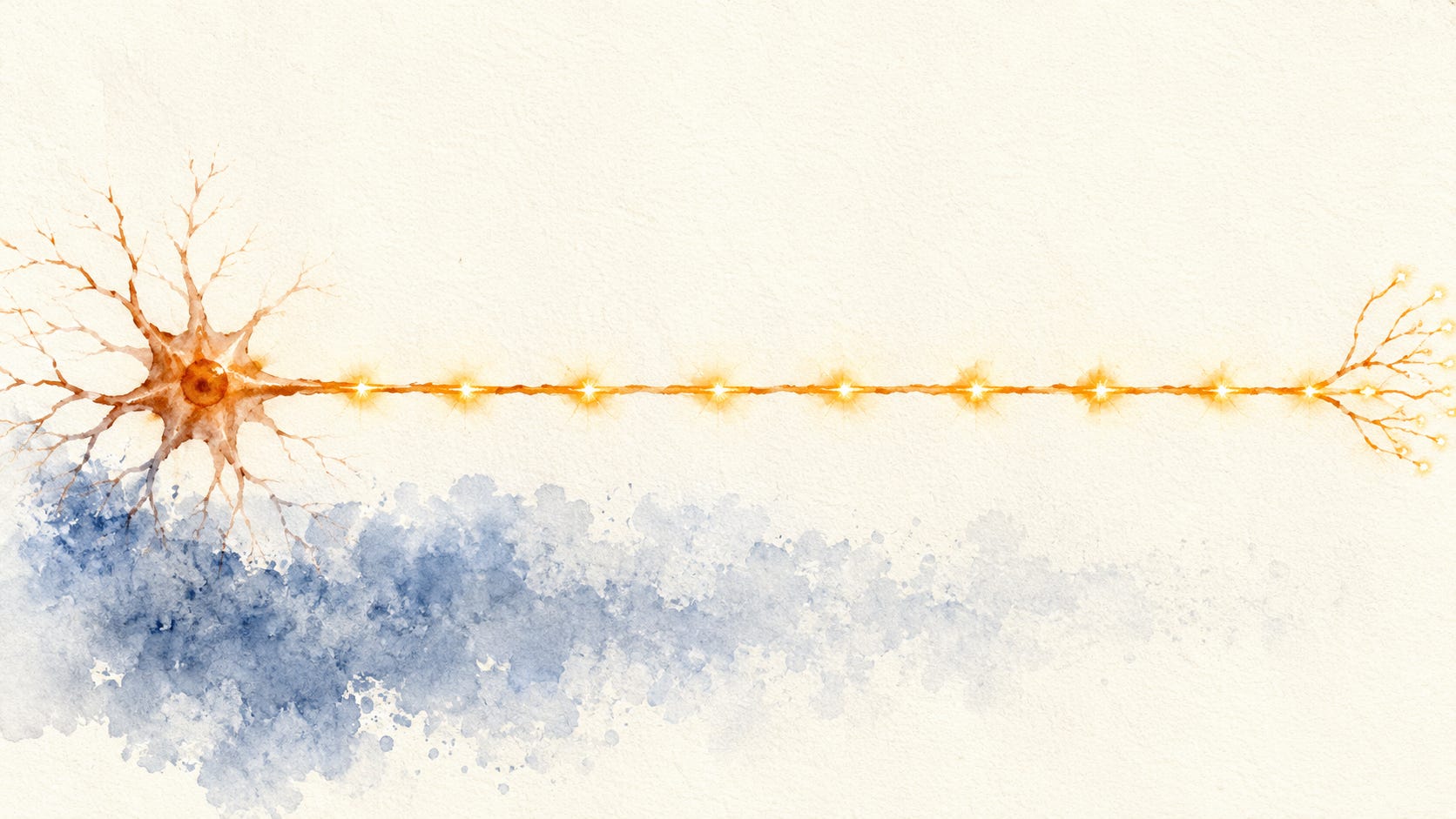
The neuron did not invent intelligence. Part 1 should have made that impossible to believe. The loop was already complete in a cell with no nervous system: sense the world, compare it against an expectation built from recent experience, act on the difference. A bacterium does all of it, in protein, and has been doing it since long before anything on Earth had a nerve.
So the neuron has to be explained differently. It is not the arrival of thought. It is a change of substrate, forced by a physical constraint that has nothing to do with cognition and everything to do with size. And what that change of substrate bought was not intelligence but speed, which turns out to be the thing that makes everything else possible. Speed lets the loop close inside the body, before the world has finished happening. It converts an organism that reacts into an organism that controls.
And then, having built a controller, evolution ran straight into a problem it had never faced before. A system that acts on the world disturbs its own senses. Every movement you make changes what you see, and your sense organs cannot tell you whether the world moved or you did. To solve that, the nervous system had to build a model, and the first model it ever built was not a model of the world.
It was a model of itself.
