

This is Episode 22 of Reading the Frontier. What the frontier’s evidence shows, and what we think it means.
Early in the morning of November 5, 2026, an automated email arrived for the maintainers of curl. Its subject line, tagged with the name of Anthropic’s OSS Scanner, announced the disclosure of 45 security vulnerabilities in curl.
curl is a command-line tool for transferring data, and libcurl is the same machinery packaged as a library that other programs call. Daniel Stenberg, the project’s lead developer, estimates the library has roughly thirty billion installations, so forty-five holes in it would be news. His own reaction was dry: forty-five at once was a lot, he wrote, but the project had asked for it.
They had asked. At the end of October a curl maintainer, Max Dymond, enrolled the project in a service through which Anthropic scans open-source code and emails what it finds. The service’s own description says its reports “are model-generated and are not reviewed by a human”, and the launch announcement warned they could be incorrect or invalid. The first delivery was a large archive: one written report per finding, each with a program to reproduce the problem and, in many cases, a suggested patch. The scanner rated one finding MEDIUM and the other forty-four LOW, and added twenty-three ordinary bugs it did not call vulnerabilities.
Ten days earlier curl had begun handling its lower-severity security reports in the open. So Stenberg posted the findings on GitHub as forty-five separate issues, and the maintainers ruled on them in threads anyone can read. This count can be watched while people decide, item by item, how much of it they will stand behind, and the watching shows what such a number is made of. What they decided makes more sense after the three years that led them to ask.
Nineteen minutes
On the morning of December 28, 2023, a report reached curl claiming a buffer overflow in its WebSocket handling, a write that runs past the end of the memory set aside for it. By Stenberg’s later account the report was neatly filed, in proper English, and came with a proposed fix. He sent the standard acknowledgment and went to the code. Nineteen minutes later he had read it three times and found nothing wrong. He asked the reporter where the overflow was, and after repeated questions concluded there was nothing there. That afternoon he closed the report as not applicable. He could not be sure a language model had written the replies, and he had no objection to AI used to phrase or translate a real finding. What he minded was the cost of a wrong report that looks right: the better it looks, the longer it takes to rule out.
Underneath that complaint sits a plainer point from the same post: “Every security report has to have a human spend time to look at it” and work out what it means. curl had paid for reports since April 2019, and by October 2024, on its own tally, had received 477. Of those, 73 were confirmed as vulnerabilities, 92 were real bugs but not security problems, 311 were neither, and one was still pending. Stenberg already described the deciding as two separate rulings. “Acknowledging that it is a security problem is only one step.” The next, at least as hard, was settling its severity. Reporters tended to rate their finds several degrees worse than the team did, and sometimes the team set a severity over a reporter’s objection.
In 2025 the share of reports that survived that process fell below 5 percent. “Not even one in twenty was real.” At the end of January 2026, after 87 confirmed vulnerabilities and more than 100,000 dollars in rewards, the project stopped paying. It hoped to remove the incentive for invented reports, and said in the same announcement that its guess might be wrong.
Then the problem changed shape. By April Stenberg could write “The slop situation is not a problem anymore.” Reports were arriving at about twice the 2025 rate, and the confirmed share was back around 15 or 16 percent. Almost every report, he judged from its wording and structure, used AI to some degree. Whether ending the bounty caused this cannot be told, since the tools and the reporting channel changed in the same months. The new difficulty, as he later put it, was “much harder: high volume, high quality”. By late May reports were averaging more than one a day, typically long and detailed. The work of verifying claims, weighing their importance, and writing patches and advisories was taking, Stenberg wrote, “almost all my days right now”. The team shut its report form for the whole of July and called the month the “summer of bliss”.
One episode from that spring is worth holding on to. On May 6 Stenberg received a report from someone with access to Anthropic’s Mythos model, who had run it over curl’s source on his behalf, in a scan separate from, and earlier than, November’s. The report presented five security vulnerabilities as confirmed, a confirmation Stenberg noted was the AI’s own. After some hours of digging, his team had one vulnerability of LOW severity, three findings about shortcomings curl’s documentation already described, and one it judged an ordinary bug. Five had become one.
The one that moved a release date
The form reopened on August 3, and by mid-September Stenberg had cleared the inbox only to write, “Then the next wave hit”.
On September 15 Luna Tong at Anthropic, using the company’s OSS Scanner, reported a flaw in how curl uploads over HTTP/2, and the team confirmed it within hours. In Stenberg’s simplified telling, a malicious server could halt an upload and cancel it in a way that left curl holding a stale pointer, a note of where something used to live in memory. After the application freed that memory, data from the server could be written into the same spot. curl would then call a function through a pointer the server had overwritten, and run code of the server’s choosing.
The team graded it HIGH and stopped short of CRITICAL because a working attack needed many things to line up, among them an upload of roughly the right size and a payload squeezed into about 23 bytes. They judged the chance of success slim: “The most likely outcome of an attempted attack is rather just a crash.” They shortened the release cycle by two weeks and shipped the fix on October 14 with twenty-three others.
That report is the reason the November email exists. Since Anthropic had found the HIGH flaw, Stenberg wrote, “I figured it could be useful to join their newly announced OSS Scanner program”. What he had to explain about the September case was its grade, not whether it was a security problem at all.
Most reports were nothing like it. By Stenberg’s reckoning, over 90 percent of submissions in recent years could quickly be assessed as less than HIGH, and in October there were days when about ten new reports arrived. On October 20 he announced that from October 26, reports of LOW or MEDIUM severity would be handled as ordinary public issues on GitHub, with only HIGH and CRITICAL kept private. He granted that openness gives attackers a slightly longer window; the hope was to share the work among more people. In the same post, speaking for himself, he added a second resolution: “I personally aim to deny and decline more vulnerabilities harder”, where they hurt no users or existing applications.
A maintainer wanting fewer vulnerabilities on the books sounds backwards until you see who pays for one. The public record of a vulnerability is a CVE, a numbered entry that tells everyone running the software there is something to fix. curl is authorised to issue its own, and for the project a new one takes a single API call. The expense is downstream, in the security teams around the world that respond to each CVE with patches and software updates. Stenberg calls it “A cost that does not land on us”. Many of the newest reports, he wrote, described option combinations unlikely ever to be used in the real world, and a CVE for those saves no users.
Nor could the project simply stop issuing the small ones. The CVE program has an appeals process, Stenberg wrote, and a real vulnerability that curl refused a CVE would get one from someone else. That process had already been turned on curl once, and curl’s refusal held. By his account, a reporter disputed the project’s decision not to give a CVE to a certificate-matching bug, already fixed, which curl judged to need too many unlikely conditions to matter. On June 24 MITRE, which adjudicates, sided with curl. Inside the team, risk that small is called lower than LOW.
The floor under LOW was written down, too. curl’s policy defines LOW as “a security problem that is truly hard or unlikely to exploit or trigger”. Anything beneath that gets the public label vuln:NONE, which covers both no risk at all and risk judged smaller than LOW; either way the issue is treated as just a bug. Being a bug is no reprieve for the code: the policy says all known bugs get fixed. What the label settles is whether the rest of the world is told to act. The scanner had rated forty-four of its forty-five findings LOW, the rung directly above that floor.
Forty-five threads
Stenberg spread the posting over several days to soften the impact on the team. Each report began with the label vuln:ASSESS, which came off once the maintainers had ruled.
One report involved a pin, a setting that tells curl to accept one specific key and no other. It also needed a TLS feature called early data, which lets a client resuming an earlier session send a request before the new connection is fully set up. With both switched on, the report said, an attacker on the network path, holding a certificate for the host from any authority the client trusts, could get past the pin and receive requests curl had reported as refused, Authorization headers included. Stenberg first objected that this assumed a very powerful attacker. Fifteen minutes later he had come round: it also happens with -k, an option that switches off curl’s ordinary certificate checks and that he thought probably common alongside pinning, and he judged it a vulnerability, with MEDIUM a suitable grade.
Twenty-two minutes after that, Stefan Eissing, another maintainer, had worked out what the application must be doing for the attack to land. It had to reuse old sessions across a changed pin while asking for early data, a combination he thought ill-advised. “LOW, in my opinion, since it requires screwup by the application.” Within two hours of the first comment the issue was labelled LOW.
Others went the other way. A report about a revoked certificate getting past a check on encrypted FTP struck Eissing as a LOW at most. Two days later Stenberg settled it. “In the spirit of raising the bar,” he wrote, it would be treated as a bug and not a vulnerability. In another, where curl ignored a rejection from an application’s own certificate-checking function, Stenberg decided the application’s setup was asking for trouble beyond what curl can guarantee. His ruling: “We serve the world better by not treating this as a vulnerability.”
Five reports held, the pinning case among them. The other four:
A truncated upload. The scanner’s test sent a 1,000,000-byte file over SCP through a relay that cut the connection; 278,528 bytes arrived and curl reported success. “The upload data could be important, so this is definitely security relevant, IMO,” Eissing wrote.
Leaked proxy credentials. Under a particular combination of HTTP/3, an HTTP/2 proxy and timing, a malicious site could be sent the user’s proxy username and password. Stenberg’s reason: “Leaking proxy credentials to the remote server sounds like a real vulnerability.”
A Windows fault, doubted after the ruling. It was labelled LOW on November 7: a use-after-free, the class of error behind September’s flaw, that arises when the API is used as documented seemed to Stenberg fair to call a vulnerability. Doubts followed: the scanner’s test imitated a Windows component with different software, and a maintainer who ran it on Windows saw no failures. On November 13 another maintainer, having investigated, concluded “the AI analysis is correct, as well as the solution”.
Barely over the floor. Asked for TLS 1.3 through its Schannel backend on Windows 10, curl used TLS 1.2 instead of failing. “It’s like an extra-low type vulnerability I guess?” a maintainer wrote, and called it low for now.
Of one report Stenberg wrote that the project had previously counted this sort of problem as a vulnerability. The report concerned WebSockets: when an application sets a non-default buffer size above 16 KB, a server could make curl report a length that an application trusting it would use to overrun its own buffer. Stenberg’s reply of November 10 went on to say that nowadays applications should be expected to check their own copies and not simply hope the size libcurl hands them will fit. He wanted to call it a bug, and the label went to vuln:NONE.
Almost three years earlier, a report of a WebSocket buffer overflow that was not there had taken Stenberg from morning to afternoon to dismiss. Now a WebSocket report had pointed at something real, and the open question was what to call it.
Another verdict was reversed in full view. A report about RTSP, one of the protocols curl speaks, said that data arriving in a particular form bypassed size limits. On November 7 the issue was labelled LOW, and Stenberg remarked that sixteen years earlier the project had treated a similar mistake as a vulnerability, CVE-2010-0734, and, he now thought, overstated its severity. Four days later he wrote “I’ve changed my mind.” The deviations were trivial, he said, and unlikely to cause real security problems. The label went back to ASSESS and then to NONE. For four days that finding carried the label of a confirmed vulnerability, and then the reading of it changed.
On November 18 Stenberg published the outcome. Five of the forty-five were confirmed, all at LOW, including the one finding the scanner had rated MEDIUM. Thirty-six he classed as bugs and nothing more, three as not even bugs, and one as wrong outright: in his judgment its suggested patch would have introduced the very vulnerability the report warned about. Each of the five has an advisory in draft, to be published with curl’s next release.
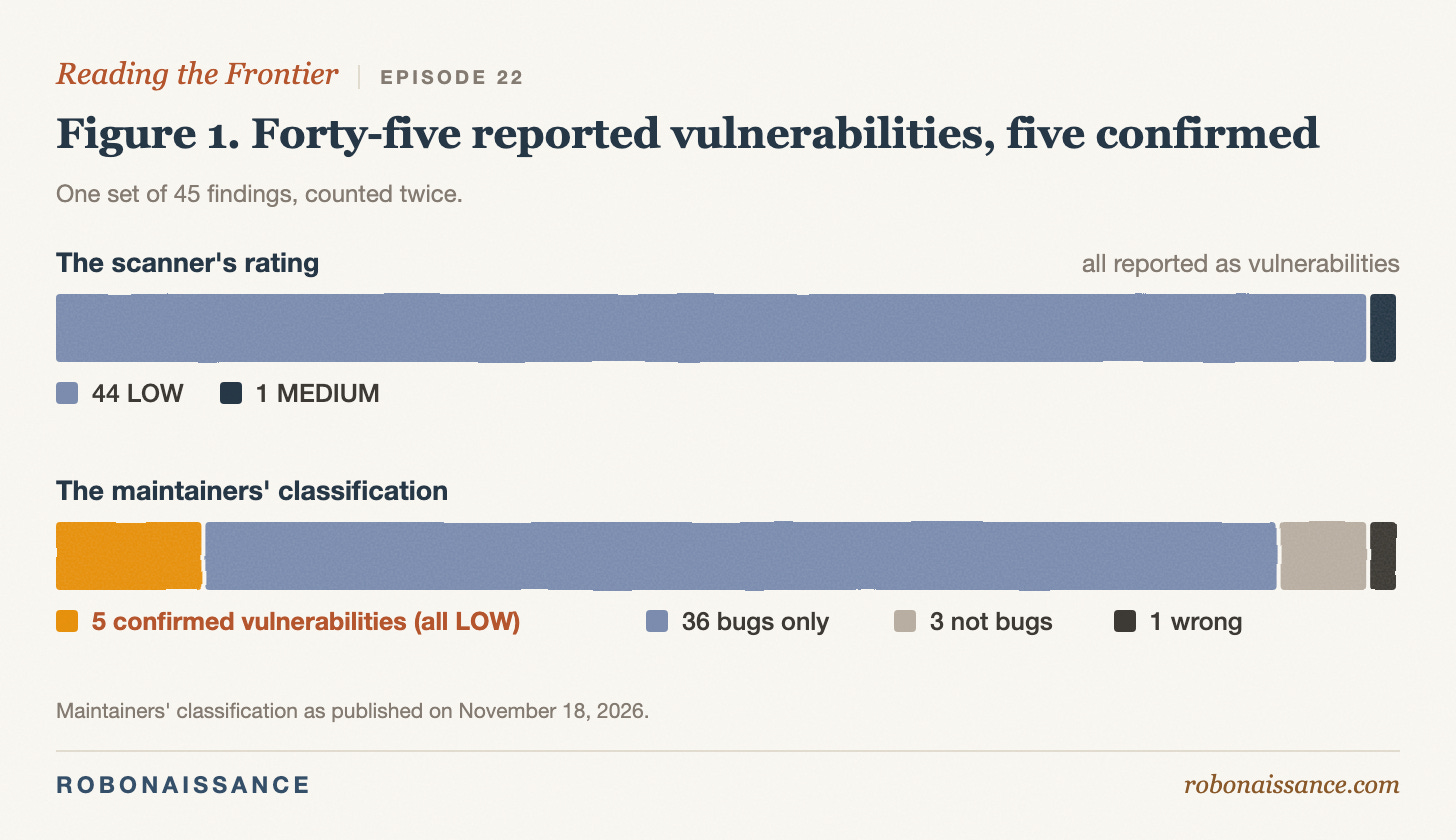
One set of 45 findings, counted twice. The scanner rated all 45 as vulnerabilities (1 MEDIUM, 44 LOW). curl’s maintainers classed the same items as 5 confirmed vulnerabilities (all LOW), 36 bugs only, 3 not bugs and 1 wrong. Maintainers’ classification as published on November 18, 2026.
What the email counted
So what was in those forty-five reports? By curl’s count, forty-one real problems: five vulnerabilities and thirty-six bugs. Also by curl’s count, five things the world will be warned about. Both describe the same forty-five findings.
The step from one number to the other is the thing we have been watching since December 2023: a person reading a claim and ruling on it. A vulnerability is made of two parts, something a finder turned up and a verdict that it is dangerous enough to announce. A count of vulnerabilities measures both at once. From the number alone you cannot tell how much of it is the finder and how much is the judge.
Stenberg’s own summary is that the reports are high in quality but far too eager to call what they find a vulnerability. He rests that on the batch’s rates: 11 percent confirmed, below the project’s 2026 average, and 80 percent bugs-only against roughly 43 percent earlier in the year. But he asks that this be read knowing that “we as a project have shifted slightly and have higher requirements now”. The same post says the project decided to raise gradually what it takes to be a LOW, marking far-fetched or unlikely issues NONE more often than before. Slightly is his word, and I see no reason to inflate it. How much of the gap either cause explains cannot be measured, because no finding was ruled on twice, once under the old requirements and once under the new. This is also one project. What the threads establish is narrower and, I think, more durable: the people who draw the line say, of particular cases, that they used to draw it elsewhere.
A written standard does not settle this. curl has one, and the sentence defining LOW reads the same now as it did in the policy tagged for the release of January 7, though lines were added around it. What the threads show moving is how the maintainers apply it.
Nor is a verdict more than a recorded decision by people reading documents, and one of November’s readings is open to question. A report said curl’s protection for specially prefixed cookie names could be sidestepped by changing the prefix’s capitalisation, and noted that the draft cookie standard treats servers and user agents, the client side where curl sits, differently on this point. The project’s reply quoted the server section and concluded that “we must check for an exact match and not allow mixed case”; the issue was closed that day as not a curl bug. The draft’s section for user agents, which the report relied on, says “UAs MUST match cookie name prefixes case-insensitively.” I am not ruling on who is right: the draft is unfinished, the report limited the risk to sites that treat cookie names case-insensitively, and nothing shows a real site harmed. But anyone with “a reasonable and convincing argument”, curl says, can have a verdict reassessed.
None of this makes the verdicts arbitrary. The September flaw came with a worked-out path to running the server’s code and moved a release date; among November’s five are proxy credentials sent to the wrong party and a file silently cut short. Facts about the code constrain the judge. They do not stand in for one, least of all near the floor, where forty-four of the forty-five were pitched.
I expect counts of AI-found flaws to end up quoted the way any instrument reading is quoted, with who confirmed them and against what standard. Finding has become cheap. “Anyone with time and some experimental spirits can find security problems now,” Stenberg wrote in May. In November the ruling still fell to maintainers, even where one of them asked a second AI to help him follow a report. When one half of a measurement is abundant and the other scarce, the scarce half is where the information is.
The forty-five in the subject line was the scanner’s count of what it had turned up. The five is curl’s count of what its maintainers were willing, that month, to call dangerous. So when a machine is credited with a number of vulnerabilities, I read the number as a joint statement by two parties, and I want to hear from the second.
This is Episode 22 of Reading the Frontier. What the frontier’s evidence shows, and what we think it means.