
Doing Cartwheels Does Not Create Value
The robotics industry spent a decade assuming factories need human-shaped robots because humans work there. RJ Scaringe and Mind Robotics are betting that assumption is wrong.

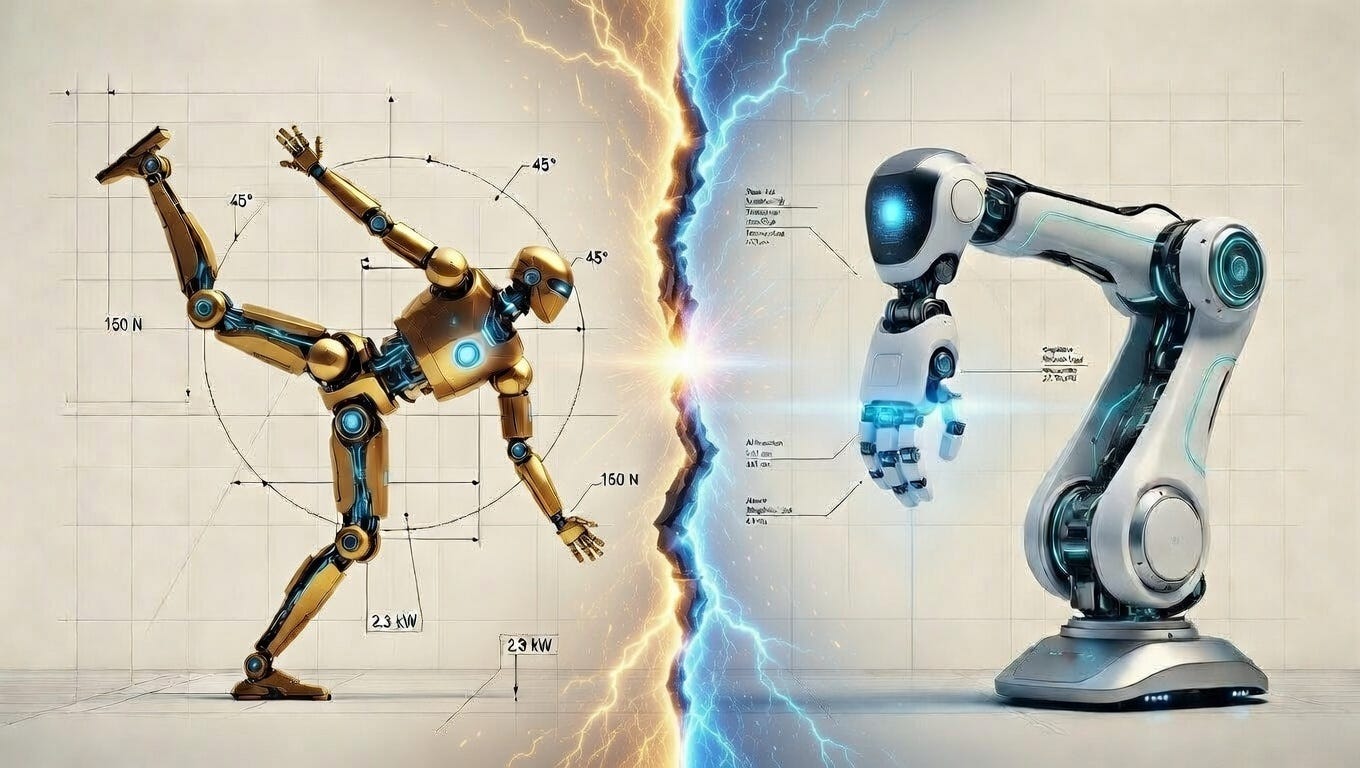
In March 2026, the Wall Street Journal asked RJ Scaringe a question he had clearly been asked before: why was Mind Robotics, the industrial robotics company he had founded and built around Rivian’s factory infrastructure, not building humanoid robots? The question had a specific context. That same week, Mind had announced a $500 million Series A. Every other company raising that kind of money in the space was building robots that walked on two legs. Tesla had Optimus. Figure had deployed at BMW. Boston Dynamics was preparing Atlas for deployment in Hyundai’s manufacturing environment. The humanoid robot had become the dominant visual language of the industry’s ambition, the image that ended every pitch deck.
Scaringe’s answer was eight words: “Doing cartwheels does not create value in manufacturing.”
The line was widely read as a dig at Tesla. But it was also a thesis. The word “robot” was invented in 1920 by a playwright who gave his machines human bodies because his play was about replacing human workers. A century later, the industry was still building on that playwright’s assumption. Scaringe was asking whether the assumption had ever been tested.
The Logic That Seemed Airtight
The humanoid argument is not irrational. It goes like this.
Factories were designed around human workers. The tools are sized for human hands. The workstations are arranged for human reach. The aisles are wide enough for human bodies. If you want a robot that can move through these spaces and operate these tools without redesigning the factory, the most direct path is a machine shaped like the people who built the factory for themselves.
This logic has a name: morphological compatibility. It was the founding intuition behind the entire humanoid robot research program, going back decades. And it contains a genuine insight. A robot that matches the form factor of a human worker can, in principle, slot into existing workflows without any infrastructure changes. You do not need to rebuild the plant. You just hire the robot.
The argument became influential enough that questioning it stopped being the default.
What Actually Breaks
In late 2025, Figure AI retired its Figure 02 fleet after eleven months of deployment at BMW’s Spartanburg, South Carolina plant. The robots had run ten-hour shifts five days a week. They had loaded more than 90,000 sheet-metal parts and contributed to the production of more than 30,000 BMW X3 vehicles. By any measure of a first industrial deployment, the numbers were real.
Figure’s account of the deployment was candid about what broke. The top hardware failure point was the forearm. The forearm is where the morphological compatibility argument runs into physics. To give a human-sized robot arm three degrees of freedom at the wrist, you have to pack actuators, power cables, a microcontroller board, and thermal management into a space roughly the size of a human forearm. That space was designed by evolution over millions of years for a different purpose. It was not designed by engineers for reliability at ten hours a day, five days a week, in a factory.
Much of that forearm complexity exists because the robot is shaped like a human, not because a factory needs it to be.
Figure 03 addresses the problem by redesigning the wrist electronics entirely, removing the distribution board, and having each motor controller communicate directly with the main computer. The redesign is intended to address that failure mode. It is also a lesson in what the humanoid form costs: not just money, but the constant engineering tax of maintaining a body plan that was not optimized for the task.
What Scaringe Actually Knows
In the third quarter of 2025, Scaringe halted all production at Rivian’s Normal, Illinois plant for approximately three weeks. The R2 was Rivian’s most consequential vehicle, a $45,000 SUV that the company needed to sell at scale to survive. The production line had to be physically reconfigured to receive it. Stopping a factory that was already behind, already burning billions, was not the kind of decision an executive makes from a conference room. It is the kind of decision you make when you understand that the factory floor itself is the constraint, and that no amount of scheduling will substitute for getting the physical arrangement right.
Scaringe had been making decisions like this for fifteen years. He founded Rivian in 2009 and built it into a vertically integrated manufacturer from nothing, which meant he had spent that time watching automation fail, succeed, and fail again in real production conditions. “It was a combination of learning for the first time, launching multiple products, dealing with a global pandemic and then being last in line to get parts from suppliers,” he said of Rivian’s early manufacturing struggles. The description is characteristically dry. What it means is that he watched, repeatedly, what happens when the theory of a production line collides with the actual factory.
The insight he came away with is specific. Traditional industrial robots are very good at what he calls “repeatable, dimensionally stable tasks.” If you need a welding arm to hit the same point on a car frame 500 times an hour, current industrial robotics handles that with very high reliability. The problem is that a large share of factory value is created by tasks that are not repeatable and dimensionally stable. Parts arrive in slightly different orientations. Bins need to be emptied at irregular intervals. Material handling requires judgment calls that depend on context. These tasks are currently done by humans, not because humans are the ideal machine for them, but because humans are the only machine flexible enough to do them.
Mind Robotics has not publicly detailed its robot’s form factor. What Scaringe has described is a system organized around dexterous manipulation arms and mobile platforms, not bipedal walkers. The arms are designed for the specific physics of factory tasks: reaching into bins at odd angles, handling parts that arrive in inconsistent orientations, adapting grip force to materials that vary in weight and texture. The legs are wheels. The body is whatever shape makes the arm more reliable. Nothing about the design is dictated by the human skeleton.
The gap Mind Robotics is targeting is not the gap between human and robot. It is the gap between what classical industrial automation can do and what a factory actually requires. Those are different problems. One requires a human shape. The other does not.
The Data Advantage Nobody Talks About
Mind Robotics has something most robotics startups do not have: access to a live factory environment.
Rivian’s plant in Normal, Illinois builds electric trucks and SUVs. It operates continuously. Every shift generates data about how objects move through a manufacturing environment, how material handling fails and recovers, how tasks that look simple from the outside turn out to require adaptation in practice. This data exists at a scale that no robotics lab can replicate. You can simulate parts of a factory, but not fully reproduce the distribution of interruptions, variability, and recovery behavior found in a live one.
The parallel to autonomous vehicles is instructive, if not exact. Tesla trained its full self-driving system on millions of miles of real-world driving data. The quality of that data, collected from actual cars in actual traffic, was a decisive advantage over competitors who relied primarily on simulation. Scaringe is applying the same logic to factory automation. The training data is proprietary not because it is secret, but because it requires a factory to generate it. Most robotics startups do not have a factory.
The arrangement creates a closed loop. Mind Robotics is expected to train on Rivian-related factory data and deploy in Rivian plants. The deployment generates more data. The models improve. The robots become more capable. Each iteration produces a training set that reflects the actual distribution of tasks in a real production environment, not the distribution of tasks in a lab designed to make robots look impressive.
The Shape of the Bet
The humanoid camp and the Mind Robotics camp are not, in the end, disagreeing about whether AI can improve manufacturing robots. Both sides agree it can. They are disagreeing about what form factor the robot should take to create the most value in a factory.
The humanoid argument says: match the human form, minimize infrastructure changes, maximize deployment speed. It has a sharper version that the industry does not often state directly. Specialized robots create their own infrastructure lock-in. Every new task requires a new arm configuration, new grippers, new fixtures. When the production line changes, as production lines always do, the specialized robot becomes a stranded asset. The humanoid, in this argument, is actually the more flexible investment. A machine that can be reprogrammed to do a different task, in a different part of the plant, without rebuilding the station around it, has a lower total cost of ownership than a machine that is optimized for exactly one thing. The forearm breaks, but the answer is to fix the forearm.
The Mind Robotics answer to this is not that specialized robots are more flexible. It is that the premise is wrong. The humanoid form is not a path to flexibility. It is a specific engineering choice that introduces specific costs, and those costs compound. The forearm breaks. The bipedal balance system imposes power and engineering costs that could otherwise go to dexterity. The flexibility argument assumes that reprogramming a humanoid for a new task is straightforward. In practice, a machine designed to perform like a human in human-scaled spaces requires everything around it to behave like a human environment. Factories are not human environments. They are optimized for production. The aesthetic appeal of a robot that walks upright is real, but aesthetic appeal does not create value in manufacturing.
Accel and Andreessen Horowitz co-led Mind’s Series A at a $2 billion valuation, following a $115 million seed round from Eclipse in late 2025. They cited Scaringe’s track record building and scaling vertically integrated hardware. That track record is the thing. Building a car company required Scaringe to learn, at scale, what manufacturing actually needs from automation. He came out of that experience with a specific answer. The answer does not involve cartwheels.
The Older Question
The playwright was Karel Čapek. The play was R.U.R., short for Rossum’s Universal Robots. His robots were indistinguishable from humans. That was the point. The play was not an engineering document. It was a meditation on labor and replacement: what happens when you create a being that works so you do not have to. The humanoid form was a narrative choice. It became an engineering program only later.
Parts of the robotics industry have carried that narrative forward for a century, even as most factory automation never looked human. The assumption that robots should look like people is so old it has become invisible. It is the water the industry swims in.
Scaringe is betting that when you strip the narrative away and ask only what a factory actually needs from a robot, the answer is dexterity, adaptability, and reliability. The answer is not a body that can do cartwheels.
Whether he is right will start to become visible by the end of 2026. He has said Mind Robotics will deploy a large number of robots in Rivian’s plants before the year is out. That would be more than a staged demo. It would be an early production test of the thesis in a live factory.
The humanoid robots will be watching.
The robot renaissance inherited the humanoid form from a century-old play about labor and replacement. Scaringe’s bet is that manufacturing will be the place where the field finally asks what it actually needs, and finds that the answer has nothing to do with the story.