

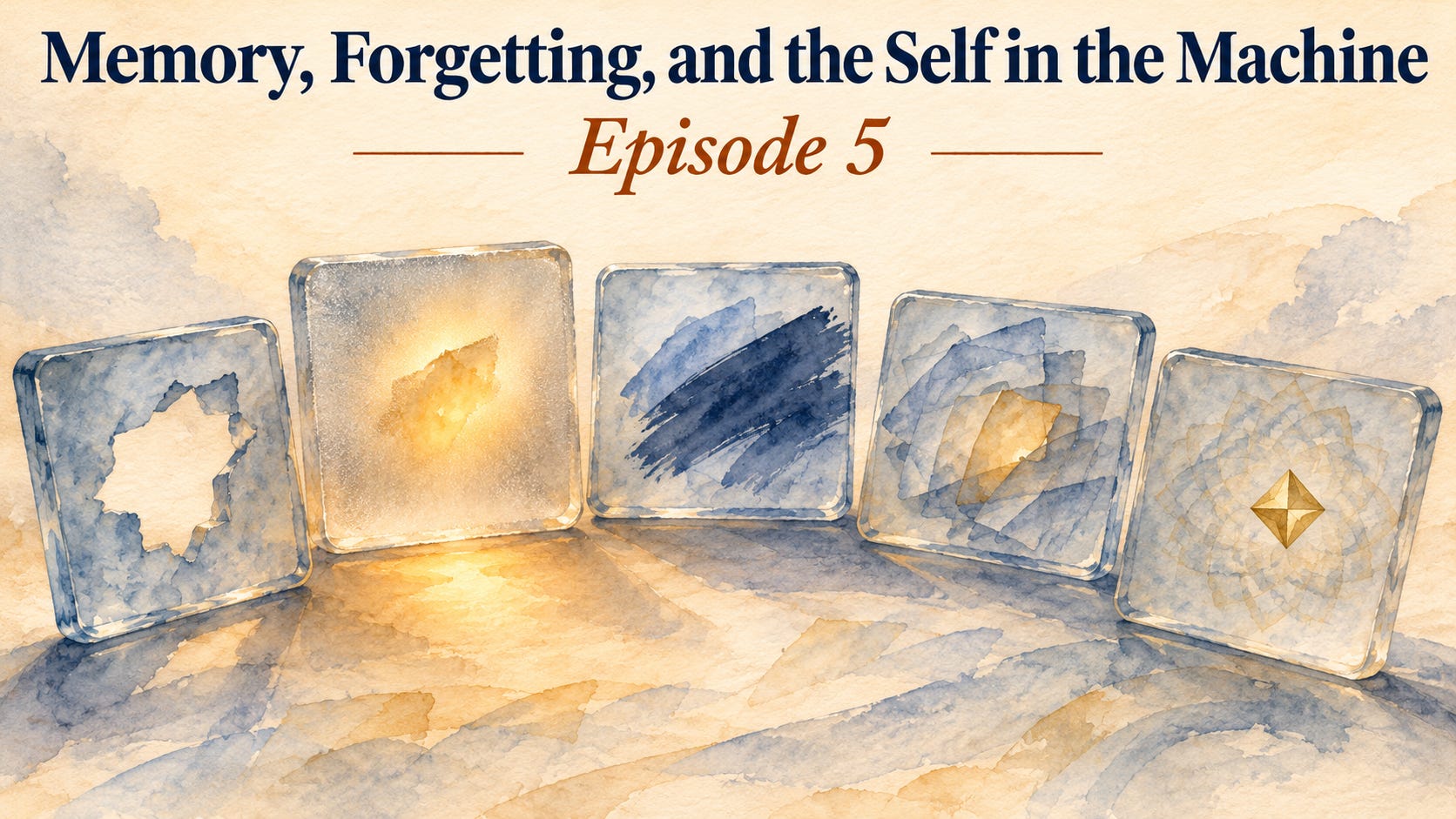
This is Episode 5 of Memory, Forgetting, and the Self in the Machine: how intelligence reaches across time when it cannot carry the whole past with it.
In 1879 and 1880, Hermann Ebbinghaus ran 163 double tests on the only subject available to him: himself. Each test began with a set of lists, eight in most tests, each of thirteen nonsense syllables, each syllable a vowel between two consonants, chosen so that no meaning could help him. He read each list until he could recite it twice without error. Then he left them. After about a third of an hour, or an hour, or nine hours, or a day, two days, six days or thirty-one days, he came back and learned the same set again to the same standard. What he recorded was how much less work the second learning took.
The saving never fell to nothing. “After 24 hours about one third was always remembered,” he wrote in Memory (1885), and “after a whole month fully one fifth of the first work persisted in effect.” A “complete vanishing,” he concluded, would come “only after an indefinitely long period of time.” He was careful about the scope of the result: it held “for a certain individual, and for a series of 13 syllables.” In 2015 J. M. Murre and J. Dros repeated the design with one subject and reported that “the results are similar to Ebbinghaus’ original data.” That is one person in 1879–80 and one in 2015. It is not a law of human forgetting.
Look at what the measure did. A list that cannot be produced on demand is, by the everyday test, gone. By Ebbinghaus’s test, something of the first learning plainly remained, because it made the second learning cheaper. The word “gone” was covering at least two different conditions. The word usually covers more, and the useful way to tell the conditions apart is to ask what would bring the detail back. That question separates five kinds of gone. The five are our own sorting, a tool and not a finding of any source. They matter because a fix for one kind may do nothing for another.
Three pictures and no verdict
Before he measured anything, Ebbinghaus noted that names and faces “that had seemed lost for years suddenly appear before the mind, especially in dreams,” and set out three pictures then on offer to explain it. In the first, old images are “more and more overlaid ... and covered by the later ones,” so the old layer might come back if the newer ones were pushed aside. In the second, ideas sink into “dispositions” which, “somehow supported and strengthened,” let the forgotten idea arise again “in perfect clearness.” In the third, a complex idea is pictured as “crumbling into parts”: “Some parts of it are entirely lacking.”
He did not choose between them. “Everybody has his private ‘explanation’ of these processes,” he wrote, “but the actual conditions which are to be explained are, after all, equally unknown to all of us.” His relearning method, he said, “gives a measure for what has been lost as well as for what remains.” It measures how much. It does not say in what form. A saving of one third after a day is consistent with a third of the list surviving intact or with all of it surviving faintly. The savings show that something persisted. They cannot show which of his three pictures is true.
