

This is Episode 1 of Humanoid Or Not?: when is the human body the right machine for the job?
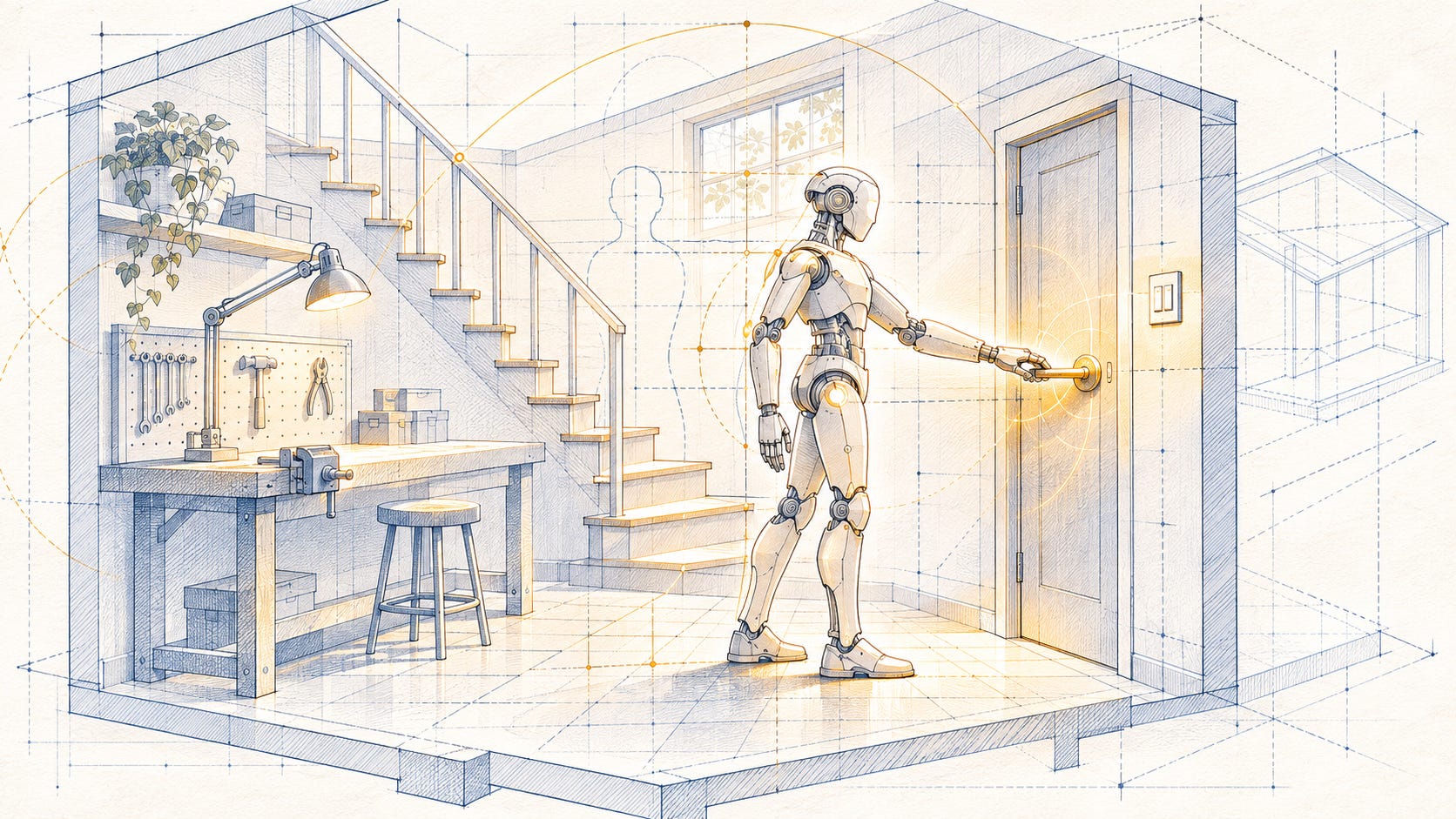
On 20 November 2000, Honda introduced a new walking robot and explained its height by pointing at the furniture. The new ASIMO stood 120 centimetres tall. Its predecessor, P3, had stood 160 centimetres and weighed 130 kilograms; ASIMO weighed 43. Honda had been working on walking robots since 1986, and after fourteen years of making a machine walk at all, its engineers made it smaller on purpose. Honda’s stated reason was the house itself. The height, Honda wrote, “was chosen because it was considered the optimum for operating household switches, reaching doorknobs within human living space, and performing tasks at tables and benches.”
Look at what set that number. It was not the robot’s motors, its balance or its battery. It was the light switch by the door, the handle on the door, and the height of a kitchen table. You can test the logic yourself. Stand in a doorway and reach for the switch, then the handle, then the edge of the nearest table. Your arm finds all three without thinking because the people who built the room had a body like yours in mind. Honda’s engineers read that room the way an architect reads a site, and they built the robot to suit it.
Engineers keep making that choice, building robots to the size and shape of our rooms and tools. A humanoid is a robot built roughly in the shape of a person, with arms and hands at human height and often two legs. A human shape is expensive to build and hard to control, so the reason for choosing it matters. It decides whether a human-shaped robot is worth what it costs, or whether it is an expensive way to avoid a simpler answer.
Honda was not alone in reading the furniture. Fifteen years later, in Pomona, California, robots built for the DARPA Robotics Challenge spent 5 and 6 June 2015 trying to do work meant for people in a disaster. The goal, in DARPA’s words, was “human-supervised ground robots capable of executing complex tasks in dangerous, degraded, human-engineered environments,” using “standard tools and equipment commonly available in human environments.” The tasks asked for the ordinary things a rescuer would do in a damaged building: work the controls, use the tools, get through the space. Many of the machines struggled. “Lots of robots fell over,” IEEE Spectrum reported on the day. Gill Pratt, quoted by DoD News, remembered the crowd’s reaction: “we heard groans of sympathy when those robots fell.” The audience understood what the robots were attempting, because the robots were attempting a human job in a human place.
NASA had reached the same reasoning in orbit and on the ground. Its Robonaut 2 was built to be “able to use the same tools station crew members use,” because a space station is a room full of equipment designed for astronauts’ hands. Its Valkyrie, built within 15 months for the 2013 trials of the same DARPA challenge, was meant to be “capable of operating in degraded or damaged human-engineered environments.” And in May 2022 a young company, Figure, stated its own aim in its master plan: “general purpose humanoid robots built for a human environment is the desired route to have the largest overall impact.”
Set these side by side and a pattern shows. A carmaker in 2000, a defence agency in 2015, a space agency between them and a start-up in 2022 each gave the same reason for building a robot in a human shape. None of them said the human body was the best mechanism for opening a door or turning a valve. They said the door and the valve were already there. The human world is the specification, and engineers across two decades have chosen to build to it rather than argue with it.
That specification is written down, often in inches. In the United States, the 2010 ADA Standards for accessible design set a forward reach of 15 to 48 inches for what the standards require to be reachable. A doorway must give at least 32 inches of clear width. Workplace rules from OSHA set standard stairs at a riser of no more than 9.5 inches and a tread of at least 9.5 inches. A robot that can reach between 15 and 48 inches, fit through 32, and climb a 9.5-inch step meets the same numbers those rules set for people.
One clause in the stair rule says even more. OSHA exempts standard stairs installed before 17 January 2017 from that stair rule. When the rule changed, the stairs already built were not made to meet it. That is the condition that makes a human shape tempting. Many of the places where work happens are brownfield sites, meaning sites already built and already running, with people in them, and those sites are not torn down because a better design arrives. They change slowly and expensively, one doorway at a time.
So why would a robot’s shape matter to the cost of using it? Because the robot can be the cheaper part. The clearest figures come from a robot that looks nothing like a person, and that is why they matter here: they price the work of fitting a site around a machine. In 2015 the Boston Consulting Group looked at spot-welding robot systems installed in US car plants and found that one averaged $133,000 in 2014, down from $182,000 in 2005. The robot’s hardware and software, BCG wrote, “account for only one-quarter of that total cost.” The rest went on what surrounded the robot: peripherals such as sensors and safety structures, and the work of installing, programming and fitting it into the line. It makes a plain point: putting a machine to work can cost much more than the machine itself, and much of that cost is the site around it.
Here the bet behind the human shape comes into focus. A fixed welding arm is a superb machine for its single job, and it needs the world arranged around it: the fence, the sensors, the fixtures, the line built to bring work to it. Changing an existing building or line to suit a new machine is called a retrofit, and retrofits are paid site by site. A body that can use the existing door, the existing stairs and the existing workbench is trying to need less of that. It does not make the robot cheaper. It tries to make the room cheaper, by leaving it as it is. The bet is only on rebuilding the room; installing, programming and integrating any machine still costs, human shape or not.
The strongest answer to that bet comes from a company that chose the other route at enormous scale. In June 2025 Amazon put its one millionth robot to work, across more than 300 facilities. Amazon gives its biggest machines areas of their own. Two of its larger robot types, Titan and Hercules, are “confined to areas where only authorized robotic specialists can enter.” Another, Proteus, works in open areas among people. Amazon also says its systems are “engineered for seamless integration across our existing buildings as well.” Amazon’s Tye Brady put the philosophy in five words, as quoted by AFP: “From function, we derive form.” It is the opposite reading of the room from Honda’s, and at Amazon’s scale it works.
Rodney Brooks argues against part of the human shape, not all of it. “Humanoid robots will get wheels for feet,” he wrote in September 2025, “at first two, and later maybe more.” And he made a sharper point about the present: “human sized two legged walking humanoid robots are not currently safe for humans to be around.” His argument splits the human shape into parts. Arms at human height and hands that can use human tools may be worth keeping. Two legs, which can fall and are hard to keep upright, may not be, on any floor smooth enough for wheels. The DARPA crowd’s groans of sympathy are the same fact seen kindly: a two-legged machine that falls in front of people is a machine people must stand clear of.
Brooks’s view and Amazon’s practice sharpen the claim rather than defeat it. Brooks’s shows that a robot need not copy the whole human body to use a human place; it can keep the arms and hands and change the legs. Amazon’s shows that where one operator controls the site, runs many of them, and can afford to organise the work around machines, the case for a human shape weakens; the machine can be built for the job and the job built for the machine. What that arrangement cost Amazon is not public. Nor is the other side of the ledger: the companies deploying humanoids today have not said what, if anything, they changed in the buildings where those robots work.
What can be read is today’s work, and it is narrow. Agility Robotics’ two-legged Digit moves plastic bins, called totes, taking them “from cobots and placing them onto conveyors.” A cobot is a robot designed to work near people, so Digit’s job sits between two machines, inside existing automation, not in place of it. By November 2025, Agility said, Digit “has moved over 100,000 totes at GXO’s Flowery Branch facility.” Agility describes its general approach as “using the same tools and infrastructure without extensive retrofitting,” which is a vendor’s description of its own product. Figure says its robots have loaded sheet metal for more than 30,000 BMW X3 vehicles; BMW, as Automotive World reported in June 2026, said a body-shop pilot supported that production and is deploying Figure’s newer robot at Spartanburg for logistics sequencing.
The buyers show how early this still is. As IDC counts them, about 70 percent of humanoid shipments in the first half of 2026 went to research, education, performance and government, down from about 84 percent in 2025. The share going elsewhere is growing, but the documented jobs are specific, and the machines are costly. A body built for a world can arrive before it is cheap enough to earn its keep there.
Put the pieces together and the condition becomes clear. A human-shaped body is not the best design for any one task; a welding arm beats it at welding and a warehouse robot beats it at carrying shelves. It earns its cost where four things hold at once: the world is already built, people still work in it, rebuilding it costs more than the human shape’s extra cost over a purpose-built machine, and the work is varied or keeps changing, so that no single purpose-built machine covers it. In Honda’s house, the switches and doors were fixed, people lived in it, and its chores were many. Amazon arranges the work around its machines at scale. Under those conditions, the stairs from before 2017, the 32-inch doorways and the benches at human height are an asset, a specification the robot can meet instead of a site someone must pay to rebuild. Where one operator can organise the site around the machine and do it at scale, the human shape loses to a body built for the job. And the body need only be as human as the room asks: arms and hands at human height, perhaps on wheels where the floor allows.
Honda’s engineers answered the question in 2000 for a house: the switches and doorknobs were fixed, and nobody was going to move them for a robot. A human-shaped body pays off where the world is already built and cannot be rebuilt for less than the human shape’s extra cost over a purpose-built machine; it stops paying where an operator can build the world around the machine for less. So the next time you see a robot, ask what world its body was built for, and who could afford to change that world instead.
This is Humanoid Or Not?: when is the human body the right machine for the job?