

This is Episode 3 of Humanoid Or Not?: when is the human body the right machine for the job?
When Boston Dynamics introduced the new hand for its Atlas humanoid, it asked a question that sounds like a joke: “If the goal is function, what does the pinky add?” The engineers decided it didn’t add enough. Each extra finger, they wrote, “means three more actuators,” which is three more motors to fit, power and keep working inside something the size of a hand. So Atlas got four fingers, one of them a thumb. Each finger joint and each way the thumb can swing is a separate direction of movement, and roboticists call each one a degree of freedom. This hand has 13 of them, and each is driven by its own motor. The fingertips and palm can feel what they touch. Boston Dynamics also says the hand can carry “a 100lb+ loaded minifridge”.
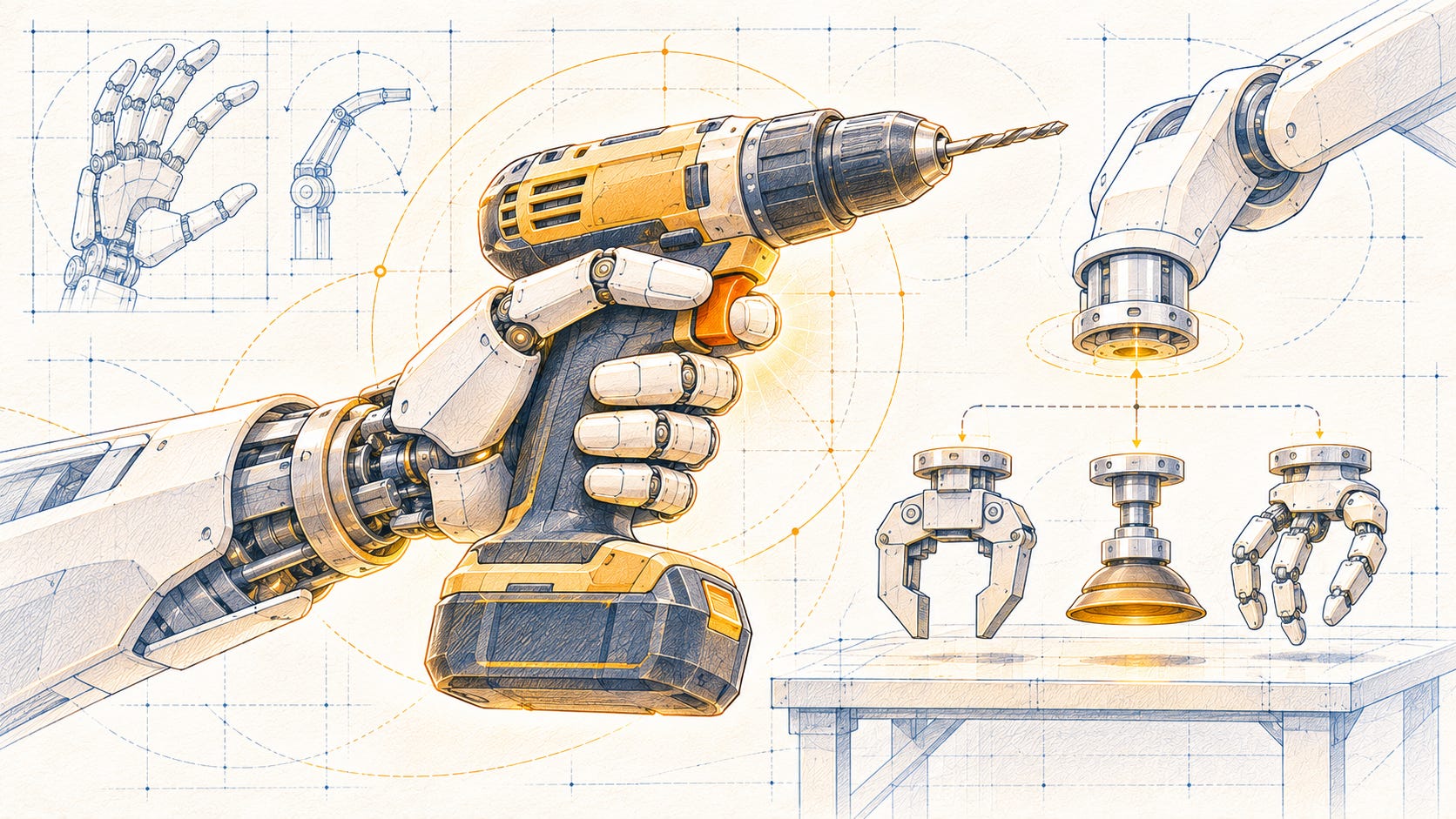
The minifridge makes a nice photo, but the more telling detail is the list of jobs at the top of the company’s page: “Triggered tool grasps, like drills, power torque drivers, grinders, nail guns, and welding torches.” Pick up a cordless drill and watch your own hand. Your palm and three fingers wrap around the handle, your thumb closes over the top, and your index finger rests on the trigger, free to squeeze while the rest of the hand holds still. The drill was designed around that grip. Boston Dynamics says so plainly: “tools are already designed around human hands.” Its earlier Atlas hand had three fingers and seven degrees of freedom. The new one adds a finger and almost doubles the number of degrees of freedom, then stops at four fingers, because the tools on that list don’t need a fifth.
So one company made one decision about one finger, and that decision contains the whole question of this episode. Does a general-purpose robot need a general-purpose hand? The answer depends on the shape the work comes in. When the work is boxes, totes and items in bins, it isn’t shaped for fingers, and simpler grippers already do it for pay. When the work comes as a drill, a torque driver or a part designed to be held by fingers, the human hand is a way in. A maker that wants those jobs has a reason to build one.
The rack
Agility Robotics, which makes the two-legged Digit, gave the other answer and explained it in a 2024 post with a fitting title, “The Right Tool for the Job.” Its plan is to change tools. Digit’s arm ends in a standard mounting plate, and the company bolts on whatever the task needs. In robotics, the device at the end of the arm is called the end effector, and it can be a gripper, a suction cup or a hand. “We are pursuing a tool-changing strategy that allows us to do valuable work today, not tomorrow,” Agility wrote, and “End-of-arm tooling maximizes flexibility while minimizing the time required to create value for our customers.” It also said a dexterous hand “may take years to fully bring to market.”
Two years later, the Digit 5 release this September kept that plan: “A swappable gripper design with ISO-standard mounting flanges allows Digit’s tools to be changed for the job at hand,” for “tasks ranging from tote handling to machine tending.” The flanges are the standardised connections between the arm and its tools. Agility’s 2024 post also makes a point that’s easy to skip past: “a five-finger hand would still frequently need to handle these same specialized tools.” A hand can hold a drill, but it cannot do the drilling without one. This isn’t a dismissal of hands. Agility is saying the specialised tool stays either way, and it says outright that swappable end effectors “do not prevent us from pursuing a five-finger end effector in the future.”
What the simple end already covers
Before taking sides, it helps to see how much work a plain gripper or suction cup already handles. One place this has been measured at scale is Amazon. Vulcan, Amazon’s picking and stowing robot, “uses an arm that carries a camera and a suction cup” to pick, and it can handle “approximately 75% of all various types of items we store at our fulfillment centers.” That figure is about types of items in Amazon’s own fulfilment centres, not a share of shipments or of warehouses in general. Still, it means Vulcan covers most of the catalogue in one of the largest item-handling operations anywhere.
The usefulness of suction isn’t new. At the first Amazon Picking Challenge in 2015, 9 of the 25 teams used some form of suction, and the researchers who analysed the contest concluded that “Suction alone ... was proven sufficient” for much of the job. The items that caused trouble were a metal-mesh pencil holder and some foam balls, which were “difficult to suck.” A suction cup needs a surface it can seal against. A pencil holder made of holes is a reasonable thing to beat a vacuum.
Rodney Brooks, who has spent a career building robots and puncturing hype about them, describes the same situation more bluntly. “No human-like robot hands have demonstrated much in the way of dexterity, in any general sense,” he wrote last year, and the parallel-jaw gripper, two flat fingers that close like a vice, “is still the dominant form of a robot hand today.” His forecast for humanoids is that “a lot will have two fingered parallel jaw grippers,” and “Some may have suction cups.” For boxes, totes and many items in a bin, the simple end already does the job and is already paid for it.
One robot, three ends
Galbot doesn’t pick a side. Its wheeled G1, the pharmacy robot from the last episode, has an end effector that can be swapped “在灵巧手、吸盘和夹爪之间”: between a dexterous hand, a suction cup and a gripper. Each arm carries 5 kilograms. The design is easy to underrate. Galbot treats the hand as one more tool in the rack, fitted when the job needs fingers and removed when a suction cup will do. That’s what an honest answer to the episode’s question looks like in hardware. A maker that doesn’t yet know what its customers’ work will look like builds for both kinds.
