


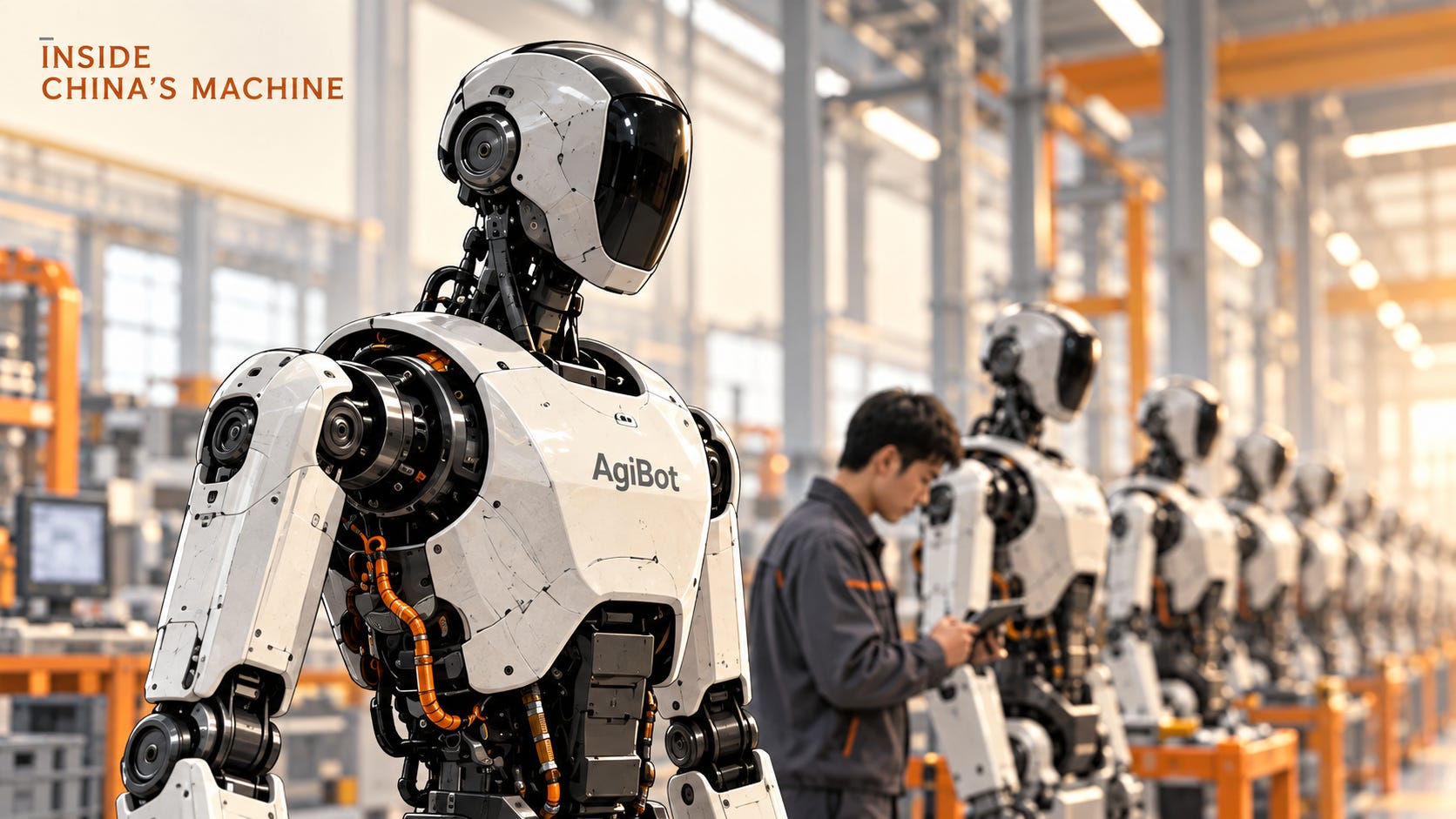
On March 30, 2026, AgiBot (智元机器人) rolled its 10,000th robot off the production line in Shanghai. The company marked the occasion with a ceremony, a press release, and a quote from co-founder Peng Zhihui that cut through the celebration: “Scale is not about whether you can do some moves. It is about whether you can work 24 hours straight in a factory.”
That sentence is the most honest thing anyone at AgiBot has said publicly. It is also a confession. The overwhelming majority of AgiBot’s 10,000 units are not working 24-hour shifts in factories. They are performing at galas, walking marathon distances for Guinness records, doing kung fu on camera, and sitting in university labs generating training data. AgiBot has built the fastest production ramp in humanoid robotics history. It has not yet proven it can build a business.
The production numbers are staggering and deserve to be taken seriously. The first 1,000 units took nearly two years. The next 4,000 took one year. The most recent 5,000 took three months. That acceleration curve has no precedent in robotics. But production velocity is not the same as commercial traction. And the gap between those two things is the central question for AgiBot’s upcoming IPO, its investors, and the industry watching it.
The Viral Engineer
To understand AgiBot’s speed, you have to understand its founder.
Peng Zhihui is not a typical robotics CEO. Before AgiBot, before Huawei, he was famous on Bilibili, China’s equivalent of YouTube, for building things in his bedroom. An Iron Man-inspired robotic arm. A self-driving bicycle. Projects that combined genuine engineering talent with a showman’s instinct for what would go viral. His videos attracted millions of views and caught the attention of Huawei, which recruited him in 2020 through its “Top Minds” program at an annual salary of 2 million yuan.
Two years later, in December 2022, Peng announced on Bilibili that he was leaving Huawei to start something new. By February 2023, AgiBot existed. By August, it had unveiled its first humanoid robot, the RAISE A1. By January 2024, it had a manufacturing facility in Shanghai. By the end of 2024, it had produced 962 units. By January 2025, the 1,000th unit rolled off the line.
The co-founders were Peng and Deng Taihua, who took the CEO role while Peng served as president and CTO. A third co-founder, Yan Weixin, a professor at Shanghai Jiao Tong University and chief scientist at the Shanghai Artificial Intelligence Laboratory, provided the academic research bridge. The founding team combined internet celebrity reach, corporate management experience, and academic credibility. It was designed to attract talent, capital, and attention simultaneously. It succeeded at all three.
The capital came fast. HongShan (formerly Sequoia China), Hillhouse Investment, BYD, Tencent, LG Electronics, Mirae Asset, Warburg Pincus. At least eight funding rounds in two years. PitchBook recorded a $2.07 billion valuation as of March 2025. Reuters reported in October 2025 that AgiBot was targeting a Hong Kong IPO at HK$40 to 50 billion ($5.1 to $6.4 billion), roughly triple the last private valuation, with CICC, CITIC Securities, and Morgan Stanley as joint sponsors.
AgiBot went from a Bilibili announcement to a potential $6 billion public company in less than four years. In China’s robotics sector, speed is not just a competitive advantage. It is the strategy.
The Product Portfolio
AgiBot’s product line is unusually broad for a company its age. Most humanoid startups ship one model. AgiBot ships five platforms across four form factors, all running on a shared AI stack the company calls “One Robotic Body, Three Intelligences,” integrating interaction, manipulation, and locomotion.
Expedition A2 Series: The flagship full-size humanoid. Standing 175 centimeters with 49 degrees of freedom and 200 TOPS (tera operations per second) of onboard AI compute, the A2 targets commercial service environments: reception, guided tours, retail showrooms. It holds certifications for China, the United States, and the European Union. In November 2025, an A2 walked 106.286 kilometers from Suzhou to Shanghai over three days, earning a Guinness World Record. The journey required 15 battery swaps along the route. AgiBot’s official online store lists the A2 Lite at approximately $44,560. Third-party reseller and enterprise integration pricing ranges higher, with some sources citing $100,000 to $190,000 for fully configured models.
Expedition A3: The newest full-size model, unveiled in February 2026. The A3 is built for dynamic movement rather than industrial labor. A flexible waist with human-like range of motion, lightweight exoskeleton-style legs, and a dual-battery system providing up to eight hours of runtime. Its debut video showed aerial flying kicks, back-to-back airborne strikes, and controlled mid-air steps, all filmed in real-world conditions without CGI. AgiBot claims the A3 demonstrates the most advanced whole-body coordination of any commercial humanoid. Industry databases estimate the A3 at approximately $45,000, though AgiBot has not published an official price. It targets performance, entertainment, and high-interaction commercial spaces. The 10,000th unit off the production line was an A3.
Genie G2 Series: AgiBot’s industrial play. A wheeled robot with force-controlled 7-degree-of-freedom arms, running on NVIDIA’s Jetson Thor platform, one of the most powerful AI processors available for robotics. The G2 achieves sub-millimeter assembly accuracy and can modulate grip force down to half a newton, roughly the weight of a small coin, enabling tasks as delicate as inserting memory chips. It operates across a temperature range of -15°C to 50°C and supports hot-swap batteries for continuous 24/7 operation. AgiBot has announced orders worth “hundreds of millions of yuan” for the G2, including approximately 1,000 units to a major electronics manufacturer.
Lingxi X2 Series: A compact, half-size humanoid designed for entertainment, education, and research. Natural language interaction, expressive movement, and a price point starting around $20,000.
D1 Series: A quadruped robot for inspection and operations in complex environments, plus OmniHand, a dexterous manipulation system.
The breadth is impressive. It is also a strategic risk. Most successful hardware companies at this stage focus on one product and one market segment. AgiBot is spreading R&D, manufacturing, and commercial resources across five platforms serving entertainment, education, industrial manufacturing, commercial service, and research. The question is whether the shared AI stack justifies the portfolio breadth, or whether the company is stretching before it has depth.
The Data Factory
AgiBot’s most important facility may not be its production line. It is the AIDEA Giga Data Factory: a 4,000-square-meter site in Shanghai’s Lingang district where roughly 100 robots continuously perform domestic and industrial tasks across more than 3,000 real objects. Every grasp, every step, every failed attempt generates training data that feeds back into the company’s foundation models.
The thesis: hardware is the vessel, but data is the moat. Every robot AgiBot ships, whether it performs in a gala, sits in a university lab, or works a factory shift, is a node generating the training data that makes the next generation better. This explains the production velocity. AgiBot is not trying to sell robots the way a car company sells cars. It is trying to flood the world with data collection platforms that happen to look like robots.
In March 2025, AgiBot released GO-1 (Genie Operator 1), its first generalist embodied foundation model. In August 2025, it introduced Genie Envisioner, a unified video generation platform for prediction, policy learning, and neural simulation. In January 2026 at CES, it launched Genie Sim 3.0, a next-generation simulation platform deeply integrated with NVIDIA Isaac Sim. And on April 7, 2026, the first day of AGIBOT AI Week, the company open-sourced AGIBOT WORLD 2026, a dataset covering five embodied AI research domains with real-world and digital twin data.
The open-source strategy mirrors what DeepSeek and Alibaba’s Qwen have done in large language models: release foundational tools to build an ecosystem, attract developer talent, and set the technical standard that competitors must follow or adopt. If AgiBot’s data and simulation tools become the default development environment for embodied AI research, the company captures value far beyond hardware margins.
AgiBot was highlighted during NVIDIA’s CES 2026 keynote. At GTC 2026 in March, AgiBot was named an NVIDIA Isaac GR00T ecosystem partner. NVIDIA’s official press materials confirmed the partnership, and the company’s own news release referenced AgiBot’s Genie Sim 3.0 integration with Isaac Sim. These signals suggest NVIDIA views AgiBot’s data infrastructure as strategically relevant to its own robotics platform ambitions.
The risk: open-sourcing data and tools accelerates competitors as well as partners. And the data factory thesis depends on a claim that has not been publicly verified: that AgiBot’s proprietary data actually produces meaningfully better models than what competitors can build with their own data or with publicly available datasets.
The Executive Exodus
Speed has a cost. In August 2025, AgiBot lost four of its most senior people.
Co-founder Yan Weixin, the Shanghai Jiao Tong professor who provided AgiBot’s academic credibility, departed. Lingxi division president Wei Qiang, a veteran of Panasonic, JD.com, and Huawei who had led key product launches across multiple companies, also left. The algorithm director and manufacturing head followed.
According to 36Kr’s reporting, the departures followed an October 2024 reorganization in which CEO Deng Taihua split AgiBot’s centralized R&D structure into competing product-line divisions. The move was designed to accelerate parallel product development. The result: internal tension and talent loss. Yan was described by an insider as “better suited to academic environments,” a diplomatic way of saying the company had outgrown its academic co-founder. Wei was described as “genuinely focused on building a great product,” which in context reads as a lament.
Peng Zhihui absorbed their responsibilities on a rotating basis. For a company preparing an IPO, the optics are difficult. The academic co-founder, the experienced product executive, the algorithm lead, and the manufacturing head all leaving in the same quarter suggests a company that is moving so fast it is shaking people loose.
The 36Kr piece included a telling quote from an employee: “We’re mentally overloaded, working 14-hour days with no time to actually refine our tech.” Another source noted that at the 2025 World Artificial Intelligence Conference, one of AgiBot’s Expedition robots, weighing 70 to 80 kilograms, toppled during a live demo. The company had boasted its robots could walk for over 360 hours without falling. The disconnect between the marketing claim and the physical reality captured something essential about AgiBot’s current stage.
The IPO prospectus will need to address executive stability. Investors buying into a company valued at $5 to $6 billion need to believe that the people who built the technology will be around to scale it. Four senior departures in one quarter is a risk factor that no amount of production volume can offset.
Deployment Reality
AgiBot claims deployment across eight core application scenarios: hospitality, entertainment, intelligent manufacturing, logistics, security, data collection, education, and guided tours. IDC’s January 2026 report confirmed AgiBot as the top shipper in five of six major humanoid deployment scenarios.
The verified commercial deployments, as of early 2026:
Fulin Precision Engineering (富临精工): Nearly 100 Yuanzheng robots deployed at factory locations under a deal worth tens of millions of yuan, announced August 2025. This is the largest documented industrial deployment from AgiBot and the closest evidence of productive factory work.
G2 industrial orders: “Hundreds of millions of yuan” in orders, including approximately 1,000 units to a major electronics manufacturer. These are orders, not verified deployments. The distinction matters.
Commercial service deployments: A2 robots are operational in hospitality, retail, and showroom environments. AgiBot launched a Robot-as-a-Service platform at MWC 2026 in Barcelona, offering rentals from €899 per day across 17 countries.
Data collection: The AIDEA facility and distributed units at universities and research labs. This is deployment in the narrow sense that robots are physically present and generating data. It is not deployment in the commercial sense that a customer is paying for productive work.
Performances and demonstrations: AGIBOT Night in February 2026 (200+ robots), the 2025 CCTV Spring Festival Gala with Shaolin monks, CES 2026, MWC 2026, and numerous conference appearances.
The pattern: AgiBot has genuine industrial traction with the Fulin deal and G2 orders, a growing commercial service presence through RaaS, and a massive data collection operation. But the gap between 10,000 units produced and the number doing paid, autonomous, productive work remains large. Internal use (data collection, training, demos) accounts for a significant share of production. The Omdia and IDC shipment numbers include all units, regardless of whether they are performing productive work or sitting in a lab.
Peng’s own quote at the 10,000-unit ceremony acknowledged this: “Scale is about working 24 hours in a factory.” By that standard, AgiBot’s scale story is just beginning.
Business Model and Capital Structure
AgiBot’s business model is a hybrid that makes it difficult to classify.
Hardware sales: The traditional revenue stream. A2 Lite from approximately $44,560 on the official store, with enterprise configurations reported up to $190,000. A3 estimated at $45,000 by third-party sources. X2 at roughly $20,000. G2 pricing undisclosed but enterprise-scale. Volume leader globally by units shipped.
Robot-as-a-Service (RaaS): Launched at MWC 2026, starting at €899 per day across 17 countries. This is a significant strategic shift: recurring revenue, lower adoption barriers, but heavier balance sheet requirements. IDC noted the RaaS model as a differentiator in its January report.
Data and platform: The open-source ecosystem (AGIBOT World, Genie Sim, AimRT framework) does not generate direct revenue today but positions AgiBot as infrastructure for embodied AI development. If the ecosystem achieves scale, platform monetization becomes possible.
“Powered by AGIBOT”: A customization program allowing partners to modify hardware, software, and appearance for specific use cases. This is a licensing and integration play.
Swancor acquisition: In mid-2025, AgiBot moved to acquire at least 63.62% of Swancor Advanced Materials, a publicly listed composites manufacturer. Swancor’s stock surged over 1,300% in 20 trading days. The acquisition was interpreted by some analysts as a backdoor listing contingency, and by others as a vertical integration play into advanced materials for robot manufacturing.
The capital structure is opaque. AgiBot has raised at least $83 million across eight-plus funding rounds (the total is likely higher, as not all rounds have been publicly disclosed). The company has not released audited financials. Revenue, net loss, cash burn, and unit economics are unknown. If the IPO proceeds, its prospectus will be the first time investors see real numbers.
For comparison: UBTECH, the only publicly listed Chinese humanoid company, reported H1 2025 revenue of 621 million yuan and a net loss of 440 million yuan. If AgiBot’s financials are in a similar range, the $5 to $6 billion IPO valuation implies a revenue multiple that will demand extraordinary growth to justify.
The capital question that the prospectus must answer: is AgiBot a hardware company, a data company, or a platform company? Each implies different margins, different growth trajectories, and different valuation frameworks. The current product portfolio suggests AgiBot is trying to be all three simultaneously. Investors will want clarity on which one drives the economics.
Competitive Position
AgiBot’s competitive positioning depends on which axis you measure.
Against Unitree (volume/price play): Unitree ships comparable volume at dramatically lower price points. The G1 at $13,600 and R1 at $5,900 reach markets AgiBot cannot touch at its reported price points. But Unitree’s strength is hardware and price, not AI capability. AgiBot’s data factory, foundation models, and simulation platform represent a software and data moat that Unitree has not matched. The competition is less direct than it appears: Unitree owns the bottom of the market, AgiBot owns the top.
Against UBTECH (industrial deployment play): UBTECH has the most verified factory deployments and the only audited financial data. Its Walker S2’s autonomous battery swapping solves a problem AgiBot’s G2 addresses differently (hot-swap). UBTECH’s advantage is deployment track record and transparency. AgiBot’s advantage is production velocity and AI stack breadth. The IPO will determine whether investors value proven deployment or production speed.
Against Galbot (AI-first platform play): Galbot and AgiBot share the most strategic overlap. Both emphasize foundation models and data infrastructure over pure hardware. Both target industrial deployment with intelligent manipulation. Galbot’s $3 billion valuation on $800 million in funding puts it in the same weight class. The differentiation: AgiBot has production scale (10,000 units versus Galbot’s “orders for thousands”), while Galbot claims deeper autonomous operation in CATL’s factories.
Against Western competitors: Figure AI, Agility Robotics, and Tesla Optimus each shipped roughly 150 units in 2025. AgiBot shipped over 5,000. The volume gap is enormous but potentially misleading: Western companies are focusing on fewer, higher-value industrial deployments rather than broad distribution. AgiBot’s A2 pricing, reported by third-party sources at $100,000 to $190,000 for enterprise configurations, undercuts Agility Digit at approximately $250,000 but does not offer the same price disruption that Unitree provides at the low end.
The NVIDIA relationship: AgiBot’s partnership with NVIDIA as an Isaac GR00T ecosystem partner, with its Genie Sim 3.0 platform integrated into NVIDIA Isaac Sim, is a significant competitive asset. The company was highlighted during Jensen Huang’s CES 2026 keynote. This relationship could become either a distribution advantage (if NVIDIA channels customers toward AgiBot’s tools) or a dependency risk (if NVIDIA’s platform priorities shift).
The Speed Trap
The 10,000th robot was an A3, the kung fu model. It performs aerial flying kicks. It does not work in a factory.
That is not a criticism. It is a description of where AgiBot is in its lifecycle. The company has accomplished something extraordinary: building the world’s most productive humanoid robot manufacturing operation in under four years, assembling a product portfolio that spans five platforms, creating a data and AI infrastructure that NVIDIA considers strategically important, and attracting enough capital and attention to attempt a $6 billion IPO.
But speed creates its own trap. When you move this fast, the gap between what you have built and what you have proven grows wider with every quarter. AgiBot has built production capacity. It has not yet proven unit economics. It has shipped 10,000 robots. It has not yet shown that those robots generate enough commercial value to justify the capital required to build them. It has assembled a world-class AI stack. It has not yet demonstrated that the AI stack produces commercially superior outcomes in real deployments. It has attracted extraordinary investors. It has lost its academic co-founder, its product lead, its algorithm director, and its manufacturing head in a single quarter.
Peng Zhihui knows this. His quote at the 10,000-unit ceremony was not about celebrating production. It was about redefining what “scale” means for the next phase: not units off the line, but hours worked in factories. If the IPO prospectus arrives as planned, it will reveal whether the company’s economics support that redefinition, or whether AgiBot’s speed has outrun its substance.
The answer will matter far beyond one company. If AgiBot’s IPO succeeds at $5 to $6 billion, it validates the Chinese model of production-first, deployment-second humanoid robotics development. If the prospectus reveals economics that cannot support the valuation, it will cool the entire sector.
Either way, we will know when the filing lands. As of mid-April 2026, we are still waiting.
Inside China's Machine. China's AI and robotics ecosystem, from the inside.
Sources
Production milestones (1,000 / 5,000 / 10,000 units): AgiBot company announcements, reported by The Information, IT之家, and RoboHorizon. Peng Zhihui’s 10,000-unit ceremony quote from IT之家 (April 3, 2026).
Shipment rankings and market share: Omdia “General-purpose Embodied Intelligent Robots” report (January 2026) and IDC “Global Humanoid Robot Market Analysis” (January 2026). Both independent, unaudited.
IPO details (valuation, sponsors, timeline, share offering): Reuters exclusive (October 2025), corroborated by Bloomberg. Previous IPO denial from AsianFin (July 2025).
Executive departures: 36Kr investigative report (August 2025), translated and published by KrASIA (January 2026). Employee quotes from anonymous sources within 36Kr’s reporting.
Peng Zhihui biography: Wikipedia, The China Academy, company announcements. Huawei “Top Minds” program and salary from Chinese media reporting.
Product specifications: CES 2026 press releases, company website, NVIDIA GTC 2026 partnership announcement. A3 pricing estimated by Humanoid Press, not officially confirmed by AgiBot. A2 Lite pricing from AgiBot official online store. Higher A2 pricing range from third-party reseller listings and enterprise integration quotes. Guinness World Record distance (106.286 km) confirmed; battery swap count (15 swaps) from Guinness official reporting.
NVIDIA CES 2026 keynote reference to AgiBot: reported by AgiBot’s own communications and multiple media outlets. NVIDIA official press materials confirmed the Isaac GR00T ecosystem partnership and Genie Sim 3.0 integration.
AGIBOT WORLD 2026 dataset and AI Week: Company announcements (April 7, 2026), The Robot Report.
Fulin Precision Engineering deal: Reuters, company announcement (August 2025). G2 orders: company claims, not independently verified.
Swancor acquisition: 36Kr reporting, stock price data from public markets.
All private company valuations are Estimated from PitchBook and most recent reported funding rounds. Production targets and deployment claims from company executives are Projected. UBTECH comparative data is from audited HKEX filings.