


Late on 16 July 2026, the largest open-weight AI model in history appeared on the internet. There was no keynote. There was no press conference. There was an updated page on kimi.com.
The timing had a certain dryness to it. The World Artificial Intelligence Conference opened in Shanghai that same week, the annual venue where Chinese AI companies build booths and give speeches about the future. Moonshot had a booth there too, and on 17 July a Reuters photographer captured people walking past it. The company had already shipped the thing overnight, from Beijing, without ceremony.
The next morning, semiconductor stocks fell. Traders reached for a phrase they had used once before, in early 2025, when a Chinese lab shipped a model that performed near the American frontier at a fraction of the assumed cost. They called it a Kimi moment.
By Sunday, Moonshot AI had stopped selling subscriptions. Its own GPUs could not keep up with the model it had just given the world.
Read those three events in order. A Chinese lab released a model that made global markets question whether the world needs as much compute as it is buying. Within seventy-two hours, that same model generated more compute demand than its own maker could serve.
Moonshot is now preparing to list in Hong Kong. It has engaged Goldman Sachs and China International Capital Corporation. Its annualised recurring revenue tripled in three months. A fundraising document seen by Reuters carried a valuation of thirty billion dollars, and the company has raised more than five and a half billion dollars in its short life. Its founder says he holds over ten billion yuan in cash and is in no hurry to go public.
That last sentence inverts the story this series told in its previous article. Zhipu listed because the public market was the only place large enough to fund what it was doing. Moonshot is listing from a position of not needing to. And the thing it cannot buy with any of that money, the thing it ran out of three days after its biggest launch, is chips.
This is the story of a company whose binding constraint stopped being capital.
The Wandering Poet
Yang Zhilin was born in 1992 in Shantou, a port city in Guangdong, and wanted to be a rock star or a wandering poet.
He got into Tsinghua in 2011, admitted to thermal energy engineering, which is to say boilers and turbines. He transferred into computer science in his sophomore year and graduated in 2015 at the top of the class. Then Carnegie Mellon, where he finished a doctorate in under four years under Ruslan Salakhutdinov, later head of AI at Apple, and William Cohen, later chief scientist at Google AI.
What he did during those four years is the part that matters. Yang was first author on Transformer-XL and on XLNet, two of the most consequential papers in language modelling before GPT-3 arrived and reorganised the field. XLNet has been cited more than ten thousand times. He interned at Google Brain and at Facebook AI Research. He came back to China and worked on Huawei’s PanGu language model, then led work on Wu Dao at the Beijing Academy of Artificial Intelligence, one of the country’s earliest large-model efforts.
This is a founder who built the technology before he built a company around it, and it shows in how he talks about the work. He is a scaling maximalist, in a specific and unfashionable way. His stated ambition is not to find product-market fit in the next year or two but to change the world over ten or twenty. Those are the words of someone who reads the scaling literature as a plan rather than a debate.
He founded Moonshot in Beijing in 2023 with three others, all from Tsinghua. Zhang Yutao, the chief technology officer, has a Tsinghua doctorate and had worked on AMiner, an academic search and knowledge-graph system. Wu Yuxin went from Tsinghua to Carnegie Mellon to Facebook AI Research, where he worked with Kaiming He on Group Normalization and built Detectron2. Zhou Xinyu came from Megvii, the computer-vision company, and co-authored ShuffleNet.
Yang and Zhou had been in a rock band together at Tsinghua. When it came time to name the company, they took it from the Pink Floyd album Yang loved. 月之暗面. The Dark Side of the Moon.
There is one more thread in this network, and it runs directly into the previous article in this series. Yang’s undergraduate research advisor at Tsinghua was Tang Jie. Zhang Yutao’s AMiner work was Tang Jie’s system. Tang Jie went on to co-found Zhipu, the first AI lab in the world to list on a public exchange, and in July 2026 he told his staff that Zhipu would spend two years declining to monetise.
The teacher and the student now run two of China’s frontier laboratories. Both came out of the same Tsinghua building. Both are pointed at the Hong Kong Stock Exchange. And they are getting there by opposite mechanisms.
What K3 Actually Is
Kimi K3 has 2.8 trillion parameters, which makes it the largest open-weight model any lab has released anywhere. Its predecessor, K2.6, had roughly a third as many. For nine of the twelve months before it shipped, Kimi models had already been setting the upper bound on open-model size. K3 extended that boundary by the widest margin yet.
Raw parameter count is the least interesting number in that paragraph. The architecture is where the engineering sits, and it is where Yang’s stated principle shows up as a design.
If a problem can be solved with scale, he has said, it should not be solved with a new algorithm. K3 is that sentence at 2.8 trillion parameters. The bet is not that Moonshot has found a cleverer idea than anyone else. The bet is that a very large model, made cheap enough to run, beats a smaller model made clever. Everything distinctive about K3’s architecture exists to make the first half of that bet affordable.
K3 is a sparse mixture-of-experts model, which means it does not run all 2.8 trillion parameters for every token. It routes each token to a small subset of specialised sub-networks. In K3’s case, sixteen experts are active out of eight hundred and ninety-six. That is 1.8 percent of the pool at any moment. The model is enormous in what it knows and modest in what it spends to answer, which is the entire point of the design.
On top of that sit two changes Moonshot names directly. Kimi Delta Attention addresses the fact that standard attention costs scale quadratically with sequence length, which makes a million-token context computationally brutal. Moonshot credits the technique with up to 6.3 times faster decoding at million-token contexts. Attention Residuals, the second, is credited with roughly 25 percent higher training efficiency at under 2 percent additional cost. Both figures are the company’s own.
The result is a model with a one-million-token context window, native vision, and two release variants, priced at three dollars per million input tokens and fifteen per million output. Full weights were scheduled for public release by 27 July under a modified MIT licence.
The benchmark picture requires precision, because the headlines flattened it.
On LMArena’s Frontend Code Arena, which tests models on building web interfaces and is evaluated by developers in blind comparisons, K3 ranked first with 1,679 points, ahead of Anthropic’s Claude Fable 5. It placed first in six of seven front-end categories. Its predecessor had ranked eighteenth. That is a seventeen-place jump in one release.
On broad capability, K3 does not lead. Moonshot said so itself: the model sits behind Claude Fable 5 and OpenAI’s GPT-5.6 Sol on overall performance, while beating everything else in the company’s evaluation suite, including Claude Opus 4.8 and GPT-5.5, on coding and agentic tasks. Artificial Analysis placed its intelligence in the same band as Opus 4.8 and GPT-5.5.
So: first place on a specific, credible, independently run coding benchmark. Not first place overall, and the company did not claim otherwise. The significance is not a crown. It is the distance closed. The UK AI Security Institute’s reading is that the gap between open and closed frontier models has narrowed to something like four to seven months, from six to ten.
One further detail matters for anyone tracking the silicon story in this series. Moonshot’s own disclosures point to export-grade Nvidia hardware and an unnamed alternative GPU vendor. Zhipu trained GLM-5 on domestic accelerators. Moonshot did not take that path, or has not said that it did.
The Kimi Moment
Chip stocks fell on 17 July. Nvidia and AMD both dropped. Bitcoin went with them, as it now tends to when the AI capital-expenditure narrative wobbles.
Honest handling of that selloff requires saying what else was happening that day. Netflix fell around nine percent on disappointing earnings. TSMC was under pressure despite posting a record quarter. Rate concerns and the Iran conflict were already pushing markets toward risk-off. Attributing the entire move to one model release from Beijing would be tidy and wrong.
What is real is the mechanism the release exposed, and it does not depend on how any single trading session closed.
Here is the arithmetic that spooked people. K3 runs at three dollars per million input tokens and fifteen per million output. It performs, on several agentic and coding measures, in the same band as models priced several times higher. And on 27 July the weights were to be published, meaning any organisation with sufficient hardware could run it themselves, forever, without paying Moonshot anything.
For an enterprise team routing routine workloads to a frontier API out of habit, that combination raises a question that did not exist the week before: at our volume, does self-hosting a 2.8-trillion-parameter open model make more economic sense? The answer varies by company. The question is now unavoidable.
Scale that up and you reach the fear the market was actually pricing. Combined hyperscaler AI capital expenditure runs to hundreds of billions of dollars, justified by an assumption that frontier-grade capability will remain scarce and therefore expensive. If near-frontier capability keeps arriving as free downloadable weights every few months, the assumption weakens. Not the demand for compute, which is a separate matter, but the pricing power that was supposed to make the capital expenditure pay.
DeepSeek made this argument in early 2025 with efficiency. Moonshot made it in July 2026 with scale and openness together. The mechanism repeating is what turns an event into a pattern.
Too Popular to Sell
Then the pattern turned on its author.
On 19 July, three days after the launch, Moonshot posted a note on its own account. Kimi K3 had received far more love than expected, it said, and the company’s GPUs were feeling it. Over the previous forty-eight hours demand had pushed close to the limits of current capacity, so to protect the experience of existing subscribers, new subscriptions were being paused.
It is not the register a frontier laboratory usually uses. There is no announcement of a strategic capacity initiative. There is a company saying, more or less, that its machines are tired.
Behind the phrasing was a real rationing decision. Available compute was redirected to existing paying users. Future memberships would be split into two plans so that resources could be allocated more deliberately. Daily sales had reportedly surged at least sixfold after the model went live, and the response was to close the door.
A company that had just told the world it could match the frontier had to stop taking money because it could not serve the customers it already had.
This is the joke the market missed while it was selling chip stocks. The bear case that Thursday was that open Chinese models would suppress compute demand. The evidence by Sunday was that one open Chinese model created more compute demand in two days than its own maker could absorb.
Moonshot was not alone in the squeeze. In the same week, Anthropic reduced usage limits on Claude Fable 5 for subscribers, citing demand it described as difficult to manage. The American closed lab and the Chinese open lab hit the same wall in the same seven days, from opposite ends of the industry. Compute scarcity is not a national condition. It is the condition.
What separates them is what each can do about it.
A closed lab facing a capacity wall has two options: buy more hardware, or ration. Moonshot has a third. On 27 July the weights go out, and any customer large enough to own serious hardware can run K3 themselves and leave the queue entirely.
Open-weighting is usually explained as a distribution strategy, a way to seed an ecosystem and build developer habit before monetising. That is true, and this series made the argument in the Zhipu article. But Moonshot’s compute wall reveals a second function that only shows up under load. When you cannot serve demand, publishing the weights lets demand serve itself. The customers you cannot host become customers who host themselves, on hardware you did not have to buy, in data centres you do not have to run.
No closed lab can do that. It is the one capacity release that costs nothing and requires no chips.
Capability, Then Revenue, Then Capital
The numbers underneath all of this arrived in an unusual order, and the order is the argument.
Moonshot’s annualised recurring revenue was around one hundred million dollars in March 2026. It reached two hundred million in April. By June it was three hundred million. Tripled in a quarter, driven by paid subscriptions and enterprise products including Kimi Work, and driven again by K3 in the days after launch.
The composition matters as much as the slope, and here the evidence is thinner. Moonshot publishes no revenue breakdown, and no prospectus exists. What reporting there is describes the growth as driven by paid subscriptions, enterprise access to products such as Kimi Work, and API demand. If that holds, it is revenue arriving through products people choose to keep paying for rather than through bespoke deployment contracts that require sending engineers into a customer’s building. That distinction is the difference between revenue that scales without headcount and revenue that does not, and it is the single most important thing a listing filing would settle.
Valuation followed rather than led. Moonshot was worth somewhere around four billion dollars at the end of 2025. A round closing in May 2026 brought in more than two billion dollars from Meituan, China Mobile, and CPE, taking the valuation past twenty billion. Reuters, citing a fundraising teaser, reported total historical fundraising above five and a half billion dollars, a further raise of up to two billion under way, and a valuation reaching thirty billion in June.
Set that beside the article that preceded this one and the contrast is stark.
Zhipu’s share price ran up roughly twenty-five-fold from its January listing to a June peak, on a free float below four percent of the company. The mechanism was scarcity: a very small number of tradable shares meeting every investor who wanted exposure to Chinese frontier AI and had no other listed way to get it. The business was growing, but the price was not primarily a statement about the business.
Moonshot has no float, no ticker, and no price except the one written into a fundraising document. What it has is revenue that tripled in three months and a product it had to stop selling. The valuation is chasing the revenue rather than the other way around.
Yang has been explicit about the resulting posture. He has said the company holds more than ten billion yuan in cash, roughly one and a half billion dollars, and is not in a hurry to list.
A company that does not need the money is negotiating from the other side of the table. Zhipu monetised its float because the float was the asset the market was pricing. Moonshot is preparing a listing while telling everyone it could wait.
Both statements might be posturing. Only one of them is available to a company whose revenue tripled in a quarter.
Taking Down the Scaffolding
There is a second structure being dismantled here, and it has nothing to do with models.
For roughly twenty-five years, foreign money reached Chinese technology companies through an arrangement called a variable interest entity. A holding company is registered in the Cayman Islands. It owns a Hong Kong subsidiary. That subsidiary sets up a wholly foreign-owned enterprise on the mainland. And that enterprise does not own the actual operating business at all. It controls it through a stack of contracts.
The contortion existed because Chinese law restricts foreign ownership in sectors including telecommunications, internet services, and now artificial intelligence. The VIE was the workaround that let global capital fund Chinese technology without formally owning it, and nearly every major Chinese internet company used it.
Consider what that meant for the investor. For twenty-five years, a fund in Boston or Singapore buying into a Chinese technology company was not buying the company. It was buying a share of a Cayman shell that held a stack of contracts promising it the economics of a business it was not permitted to own. The arrangement worked because everyone agreed to treat the contracts as if they were ownership. It was a legal fiction with hundreds of billions of dollars invested on top of it, and it held for a generation because it was never definitively tested in a Chinese court.
Moonshot is taking it apart.
In May 2026 an email went out to Moonshot’s shareholders. It said the company would begin dismantling its Cayman-registered red-chip and VIE structure. Bloomberg and the South China Morning Post reported it within a day of each other, both citing people familiar with the plan. The China Securities Regulatory Commission has not enacted a formal rule change, but it has increased scrutiny of offshore entities and now routinely requires companies to justify why a VIE is necessary before approving an overseas listing.
That email was a concession, and the sequence behind it is the part worth reading twice. Moonshot did not begin by offering to dismantle anything. It first went to the regulator and asked to keep the structure, seeking an exemption that would let it list without touching the arrangement its investors had bought into. The request did not land. The decision to unwind instead signalled, according to one person familiar with the process, that the chance of a waiver was slim.
A company that had just raised billions of dollars and was preparing one of the largest Chinese AI listings to date tried the easy path, found it closed, and rebuilt its own foundation rather than argue.
The replacement is a joint venture arrangement in which the operating entity is incorporated more directly under Chinese domestic frameworks while existing dollar-denominated funds keep their economic stakes without having to divest. The design threads a specific needle: satisfy Beijing on control and data, retain access to international capital.
Moonshot is not alone. StepFun, a Shanghai competitor racing toward its own Hong Kong debut, has reportedly stripped out its red-chip arrangement. DeepSeek and MiniMax are watching, because whatever structure clears the regulator first becomes the template everyone else copies.
This series has traced two forks already. Cambricon and Huawei represent a fork in silicon, where sanctions produced a domestic accelerator industry that would not otherwise exist. Zhipu and the open-weight labs represent a fork in models, where American capability arrives as a rentable API and Chinese capability arrives as downloadable weights.
This is the third fork, and it runs through the plumbing. The channel that carried foreign capital into Chinese technology for a generation is being rebuilt, by the companies themselves, under regulatory pressure, into something that keeps the money and changes the ownership. Whether international investors find the new pipe as trustworthy as the old one is the question nobody can answer until the first one is tested in a listing.
The Teacher and the Student
Two Chinese AI laboratories are heading for the Hong Kong Stock Exchange. Both trace to the same Tsinghua research network. One is run by a man who taught the other’s founder.
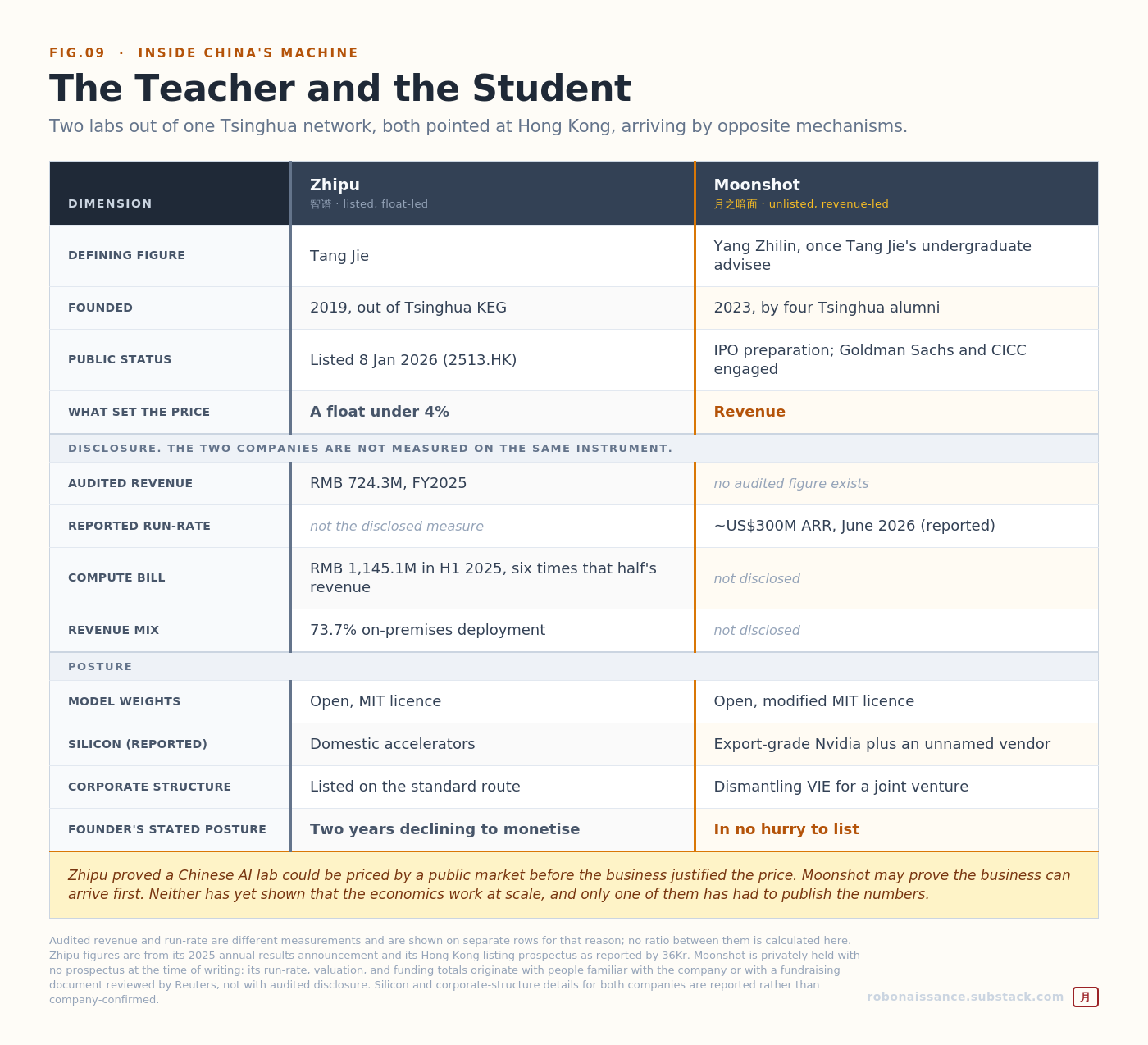
Tang Jie’s Zhipu got there first, in January 2026, and became the first frontier AI lab in the world with a public share price. That price was set by a float under four percent, and it ran up twenty-five-fold by June on scarcity, sovereignty, and the absence of any alternative listed vehicle. In July, three days after selling four billion dollars of stock into the rally, Tang told his staff that Zhipu would spend two years declining to pursue short-term monetisation.
Yang Zhilin’s Moonshot has not listed yet. Its revenue tripled in a quarter. It paused subscriptions because demand outran its GPUs. It holds one and a half billion dollars in cash and says it is not rushing. When it does list, the numbers will already be there.
Two laboratories, one lineage, opposite sequences. Zhipu proved a Chinese AI lab could be priced by a public market before the business justified the price. Moonshot may prove the business can arrive first.
Neither has yet proved the thing that matters most, which is that the economics work at scale. Moonshot’s formal IPO filing will be the first time anyone outside the company sees its cost structure, its compute bill, and its actual margins. Three hundred million dollars of annualised revenue against a thirty billion dollar valuation is roughly a hundred times revenue. That is a number that requires the growth to continue for years without interruption.
And the compute bill behind it has not been disclosed. Zhipu’s was, eventually, in a prospectus, and it showed a company paying out six yuan in compute for every yuan it earned. Moonshot’s may look better, given a revenue base that arrived faster. It may look worse, given that it just hit a capacity wall. Nobody outside the company knows, and that is precisely what a listing is for.
The Constraint Moved
Every article in this series has been about a constraint.
Cambricon exists because export controls made the best chips unavailable, and a good-enough domestic chip became the one you could actually buy. X Square exists because the body of a robot has been substantially solved and the brain has not. Zhipu listed because building frontier models costs more than private capital in China wanted to supply, and a four percent float turned out to be a remarkable fundraising instrument.
Moonshot’s constraint is different, and it is the most interesting one yet, because it is the constraint that arrives after you have solved the others.
The capital is there. Five and a half billion dollars raised, two billion more in progress, one and a half billion sitting in cash, Goldman Sachs and CICC already engaged, a valuation that tripled in seven months while the revenue tripled in three. The company is dismantling and rebuilding the legal structure that connects it to foreign investors, which is an expensive and delicate operation, and it is doing so from a position where it says it does not need to hurry.
The capability is there. The largest open model anyone has built, first place on a real coding benchmark, within a few months of the closed frontier.
The demand is there. So much of it that the company had to stop selling.
What is not there is compute. Not money for compute. Compute. The physical capacity to serve the customers who already want to pay, which no amount of Hong Kong listing proceeds converts into GPUs on a timeline that matters when your model goes viral on a Thursday.
This is what it looks like when a Chinese AI lab stops being capital-constrained and becomes hardware-constrained. It is the same wall Anthropic hit the same week from the other side of the industry, and the same wall that makes Cambricon’s inference business a real business rather than a policy artifact. The whole stack this series has been mapping, the chips, the models, the robots, the capital structures, converges on one physical limit.
Moonshot’s answer, for now, is to give the model away and let the customers bring their own machines. On 27 July the weights go out. The queue empties into other people’s data centres.
It is an elegant solution to a problem that money cannot solve. It is also an admission that the most valuable thing this company owns is something it has just decided to publish for free.
Which returns the story to the man who decided it. Yang Zhilin has said he is not building for the product-market fit of the next year or two but for what changes over ten or twenty. A founder working on that clock can afford to publish his best asset, because he is not trying to extract its value this quarter. On the most plausible reading of the strategy, what he is buying instead is position: that when the decade turns, the default open model on earth turns out to have come from Beijing.
The boy from Shantou who wanted to be a wandering poet has built the largest open model anyone has made, priced it at a fraction of the frontier, watched traders reach for his company’s name to explain a bad day in American chip stocks, run out of the hardware to serve it, and responded by giving it away. Whether that is the beginning of a business or the most expensive act of distribution in the history of software is the question a Hong Kong prospectus will have to answer.
He says he is in no hurry.
Inside China’s Machine. China’s AI and robotics ecosystem, from the inside.
Sources
Founder and founding team: Wikipedia (Yang Zhilin); Baidu Baike (Zhilin Yang); China AI Atlas / TechBuzz China; nextomoro; AOL summarising Business Insider reporting. Yang Zhilin’s birth in 1992 in Shantou, Guangdong; entry to Tsinghua in 2011 into thermal energy engineering with transfer to computer science; bachelor’s degree in 2015; doctorate at Carnegie Mellon completed in under four years under Ruslan Salakhutdinov and William Cohen; first authorship of Transformer-XL and XLNet; internships at Google Brain and Facebook AI Research; work on Huawei PanGu and BAAI Wu Dao; co-founding of Recurrent AI; and the founding of Moonshot AI in 2023 are reported across these sources. The ambition to be a rock star or wandering poet is per Wikipedia. XLNet citation count above ten thousand is per China AI Atlas. Co-founder details (Zhang Yutao, Tsinghua doctorate and AMiner work; Wu Yuxin, FAIR, Group Normalization with Kaiming He, Detectron2; Zhou Xinyu, Megvii and ShuffleNet) and the Tsinghua rock band are per publicly circulated founder profiles and are the least independently corroborated material in this article; they are presented as background rather than as load-bearing claims. The company name’s derivation from Pink Floyd’s The Dark Side of the Moon is widely reported. Yang’s engineering principle regarding scale and his ten-to-twenty-year framing are his own public statements.
The Tang Jie connection: China AI Atlas / nextomoro report that Yang Zhilin’s undergraduate research advisor at Tsinghua was Tang Jie, who later co-founded Zhipu AI. Zhang Yutao’s AMiner work connects to the same research group. This relationship is reported rather than company-confirmed and is presented as such.
Kimi K3: Moonshot AI technical blog (kimi.com/blog/kimi-k3); Tom’s Hardware; BenchLM; Graphify; Digital Applied; Labellerr. Release on 16 to 17 July 2026 across Kimi.com, Kimi Work, Kimi Code, and the Kimi API; 2.8 trillion total parameters; sparse mixture-of-experts routing sixteen of eight hundred and ninety-six experts per token; one-million-token context window; native vision; Kimi Delta Attention and Attention Residuals; full weights scheduled for release by 27 July 2026 under a modified MIT licence; and API pricing at $0.30 per million cache-hit input tokens, $3 per million uncached input tokens, and $15 per million output tokens are per the company’s technical blog and these outlets. The 6.3x decoding speedup and 25 percent training-efficiency figures are vendor-stated and are attributed as such. Sources differ on whether the release date is 16 or 17 July; both are noted rather than one asserted.
Benchmarks: LMArena Frontend Code Arena results (K3 first at 1,679 points, ahead of Claude Fable 5, first in six of seven front-end domains, a rise from eighteenth place for Kimi K2.6) are per LMArena as reported by Tom’s Hardware and BenchLM. Moonshot’s own statement that K3 sits behind Claude Fable 5 and GPT-5.6 Sol on overall performance while leading other models in its evaluation suite is per the company’s disclosures via Tom’s Hardware. Artificial Analysis placement is per BenchLM. The UK AI Security Institute finding on the open-to-closed frontier gap narrowing to four to seven months from six to ten is per commentary circulated on 17 July 2026 and is the least firmly sourced figure in this section. Vendor-reported benchmarks and independent leaderboard results are kept distinct throughout.
Hardware: Tom’s Hardware reports that Moonshot’s own disclosures point to export-grade Nvidia silicon and an unnamed alternative GPU vendor. This is reported rather than confirmed, and no claim is made here about the specific mix.
Market reaction: Cryptobriefing; Tech Times; tech-reader.blog; BeInCrypto. The 17 July decline in AI and semiconductor stocks including Nvidia and AMD, the “Kimi moment” framing, and the accompanying weakness in bitcoin are reported across these outlets. This article does not attribute the move solely to the K3 release: the same day saw Netflix fall roughly nine percent on earnings, TSMC under pressure despite a record quarter, and pre-existing risk-off pressure from rate concerns and the Iran conflict, per tech-reader.blog. Larger figures circulating for total market value lost are not used here because they could not be verified against a primary market source.
Subscription pause: Moonshot AI official account statement of 19 July 2026 as reported by BeInCrypto, The Next Web, and Reuters via Business Standard and Rappler. The pause on new consumer subscriptions, the redirection of compute to existing paying users, the plan to split future memberships into two plans, and the company’s description of demand pushing close to capacity limits over forty-eight hours are per that statement. The reported at-least-sixfold surge in daily sales is per Cryptobriefing citing sources and is attributed as reported. Anthropic’s reduction of Claude Fable 5 usage limits in the same week, citing demand it described as difficult to manage, is per The Next Web.
Revenue and funding: Reuters via Business Standard and Rappler; Bloomberg via Taipei Times and FXStreet; Cryptobriefing; FourWeekMBA. Annualised recurring revenue of approximately $100 million in March 2026, $200 million in April, and $300 million in June is reported across these outlets and originates with people familiar with the company rather than with audited disclosure. The May 2026 round of more than $2 billion from investors including Meituan, China Mobile, and CPE, total historical fundraising above $5.5 billion, an additional raise of up to $2 billion under way, and a valuation reaching $30 billion in June are per Reuters citing a fundraising teaser it reviewed. Yang Zhilin’s statement regarding more than RMB 10 billion in cash and not being in a hurry to list is per Cryptobriefing. Moonshot is privately held and none of these figures carry audited confirmation; all are attributed accordingly. The engagement of Goldman Sachs and China International Capital Corporation, with a fluid timetable, is per Reuters; CICC did not respond to Reuters’ request for comment and Goldman Sachs and Moonshot declined to comment.
Corporate restructuring: Bloomberg (19 May 2026); South China Morning Post (19 May 2026); BigGo Finance; IndexBox; The Next Web; Finexus. The May 2026 notification to shareholders of intent to dismantle the Cayman-registered red-chip and VIE structure, the mechanics of the VIE arrangement, increased CSRC scrutiny in the absence of a formal rule change, Moonshot’s initial attempt to seek an exemption and the assessment that a waiver was unlikely, and the joint venture replacement designed to let existing dollar-denominated funds retain stakes without divesting are reported across these sources, all citing people familiar with the matter. StepFun’s reported removal of its own red-chip arrangement is per Finexus.
Cross-references: Zhipu figures cited for comparison (the roughly twenty-five-fold rise from the January 2026 listing price to the June peak, the free float below four percent, the July placement, and Tang Jie’s 11 July 2026 internal letter) are drawn from the preceding article in this series and its sources. The compute-to-revenue ratio cited for Zhipu is from its Hong Kong listing prospectus as reported by 36Kr.
Classification: Model specifications, pricing, and release dates are Confirmed from the company’s technical blog and multiple outlets. Benchmark placements are Confirmed where independently run and labelled vendor-reported where not. Revenue, valuation, funding totals, and the IPO timetable are Reported, originate with unnamed sources or fundraising documents rather than audited filings, and are attributed throughout. The corporate restructuring is Reported from two independent outlets citing people familiar with the matter. Market-reaction causation is explicitly treated as multi-causal rather than attributed to a single event. Moonshot is privately held; no prospectus exists at the time of writing, and the first audited view of its economics will arrive with a formal listing filing.


This is an excellent piece, especially in the way it connects Moonshot’s architecture, financing, compute shortage, and open-weight distribution into one story.
I’m less persuaded, though, by the romantic interpretation of Yang Zhilin as a poet-founder giving away his greatest asset because his strategy will only become clear twenty years from now. That may be part of the story, but it risks placing too much explanatory weight on one exceptional individual.
China has explicitly favored developing AI capability through broad adoption, open-source ecosystems, and the diffusion of advanced models across companies, universities, developers, and domestic hardware suppliers. Moonshot’s strategy fits those state priorities remarkably well.
K3 was designed in an environment where access to frontier compute was already known to be constrained. Its sparse architecture, lower inference cost, and open-weight release therefore look less like an unexpected act of visionary generosity and more like a rational response to those conditions. When Moonshot cannot supply all the compute itself, users bring their own machines. The model spreads, experimentation multiplies, domestic chips are tested, and technical learning is distributed across the larger Chinese AI ecosystem.
I cannot tell from the available evidence how directly state policy shaped Moonshot’s specific decision. But the alignment is too strong to treat as incidental. The important asset being created may not simply be Moonshot’s future market position. It may be a much larger population of Chinese engineers and institutions learning on one of the country’s most advanced models.
That makes the strategy seem less like a brilliant personal revelation waiting twenty years to be understood—and more like a present-day industrial response to China’s geopolitical, financial, and compute constraints.