


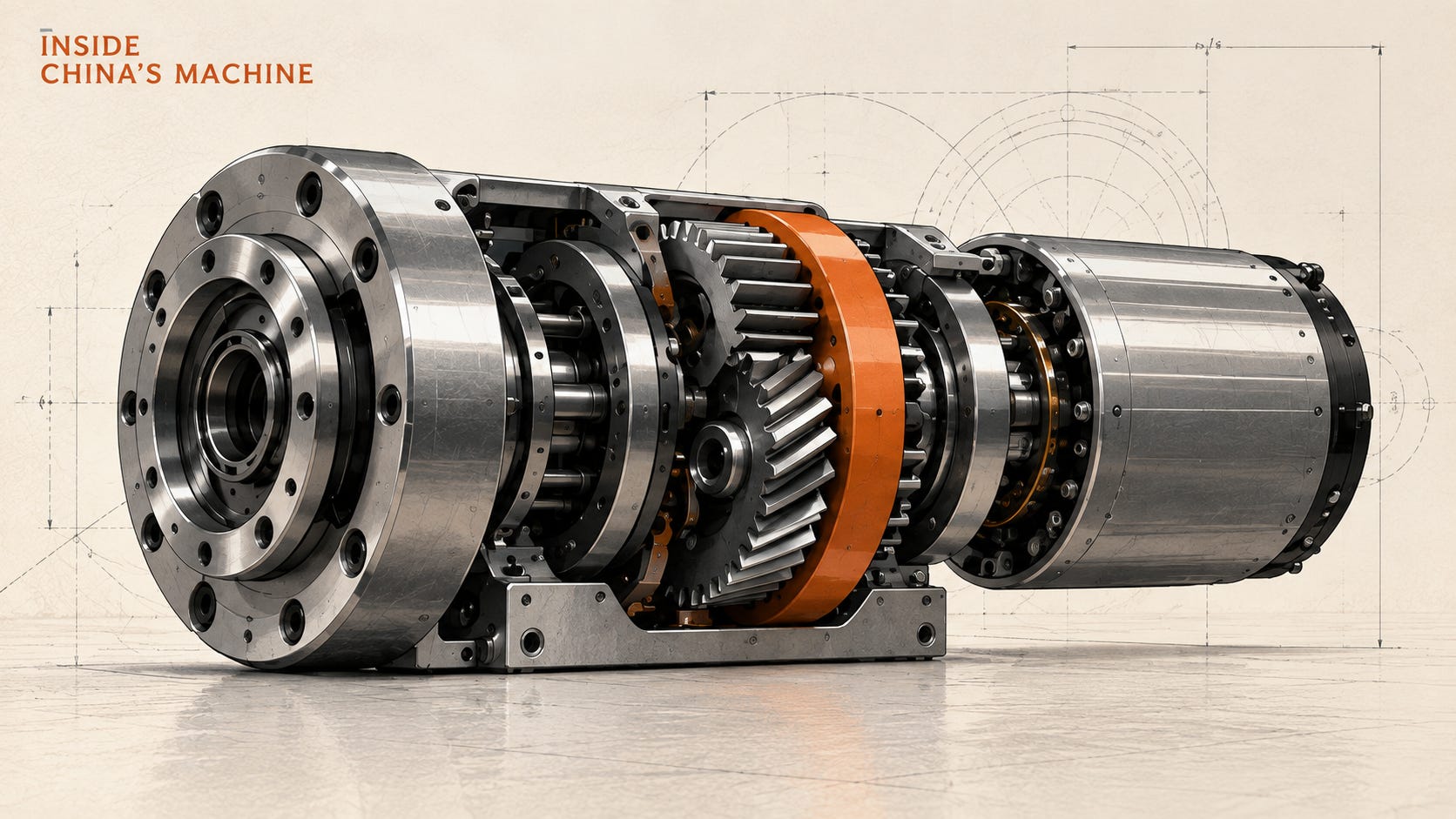
A few hundred precision manufacturing firms in the Yangtze and Pearl River deltas solved the humanoid body. The robot companies bought the result and put their names on it.
Watch what that looks like on television. At the 2026 Spring Festival Gala, a few hundred million people saw humanoid robots throw punches and turn backflips on the most-watched broadcast on Earth. Machines from four Chinese companies appeared across the night's programme. Unitree's performed the martial arts routine. Galbot's appeared elsewhere in the show.
The joints came from the same factory in Suzhou.
That company is called Leaderdrive, known in Chinese as 绿的谐波, and it trades on Shanghai’s STAR Market under the code 688017. In 2025 it booked 571 million yuan of revenue, roughly 80 million dollars. That is less than Zhipu earned in the same year, and Zhipu is a company this series has described as losing six yuan for every one it takes in.
Hold those two facts next to each other. The company that supplies the joints for most of China’s humanoid robots is smaller, by revenue, than a loss-making AI lab. And if it stopped shipping tomorrow, a large fraction of China’s humanoid programmes would stop with it.
This series has spent four articles on companies the capital markets have already found. Cambricon, priced as a proxy for the entire domestic chip industry. X Square, valued at 2.8 billion dollars on a model that clears its own benchmark four times out of seventeen. Zhipu, whose share price went up twenty-five-fold on a float under four percent. Moonshot, worth thirty billion by the last reported round.
This article is about the layer underneath all of them, where the numbers are small, the companies are unglamorous, and the actual constraint on China’s robot industry has been sitting for the last fifteen years. The story starts with a man who flew to Tokyo to look at a part.
Tokyo, 2003
Zuo Yuyu studied physics at Nanjing University and went into manufacturing. By the early 2000s he was running a metal-parts business that supplied components to GE and ABB, which is a respectable place to be and not a famous one.
Somewhere in that work he learned something that stuck. ABB, one of the largest robotics companies in the world, was unhappy with its Japanese suppliers. Not unhappy enough to switch, because there was nothing to switch to. Just unhappy, in the way a customer is unhappy when it has no alternative and everyone in the room knows it.
At the end of 2003 he flew to Japan to see the part.
In Tokyo he learned the name of the company that made it: Harmonic Drive Systems. By then it had held the global market for harmonic reducers for more than forty years, with a share that at times exceeded ninety percent. Its technology was in the drive wheels of the Apollo lunar rover. Every robot manufacturer on Earth, regardless of size, bought on its terms.
The account of that trip comes from a Chinese-language reconstruction published years later by 36Kr, so the interior detail should be read as the company’s own telling. What is reported is that the visit stung. And that Zuo’s response was a physicist’s rather than an entrepreneur’s.
Isn’t this just a more complicated physics problem? Why can’t we do it?
He went home and convinced his team to try.
Under a Millimetre
To understand why that question was harder than it sounds, you have to understand what a harmonic reducer is, because it is one of the strangest devices in mechanical engineering.
Every robot joint has the same problem. The electric motor spins fast and weakly. The joint needs to move slowly and strongly. Something has to convert one into the other, and in a humanoid robot that something has to be small, light, and precise enough that a hand arrives where the software said it would.
A harmonic reducer solves this with three parts. There is a rigid outer ring with teeth on the inside. There is a thin steel cup, called a flexspline, with teeth on the outside and slightly fewer of them. And there is an elliptical bearing, the wave generator, which sits inside the cup and squashes it into an oval so that its teeth engage the outer ring at two points. Turn the wave generator, and the point of contact travels around the ring. Because the cup has fewer teeth, it creeps backwards by that difference with each revolution. Enormous reduction ratios come out of a device barely thicker than a hockey puck.
The cup is bent out of shape, continuously, for the entire life of the machine.
That is the elegance and it is also the problem. The flexspline is a structural component designed to be deformed millions of times without failing. Its wall is typically under a millimetre thick. Its teeth must be cut to ISO Class 4, which means pitch tolerances in single-digit micrometres, and its runout has to stay within about five micrometres. It is made of high-strength steel, which resists being machined, and it must be clamped for machining without distorting, which is difficult precisely because it is thin enough to distort.
Get the mesh slightly loose and the joint has backlash, which means the robot’s hand does not arrive where the software said. Get it slightly tight and the reducer cannot be assembled at all. And the failure mode that matters most is not immediate. It is fatigue, cracks that begin at the roots of the teeth after millions of cycles, seeded by a fillet radius that was slightly wrong or a tool mark left behind during machining.
This is the reason the monopoly lasted forty years, and it is not the reason people usually assume. The principle is public. It was patented in the 1950s and the patents expired long ago. Any competent engineer can read how a harmonic drive works in an afternoon.
What could not be read was the process. How to hold a sub-millimetre steel cup so it does not flex under the cutter. Which heat treatment gives fatigue life without warping the geometry. How to finish a tooth root so it does not seed a crack. That knowledge lives in machine operators and process engineers and years of scrapped parts, and it does not transfer by reading.
There is a particular cruelty in the feedback loop. A flexspline machined slightly wrong does not announce itself. It assembles correctly, turns smoothly, passes inspection, and works for months before a crack opens at a tooth root and a joint fails inside a customer’s machine. The interval between making the error and learning of it can be a year, and there is no way to run that loop faster. A barrier of this kind is not measured in cleverness. It is measured in how many times you have been allowed to be wrong.
Zuo was right that it was a physics problem. He was wrong about how long the physics would take.
Six Years
The company was not founded in 2003, or 2004, or 2007.
Leaderdrive was incorporated in 2011, more than six years after the Tokyo trip. Six years passed between deciding to make the part and having a company that made it. Those years went into the part of the work that does not photograph well: metallurgy, grinding, heat treatment, measurement, and the slow accumulation of knowledge about how a thin steel cup behaves when you try to make it perfectly.
In March 2011 the company sent its first reducer prototype to the Jiangsu provincial inspection centre for reducer product quality. The part passed. It was the first harmonic reducer in China to reach industrial production and large-scale application, which is a sentence that means a Chinese factory could finally buy a domestic one.
The company that resulted is not large even now. Its revenue is a fraction of any of the AI labs this series has covered. It listed on the STAR Market in 2020 and was the first company from its district of Suzhou to do so, which tells you something about the neighbourhood it grew up in: an industrial town where a listed company was still an event.
The Share Shift
For most of the following decade, the numbers moved slowly. Then the humanoid programmes arrived, and the market moved faster than it had in forty years.
Precision matters in describing this, because share figures for harmonic reducers get quoted with several different denominators and they are not interchangeable.
Within China’s harmonic reducer market, domestic producers as a group held roughly fifteen percent in 2022. By the first quarter of 2024 that had risen to around thirty-eight percent. As of 2022, Harmonic Drive Systems still led the Chinese market at approximately thirty-eight percent with Leaderdrive at roughly twenty-six percent, and JPMorgan has more recently put Leaderdrive at thirty to forty percent of that same market.
Inside the humanoid segment specifically, the picture is different and more lopsided. Leaderdrive is reported to hold about sixty percent of Chinese service and humanoid robot harmonic reducers. Morgan Stanley assumes it will take about forty percent of the global humanoid harmonic reducer market in 2026, settling to around twenty-five percent over the longer term.
Those measurements run on different denominators and this article is not going to average them. What they agree on is direction. A market that barely moved for four decades reorganised itself in about three years, and it reorganised fastest exactly where the new demand was.
The financial result showed up in 2025. Revenue of 571 million yuan, up 47.31 percent. Net profit attributable to shareholders of 124 million yuan, up 121.42 percent. The fourth quarter turned a small prior-year loss into a 31 million yuan profit. In the first quarter of 2026 revenue rose 42.96 percent and profit 61.17 percent. Gross margin held near 37 percent for the full year.
The equity market noticed in its own way. Leaderdrive shares rose about forty percent over the year to April 2026, and Zuo Yuyu and his brother Zuo Jing became billionaires on paper.
Twenty-three years after a trip to Tokyo to look at a part nobody in China could make.
Investors looking for humanoid exposure had begun stepping past the robot companies and buying the joints instead, which is a rational thing to do when the robot companies are numerous and the joint suppliers are not.
The Delta
Leaderdrive is the cleanest example, not the whole story. Around it sits a supply chain that has been quietly assembling for two decades, and the aggregate effect is larger than any single firm in it.
Start with the multiplier. A humanoid robot needs somewhere between twenty and forty harmonic reducers, depending on design. A six-axis industrial arm typically uses harmonic gears only on its three wrist axes, with sturdier cycloidal units carrying the base and shoulder. Every humanoid that ships is therefore worth roughly seven to thirteen industrial arms to a harmonic reducer maker, which is why a market that grew arithmetically for forty years is now being asked to grow geometrically.
The multiplier explains why the joint dominates the bill of materials. Joint actuators account for more than thirty percent of a humanoid’s component cost by industry estimates, reaching around half in simpler configurations. Dexterous hands add another fifteen to twenty percent. Taken together, somewhere between roughly half and two-thirds of the physical cost of a humanoid robot is the machinery that makes it move. The price of the robot is largely a question about the price of motion, and the price of motion is set in a handful of industrial districts.
The rest of the joint has followed the same path. Leadshine reported delivering more than 120,000 frameless torque motors in 2025, more than twenty times the prior year. Shuanglin has developed sixty-three ball and planetary screw products for three customers. Sanhua’s robotics revenue grew 320 percent year on year in the first half of 2025, a figure the company disclosed while denying a widely circulated report about the size of a specific order.
The most dramatic collapse happened in sensing. Five years ago a tactile sensor of the kind a robot hand needs had to be imported and cost more than a hundred thousand yuan. After domestic breakthroughs, prices have fallen as low as 199 yuan. The cost of one imported sensor five years ago now equips an entire domestically made dexterous hand.
Dexterous hands themselves ran an average of about 7,960 dollars globally in 2024. Some Chinese models are now under a thousand. Lingqiao’s DexHand021 Pro offers twenty-two degrees of freedom at a fifth of the price of comparable international products.
None of this happened in laboratories.
It happened in the industrial belts of the Yangtze and Pearl River deltas, in towns like Mudu, the district of Suzhou where Leaderdrive built its plant, and in several hundred others that look much the same: low buildings, a rail spur, a canteen, a car park filling with the vehicles of people who machine things for a living. These were factories already making precision parts for cars and appliances and industrial automation. Around 2024 they discovered that a new customer had appeared, one that wanted the same skills pointed at smaller and stranger parts.
What followed is legible in what they bought. Screw factories bought grinding machines. Reducer factories bought inspection equipment. Dexterous hand makers went looking for micro motors and flexible materials, which meant orders for their suppliers, which meant orders further up again. A purchase order for a grinding machine is a slower and more reliable signal than a funding round, because nobody buys one to be seen buying it.
Analysis by Gasgoo’s automotive research institute puts the cost advantage of localised core components at fifty to seventy percent against foreign equivalents. That is the number underneath Unitree’s price destruction, described earlier in this series. Unitree did not invent a cheaper robot. It bought from a chain that had spent a decade learning to make the expensive parts cheaply, and then passed the saving on faster than anyone expected.
Optimus Runs on Chinese Joints
The awkward part of this is not Chinese.
By multiple accounts, something like seventy percent of the components in Tesla’s third-generation Optimus are sourced from Chinese suppliers. Tuopu, a Ningbo company that has supplied Tesla vehicle chassis since 2016, became an actuator supplier for Optimus and delivered batches in the second quarter of 2025 sufficient for roughly seven hundred robots. Its reducers are priced thirty to forty percent below Japanese equivalents. Leaderdrive has passed Tesla’s supplier validation.
Musk’s stated target is an Optimus that costs under twenty thousand dollars, because his own internal arithmetic says the market only becomes enormous below that line. The arithmetic works if the joints are Chinese. It is considerably harder if they are Japanese, and it has not been demonstrated at all if they have to be American, because the American supply chain for this specific category of precision component largely does not exist.
This is the same structure the earlier articles in this series found in silicon, arriving from the opposite direction. There, export controls made the best chips unavailable to China, and a domestic industry grew in the space that was left. Here, no controls were needed. The capability simply migrated, one machine tool and one process engineer at a time, to the place that was already making everything else.
A humanoid robot is a machine assembled from a few thousand precision parts. Whoever makes those parts most cheaply and most reliably will end up inside everyone’s robot, including the robots built by companies that would prefer otherwise.
The obvious response is to build the capability somewhere else, and the obvious response is harder than it sounds. A chip fabrication plant can be bought. It costs a great deal of money, the equipment list is known, and a government that wants one badly enough can write the cheque, as several have. A precision components industry cannot be bought, because what makes it work is not the machines. It is several thousand people who have spent fifteen years learning what a particular alloy does when you grind it at a particular speed, distributed across hundreds of firms that supply and poach from one another inside a few hundred kilometres.
That is why the joints are a more awkward dependency than the chips. Chips are a chokepoint that can be attacked with capital. Joints are a chokepoint that has to be attacked with time, and the clock started in the deltas around 2005.
What the Capacity Decision Looks Like
A chokepoint only stays one if it can supply. For Leaderdrive the live decision is not whether demand is coming. It is how much capacity to build before it arrives.
Get it wrong in one direction and the orders go to someone else, permanently, because a validated supplier relationship in a safety-critical component is not easily reversed. Get it wrong in the other and a company with 571 million yuan of revenue is sitting on a factory built for a market that did not show up on schedule.
Leaderdrive chose to build. Monthly harmonic reducer capacity went from about fifty thousand units in the first quarter of 2026 to roughly seventy thousand by mid-year, with a stated plan to reach one hundred to one hundred and twenty thousand by year end. That is roughly a doubling across 2026, funded by a company whose entire annual revenue would cover about three months of Zhipu’s compute bill.
The demand forecast underneath it comes from the sell side and should be read as such. Morgan Stanley raised its 2026 shipment forecast for Chinese humanoids from twenty-eight thousand units to fifty thousand, and projects four hundred and forty-six thousand by 2030, a compound annual growth rate of 106 percent from 2025. It expects humanoid-related sales to reach thirty-five percent of Leaderdrive’s revenue in 2026 and half by 2027.
Set against that, the current reality is modest. Soochow Securities expected global humanoid sales below thirty thousand units in 2025. UBTech’s total order value for the year approached 1.4 billion yuan and Unitree’s approached 1.2 billion. These are real businesses and they are not yet large ones.
Which means the capacity being built today is a bet on a forecast, made by a company that cannot afford to be wrong twice.
The Force That Eats Its Parents
There is a problem with being the company that made things cheap, and it is visible in the numbers already.
Look again at what happened to tactile sensors. An imported unit cost more than a hundred thousand yuan five years ago. Domestic versions now sell for as little as 199 yuan. That is not a discount. It is a category destroyed and rebuilt at roughly a five-hundredth of the price, and the destruction reached the domestic sensor makers who performed it, not only the foreign incumbents they displaced.
Nothing about harmonic reducers exempts them from the same process. The barrier described earlier, process knowledge held in machine operators and scrapped parts, is durable against a foreign competitor starting from nothing. It is much less durable against the fiftieth Chinese firm to enter, hiring from the first, buying the same grinding machines from the same vendors, in the same industrial district.
The share data hints at this. Domestic producers collectively went from roughly fifteen percent of the Chinese market in 2022 to roughly thirty-eight percent by early 2024. Leaderdrive is the largest of them and did not capture all of that gain. The rest went to companies most readers have never heard of, and there are more of them every quarter, because a market growing at the rate the sell side is forecasting attracts entrants the way an open window attracts weather.
Leaderdrive’s gross margin was 36.91 percent for 2025 and 33.62 percent in the first quarter of 2026. Those are healthy numbers for a components manufacturer, and they are also the target that every new entrant is aiming at. The company’s own answer is to move up: a stated strategy of pairing reducers with integrated electromechanical actuator modules, which is the standard defence of a component maker trying not to become a commodity supplier, and which works for exactly as long as the module is harder to copy than the part.
The uncomfortable symmetry is this. The thing that made Chinese humanoids possible was a decade of relentless cost reduction in precision components. The thing most likely to damage the companies that performed it is another decade of the same. Unitree could destroy the price of a robot because its suppliers destroyed the price of a joint. Someone is now preparing to destroy the price of a joint again.
And this time Zuo Yuyu is the incumbent.
He spent six years learning to make a part that a Japanese company had owned since the 1960s, and roughly fifteen more turning that into a business with a national share. Somewhere in a similar town, someone who once worked for him is currently explaining to an investor that the technology is not that hard, that the patents expired decades ago, and that the process knowledge can be acquired by hiring the right eleven people.
That argument was correct when Zuo made it in 2003. It is not obvious why it stopped being correct.
That is the ordinary fate of a supply chain that works. The current market narrative, in which the joint makers are the scarce and defensible layer of the humanoid trade, describes a moment rather than a structure.
The Layer Nobody Priced
Every article in this series has found a constraint.
Cambricon exists because export controls made the best chips unavailable, and good enough and available beat best and unavailable. X Square is expensive because the brain is the unsolved layer of embodied AI. Zhipu cannot yet make the arithmetic work because a model is built once and paid for again every time somebody uses it. Moonshot ran out of compute three days after shipping the model that made the market question whether the world needed so much of it.
The joints are the constraint nobody wrote about, because they were solved before anyone was watching.
While capital was pricing chips and models and brains, a few hundred manufacturing companies were working out how to machine a sub-millimetre steel cup to five-micrometre precision, and how to do it at a price that would let a robot cost less than a car. That work did not produce a valuation story until 2025. It produced something more durable: a physical capability that sits inside almost every humanoid robot on Earth, including the ones assembled in Texas.
There is a version of this story that credits national strategy, and it would not be wrong. China’s humanoid action plan sets a target of a hundred thousand robots deployed by 2027, and calls explicitly for a complete domestic supply chain in actuators, dexterous hands, and perception. The policy is real and the money behind it is real.
But the physics was done first, and it was done by people who were not waiting for a plan.
In 2003 a man who had studied physics flew to Tokyo because he wanted to look at a part that his customers could not buy anywhere else. It took him more than six years to make one, another decade to make it well, and about three years after that for the rest of the world to notice that the joints inside its robots had quietly changed nationality.
The bodies were never the hard part, in the end. They were just the part that somebody had to learn to make.
Inside China’s Machine. China’s AI and robotics ecosystem, from the inside.
Sources
Leaderdrive company and founder: 36Kr (Chinese-language profile of Zuo Yuyu and the founding of Leaderdrive); Kunihiro Koreeda’s Chinese Corporate Encyclopedia via Nikkei-affiliated commentary (April 2026); Leaderdrive corporate website and STAR Market disclosures (688017.SH). Zuo Yuyu’s physics background at Nanjing University, his metal-parts business supplying GE and ABB, ABB’s dissatisfaction with Japanese suppliers, the 2003 Tokyo visit, the “more complicated physics problem” framing, the six-year development period, and the 2011 founding in Suzhou are drawn from these accounts. The interior detail of the Tokyo trip rests on a single Chinese-language reconstruction published years after the fact and is presented as the company’s own telling rather than as independently verified reporting. The March 2011 submission of the first prototype to the Jiangsu provincial reducer inspection centre, and Leaderdrive’s status as the first Chinese firm to achieve industrial production and large-scale application of harmonic reducers, are reported in Chinese industry coverage. Leaderdrive’s position as the first STAR Market listing from its district of Suzhou is per the company’s own account of its 2020 listing.
Harmonic Drive Systems and the historical monopoly: 36Kr; Nikkei-affiliated commentary. The forty-year duration of the monopoly, the peak global share above ninety percent, and the use of the technology in Apollo lunar rover drive wheels are as reported in these accounts. Harmonic drive principles were patented in the 1950s and those patents have long expired.
Harmonic reducer engineering: EMAG (flexspline machining specifications); MDPI Actuators, “A Novel Strain Wave Gear Reducer with Double Flexsplines” (2023); Springer, International Journal of Precision Engineering and Manufacturing (2026); EVS International reducer comparison (May 2026); USPTO patent documentation on double-flexspline designs. Flexspline wall thicknesses typically under one millimetre, ISO 1328 Class 4 gear quality with single-digit micrometre pitch tolerances, runout within approximately five micrometres, typical workpiece diameters of 25 to 140 millimetres, and high-cycle fatigue at tooth roots as the life-limiting failure mode are drawn from these engineering sources. The characterisation of process knowledge rather than intellectual property as the durable barrier is this article’s reading of that material, not a claim made by any single source.
Leaderdrive financials: Company annual results and quarterly disclosures as summarised by Soochow Securities via Sina Finance (May 2026). FY2025 revenue of RMB 571 million (+47.31%), net profit attributable to shareholders of RMB 124 million (+121.42%), Q4 2025 revenue of RMB 164 million with net profit of RMB 31 million against a prior-year loss of RMB 3 million, Q1 2026 revenue of RMB 140 million (+42.96%) and net profit of RMB 33 million (+61.17%), FY2025 gross margin of 36.91% and net margin of 21.79%, and Q1 2026 gross margin of 33.62% are per those disclosures. H1 2025 revenue of RMB 251 million with 34.77% gross margin is per 36Kr citing company reporting.
Market share: Figures in this section carry different denominators and are labelled accordingly. Domestic Chinese producers’ collective share of the Chinese harmonic reducer market rising from approximately 15% in 2022 to approximately 38% in Q1 2024 is per industry analysis circulated in June 2026. Harmonic Drive Systems at approximately 38% and Leaderdrive at approximately 26% of the Chinese market as of 2022, and Leaderdrive at approximately 60% of the Chinese service and humanoid robot segment, are per Nikkei-affiliated commentary. JPMorgan’s estimate of Leaderdrive at 30-40% of China’s harmonic reducer market is as reported by humanoid.guide. Morgan Stanley’s assumptions of 40% of the global humanoid harmonic reducer market in 2026 and approximately 25% long term are per its research as reported by BigGo Finance. No average or composite of these figures is calculated here.
Capacity and forecasts: Morgan Stanley research as reported by BigGo Finance (June 2026). Monthly harmonic reducer capacity rising from approximately 50,000 units in Q1 2026 to approximately 70,000, with a stated plan of 100,000 to 120,000 by year end; the raised 2026 Chinese humanoid shipment forecast from 28,000 to 50,000 units; the 2030 projection of 446,000 units at a 106% compound annual growth rate from 2025; and the expectation that humanoid-related sales reach 35% of Leaderdrive revenue in 2026 and 50% in 2027 are per that research. Sell-side forecasts are estimates and are presented as such. Soochow Securities’ expectation of global humanoid sales below 30,000 units in 2025, and 2025 order totals approaching RMB 1.4 billion for UBTech and RMB 1.2 billion for Unitree, are per 36Kr.
Wider supply chain: Gasgoo Automotive Research Institute (February 2026) for the 50-70% cost advantage of localised core components and Lingqiao’s DexHand021 Pro specifications; Tianxia Gongchang Research (July 2026) for Leadshine’s 2025 delivery of more than 120,000 frameless torque motors representing more than twentyfold growth, Shuanglin’s 63 ball and planetary screw products, and the characterisation of delta-region factory capacity expansion; China Humanoid Robotics Tracker (March 2026) for tactile sensor pricing falling from above RMB 100,000 for imported units to as low as RMB 199, and for global average dexterous hand pricing of approximately $7,960 in 2024 against sub-$1,000 Chinese models. Sanhua’s 320% year-on-year robotics revenue growth in H1 2025 is per company disclosure as reported by Humanoids Daily; Sanhua publicly denied a separately circulated report regarding the size of a specific Tesla order, and no order figure is asserted here.
Tesla Optimus supply chain: optimusk.blog compilation citing iNEWS Robot Core supply chain reporting and Yicai Global; KR-Asia (January 2026). The estimate that approximately 70% of third-generation Optimus components are sourced from Chinese suppliers, Tuopu’s role as an actuator supplier and its Q2 2025 delivery volumes sufficient for approximately 700 robots, its pricing 30-40% below Japanese competitors, and Leaderdrive’s passage of Tesla supplier validation are reported across these sources rather than confirmed by Tesla. Tesla’s internal target of an Optimus unit price below $20,000 is per Musk’s public statements and Tesla’s Q3 2025 earnings call.
Policy: MIIT and five other ministries’ 2025 Humanoid Robot Action Plan, setting a national target of 100,000 humanoid robots deployed by 2027 and calling for a complete domestic supply chain in actuators, dexterous hands, and perception systems, is per Silicon Valley Robotics Center research (April 2026).
Cross-references: Figures cited for Cambricon, X Square Robot, Zhipu, Moonshot, and Unitree are drawn from the preceding articles in this series and their sources.
Classification: Leaderdrive’s financial results are Confirmed from company disclosures. Engineering specifications for flexspline manufacturing are Confirmed from published technical sources. Market share figures are Reported, carry differing denominators, and are labelled individually. Capacity plans and shipment forecasts are sell-side estimates and are attributed as such. The Tokyo founding narrative is a single-source reconstruction and is flagged in the text. Tesla supply chain composition is Reported and not confirmed by Tesla.

