

Robonaissance’s open-source project: withpompom.com
Think about everything you’ve learned over the past year.
The articles you’ve read. The ideas you’ve explored. The problems you’ve solved. The mistakes you’ve made. The decisions you’ve reconsidered.
Some of that knowledge lives in notebooks. Some is buried in conversations, documents, and project folders. Much of it exists only in your memory.
And even when you’ve saved everything, there’s a difference between having a record of your experiences and being able to learn from them.
Your notebook may contain the conclusion you reached six months ago. But can it help you remember why you reached it? What evidence changed your mind? Which approaches failed? What you might do differently next time?
That’s the problem we’re setting out to explore with Pompom, a new open-source project from Robonaissance.
Pompom is a LEAP-powered Markdown notebook.
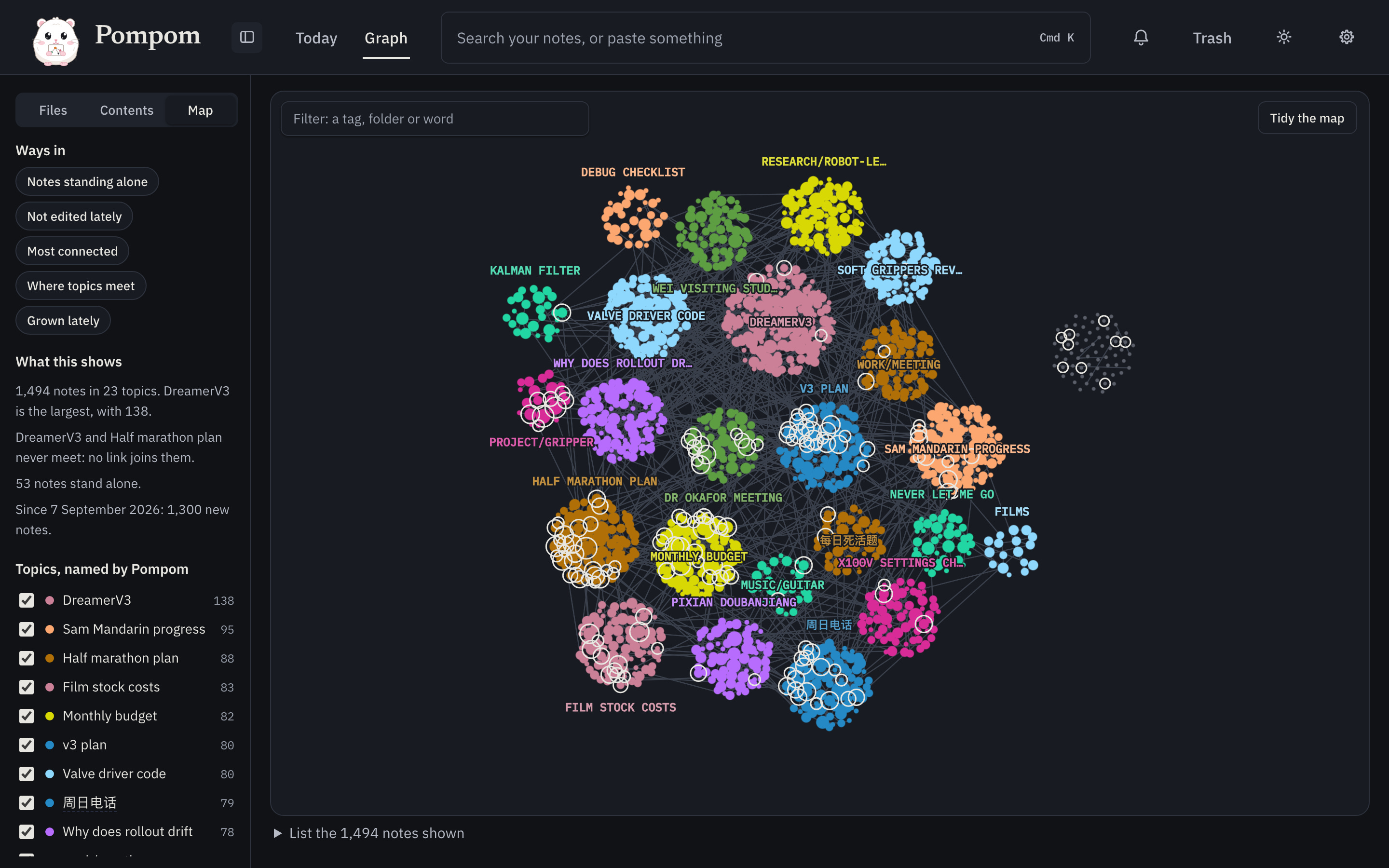
It remembers what matters, learns from your experiences, and connects what you know, helping you think, learn, and make better decisions.
Our vision is a notebook that doesn’t simply accumulate information. It develops alongside you.
A Notebook Should Do More Than Remember
Today’s note-taking tools are good at helping us capture information.
We write notes, organize documents, create links, and search for things we’ve saved. AI has made those tools more powerful by letting us ask questions about our own knowledge.
But storing information isn’t the same as learning.
Imagine you’re developing a new project.
At first, you choose one technical approach. After several weeks, you discover its limitations and switch to another. Along the way, you uncover useful ideas, solve unexpected problems, and learn which assumptions were wrong.
A conventional notebook can preserve those experiences if you document them.
But what if your notebook could help you turn them into lasting knowledge?
What if it could connect a problem you’re facing today with a lesson you learned months ago, even when the two situations appear unrelated?
And what if the AI agents working alongside you could draw on those same experiences rather than repeatedly starting from scratch?
This is where we want to take Pompom.
What Pompom Helps You Do
We’re designing Pompom around five closely connected capabilities.
Build a living memory.
Capture your ideas, experiences, and meaningful moments in a Markdown notebook that remembers what matters, connects what you know, and grows with you.
Rather than becoming an ever-expanding archive, your notebook should become a living record of your knowledge and experiences.
Learn from experience.
Everyday activities, successes, and mistakes can teach us something useful.
Pompom aims to help turn those experiences into lasting knowledge. Not simply recording what happened, but helping preserve what you’ve learned and making those lessons useful again.
Connect the dots.
Some of our most valuable insights come from discovering relationships between things we previously considered unrelated.
A research paper may illuminate a problem in another project. A conversation may challenge an old assumption. A solution developed for one task may help solve another.
Pompom is designed to help uncover those connections across your ideas, experiences, and information.
Think and decide better.
Knowledge becomes more valuable when we can put it to use.
By drawing on what you’ve learned, Pompom aims to help you gain insights, solve problems, evaluate alternatives, and make informed decisions.
The goal isn’t to replace your judgment. It’s to help you make better use of your own knowledge and experience.
Grow together with AI.
Pompom isn’t intended only for human memory.
We also want AI agents to remember, learn from experience, and continuously improve, so people and their AI can build on what they’ve learned together.
Imagine an AI assistant that can learn from corrections, remember approaches that worked, and help carry knowledge from one project into another.
That’s the kind of long-term collaboration we’re working toward.
The Learning Engine Behind Pompom
At the heart of Pompom is LEAP, short for Learning from Experience through Adaptive Plasticity.
LEAP is a broader memory and learning architecture we’re developing to explore a fundamental question:
How can experience become lasting knowledge that improves future thinking and behavior?
Consider how you learn a new skill.
At first, you follow instructions. Then you practice. You make mistakes, notice patterns, and gradually discover what works.
Over time, your experiences change how you approach similar problems.
Memory plays an essential role in that process. Without retaining something from previous experiences, learning cannot accumulate.
But remembering everything isn’t enough.
We also need to distinguish useful lessons from misleading ones, recognize when circumstances have changed, and revise what we previously believed.
LEAP explores how a memory system might do something similar.
Its central challenge is deciding what should be learned from an experience, how strongly that learning should influence existing knowledge, and when it should be reconsidered.
This matters for both personal knowledge and AI agents.
An agent that simply stores every interaction may accumulate contradictions, outdated assumptions, and irrelevant details. An agent that treats every new observation as authoritative may learn the wrong lessons.
A useful learning system needs to be selective, adaptable, and capable of correcting itself.
That’s the research direction behind LEAP.
Pompom is where we intend to bring these ideas into an everyday tool.
A Shared Memory for Humans and AI
AI is changing how we work with information.
Increasingly, we don’t just use software to organize our projects. We collaborate with AI systems that help us research, write, code, analyze, and make decisions.
But there’s still a gap between an AI that can perform a task and an AI that can build on a long history of working with you.
Consider an AI coding assistant.
You spend several days debugging a difficult problem together. You test different solutions, discover what doesn’t work, and eventually find an approach that succeeds.
A month later, you encounter a related problem.
Ideally, your assistant should be able to draw on that previous experience, including the unsuccessful approaches and the reasons they failed.
The same principle applies to research, writing, learning, and countless other activities.
We believe memory shouldn’t be an isolated feature within each AI application. It should be something that can support continuity and learning across the tools and agents we use.
Pompom is our attempt to explore a shared environment where human knowledge and AI memory can develop together.
Your experiences help build your knowledge. Your AI can help you discover connections and apply what you’ve learned. New outcomes can challenge previous conclusions, giving both of you an opportunity to improve.
The human remains at the center, with AI extending what can be remembered, connected, and learned.
Why We’re Making Pompom Open Source
Memory is personal.
A notebook may eventually contain years of ideas, experiences, research, and decisions. It can become one of the most valuable collections of knowledge a person possesses.
We believe the foundations of such a system should be open to inspection, improvement, and extension.
That’s why we’re developing Pompom as an open-source project.
We want developers to explore how it works, researchers to challenge its assumptions, and contributors to experiment with new approaches to memory and learning.
We also want LEAP to develop beyond a single application.
Pompom is its first major application, but the underlying ideas may be useful for other kinds of AI agents, personal knowledge tools, and learning systems.
There are many difficult questions ahead. How should a system determine what matters? How can it preserve uncertainty? How should it handle conflicting evidence? How can we tell whether it has actually learned something useful?
These are questions worth exploring in the open.
Robonaissance, LEAP, and Pompom
Robonaissance explores the technologies shaping the future of intelligence, particularly artificial intelligence and robotics.
Much of our work examines what machines are becoming capable of, what limitations remain, and how advances in intelligence may change the world.
Pompom brings some of those questions into something we can build and use ourselves.
Intelligence is not only about solving problems, but also about learning from experience so we can solve new problems better in the future.
That raises questions about how experiences become memories, how memories influence behavior, and how knowledge develops over time.
LEAP is our research direction for exploring those questions.
Pompom is the practical product we’re building around them.
Through this project, we hope to connect our exploration of machine intelligence with a more immediate possibility: tools that help people learn, think, and grow throughout their lives.
What’s Next
Pompom is under active development, and we’re preparing its open-source release.
We’re starting with a Markdown notebook and building toward a richer system for memory, knowledge connections, and learning from experience.
Some of our ambitions will take considerably longer to realize than others. We’re approaching the project as an ongoing process of building, experimenting, evaluating, and improving.
We’re also inviting early users to try the preview version of Pompom.
If you’re interested in personal knowledge management, AI agents, memory architectures, or the future of human-AI collaboration, we’d love for you to give Pompom a try and tell us what you think.
Your feedback, whether it’s about what works, what doesn’t, or what you’d like to see next, will help shape the project’s development.
Explore the preview at withpompom.com, give it a try, and share your feedback with us.
We already have plenty of tools that help us save information.
We’re building Pompom because we want a tool that helps us learn from it.