

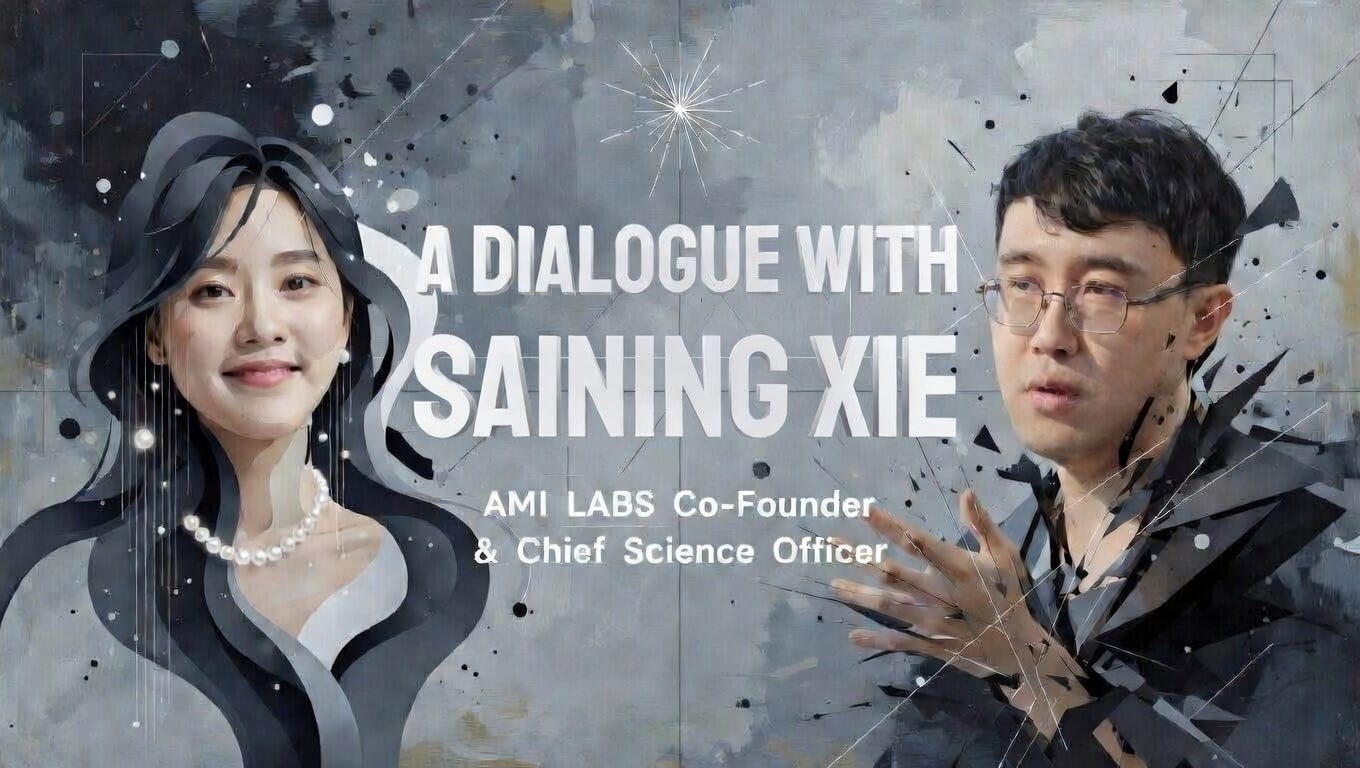
This deep-dive series explores a seven-hour interview with Saining Xie, hosted by Xiaojun Zhang in February 2026. To better convey the depth and ideas of the conversation, I have reorganized the narrative, added background context, and clarified some of the more technical points.
It was a February afternoon in Brooklyn, a few days after what would be called the Blizzard of 2026, the ninth-biggest snowstorm in Central Park’s recorded history. The streets still had snow that had not melted. In a somewhat cluttered building, an interview began at 2 PM and did not end until the early hours of the following morning. No one had expected a marathon.
Over seven hours, the conversation drifted from scaling laws to Hannah Arendt to the Diamond Sutra. Xie let it drift, but always circled back to the people who had shaped his path, insisting on finishing each portrait before moving on. “Perhaps because his original dream was to be a film director,” the interviewer noted. “That dream was shattered early on, but it has found a new form of expression here.”
Parts 1 through 3 of this series presented Xie’s technical arguments: language as poison, the Bitter Lesson revisited, the five definitions of world model. This final part tells the story behind the arguments. Not because the story validates the claims. Arguments stand or fall on their own merits. But because the path a person takes to reach a position reveals something about why they hold it with the conviction they do.
The Normal One
Xie introduces himself, repeatedly, as ordinary.
“He kept telling me he is not the chosen one,” the interviewer reports. “He is the normal one.”
His childhood in China sounds anything but strategic. A father who never left the house and read constantly, leaving walls of books that the young Xie consumed indiscriminately. A mother who traveled for business and brought him along, giving him early exposure to the size and variety of China. A first computer at age nine, used for games, not programming. Then the internet arrived, and with it forums, blogs, and the first experience of writing for an audience.
“I wrote many, many blog posts,” Xie recalls. “On all sorts of random topics. Looking back now, it would all be quite embarrassing.” He was an early user of Fanfou, the Chinese microblogging platform that predated Weibo. “You can still log in to Fanfou,” he says. “But what I wrote there is too painful to look at.”
This is not modesty for the cameras. It is a consistent feature of how Xie narrates his career. The half-hour job talk at FAIR that was supposed to last an hour, because no one told him the format. The admission that he learned to write research papers by treating them as short films: find the story, show the decisions, make the reader feel why those decisions mattered.
The Director Who Became a Scientist
The film director dream surfaces casually, almost as an aside.
“My childhood dream was to be a director,” Xie says. “That dream fell apart quickly. Very unfortunately.”
He does not elaborate on why it fell apart. But its influence runs through the interview like a structural thread. Xie chose NYU partly because of its film school, where Martin Scorsese and Chloé Zhao studied. He recommended to his students a screenwriting book by Robert McKee called Story, which argues that the essence of narrative is not a character’s background but their choices under pressure, and the consequences that follow. “Paper writing is exactly the same,” Xie says. “The technique matters. The knowledge matters. But what matters more is: how did you get here? What decisions did you make? Why were those decisions important?”
He draws the parallel explicitly: “Is this not just filmmaking?”
The connection between filmmaking and research is not decorative. It explains something about how Xie thinks about the world model problem. He is not approaching it as an engineer looking for the optimal architecture. He is approaching it as someone who wants to understand the structure of a story: what is the problem, what are the characters doing about it, where does the conflict lie, and what happens at the turning point? The interview itself is structured this way. Xie does not present a linear argument. He circles, doubles back, insists on finishing his portraits, because the people are the argument.
The People
Three figures dominate Xie’s account of his intellectual formation.
Kaiming He appears as the quiet standard against which Xie measures himself. He describes He as someone who finishes papers a full month before the deadline, then polishes while everyone else is scrambling. “When others were pulling all-nighters for the deadline, experiencing that huge rush of satisfaction, Kaiming had already finished everything a month ago. Relaxed, unhurried, perfecting his work while watching everyone else rush.” Xie spent four years at Meta FAIR working alongside He, and the influence is visible in the precision of Xie’s arguments, even when the style is more emotional. He attributes to Kaiming a piece of advice he has never managed to follow: start writing early.
Fei-Fei Li appears as the person who taught Xie how to define problems. “Her greatest achievement is not building ImageNet the dataset,” Xie says. “It is defining image classification as a clear problem. Setting that agenda was far more important than building the data.” Li’s influence is methodological: before you solve a problem, make sure you have identified the right problem. Xie describes dinners in New York where Li shared stories of her own difficult path, which he found “an enormous comfort.” Their collaboration produced work on spatial intelligence and video understanding. But the deeper influence is Li’s approach: find the north star, define the question, and then the field has a direction.
Yann LeCun appears not as a boss or a legend but as, in Xie’s telling, a 65-year-old teenager. Someone who takes selfies with everyone at conferences, who is “quite pure and warm in private,” who can be moved by evidence but not by authority. When Meta colleagues told him to stop publicly criticizing LLMs, his response was: “My integrity as a scientist cannot accept this.” Xie describes LeCun’s management style using LeCun’s own sailing metaphor: trust everyone to do their work, but when course correction is needed, do it as early as possible. LeCun sails in the Caribbean every March. But what sealed the partnership for Xie was something smaller. Xie named a research paper after a Tarkovsky film, and when he mentioned the title, LeCun immediately asked: “Do you mean the 1975 version or the 2002 version?”
“I found the right person,” Xie says of that moment. “Not just in research. In film, he seems to know more than me too.”
Turning Down Ilya Twice
The interview reveals a detail that crystallizes Xie’s intellectual trajectory: he turned down Ilya Sutskever twice.
The first time was when he chose FAIR over OpenAI as a fresh PhD graduate. At that time, FAIR was the more prestigious option for someone interested in vision and representation learning. OpenAI was doing interesting work, but for the top PhD graduates in vision, FAIR was the clearer choice. Xie received the OpenAI offer and declined without much deliberation.
The second time was in July 2024, when Sutskever had just founded SSI, his new venture after leaving OpenAI. Sutskever emailed Xie directly: would he like to come work together? Xie had just started at NYU. He spoke with Sutskever, but their discussion revealed a fundamental divergence in what each thought mattered most. Xie declined again.
The pattern is not anti-OpenAI sentiment. It is a consistent orientation: toward vision, toward representation, away from the language-first paradigm, even when the language-first paradigm was clearly winning the commercial race. Every career choice Xie describes points in the same direction. FAIR over OpenAI. NYU over industry. Representation over language. And finally, AMI Labs over everything.
The Founding Moment
The story of AMI’s founding has the quality of a scene Xie might have wanted to direct.
Bay Area friends, some investors, some entrepreneurs, had been encouraging Xie to consider starting a company. Then, around late 2025, a manager suggested he approach LeCun, who apparently had not been having the smoothest time at Meta. Xie’s first reaction was disbelief: LeCun was a godfather of AI, a pure researcher. How could you pull him into a startup?
But their next scheduled one-on-one meeting changed everything. Before Xie could say a word, LeCun spoke first.
“Saining, don’t tell anyone. But I have decided. What I want to do next, I should do outside. I want to start a company.”
Xie asked what the business model was. “And I realized: what he wanted to do was exactly what I had been thinking about.”
The timing was driven by converging pressures. Meta had gone through multiple reorganizations that shifted focus away from fundamental research. FAIR, once the premier AI research lab, had been losing researchers and direction for months. Xie had hit what he calls a “medium-paper trap” at NYU: resources too limited to turn good ideas into breakthroughs, just enough to publish work that was solid but not transformative. Both he and LeCun had reached the same conclusion independently: the next step required a different structure.
Within weeks, AMI Labs existed. Twenty-five people. Paris, New York, Montreal, Singapore. $1.03 billion. And a thesis that the entire industry was building on the wrong foundation.
The Underdog
The most surprising element of the interview is the identity Xie claims for AMI Labs.
“We are an underdog,” he says. “We are surviving under the pressure of the industry.”
This sounds absurd for a company that just raised a billion dollars. Xie acknowledges the paradox but insists on it. “We may have a large funding round. But compared to the resources LLMs are commanding, it is a tiny fraction.” He describes LeCun not as the celebrated Turing Award winner but as “someone who is not surrounded by admirers. He sticks to his beliefs and always pursues the next thing, before the last one has been proven right.”
Xie draws an analogy to the history of Visa and Mastercard. Visa was created by Bank of America, which dominated the credit card market. When smaller banks realized they could not compete individually, they formed an alliance and created Mastercard. “I am not saying our company will follow this exact model,” Xie says. “But there is a resemblance. The world model narrative is more decentralized. It naturally resists a certain kind of monopoly.”
“I very much enjoy this underdog identity,” he says. “Especially as an entrepreneur. Because being a researcher is the same. You are always looking up at the problem, knowing it is bigger than you.”
What Matters
Seven hours in, the streets of Brooklyn are dark. The blizzard’s remnants are freezing into ice. Xie is asked: what matters?
“I am always searching for balance,” he says. “I think the sincere exchange between human beings is important. Perhaps nothing else is.”
It is consistent with everything that came before. Xie did not choose his career path by optimizing for impact. He chose it by following the people who made him want to understand something deeply, and then trying to build something that would let him share that understanding.
Whether his technical arguments about language, representation, and the Bitter Lesson prove correct will be determined by experiments that have not yet been run. But the interview reveals something that the technical arguments alone do not: the person making them is not a contrarian for the sake of contrarianism. He is someone who has spent fifteen years watching the field from a specific angle, reaching a specific conclusion, and finally finding himself in a position where the conclusion can be tested at scale.
The dream of being a film director died early. But the instinct survived: find the story, show the choices, make people understand why those choices matter.
This is his story. The next chapter will be written by a team that is still growing, with a billion dollars and a bet against the field’s most successful technology.
This concludes the “Language Is Poison” series. For earlier parts: Part 1, “World Model, Not Word Model”; Part 2, “The Bitter Lesson, Revisited”; Part 3, “Everyone Is Heading to the Same Place.”