

This is Episode 2 of Memory, Forgetting, and the Self in the Machine: how intelligence reaches across time when it cannot carry the whole past with it.
In 1997 Sepp Hochreiter and Jürgen Schmidhuber published a design for a network meant to hold on to information for a long time. They called it Long Short-Term Memory. In the methods of their own experiments, they also wrote down when they made it let go. “All activations are reset to zero at the beginning of a new sequence,” one line reads. Another says, “Net activations are reset after each processed input sequence,” and one of the older methods the paper compares LSTM with was run with “no activation resets, online weight changes.” The network did not force either choice. The reset was part of the experimental protocol. It was the experimenters’ ruling on where one task ended and the next began, and it lived in the setup, not in the machine.
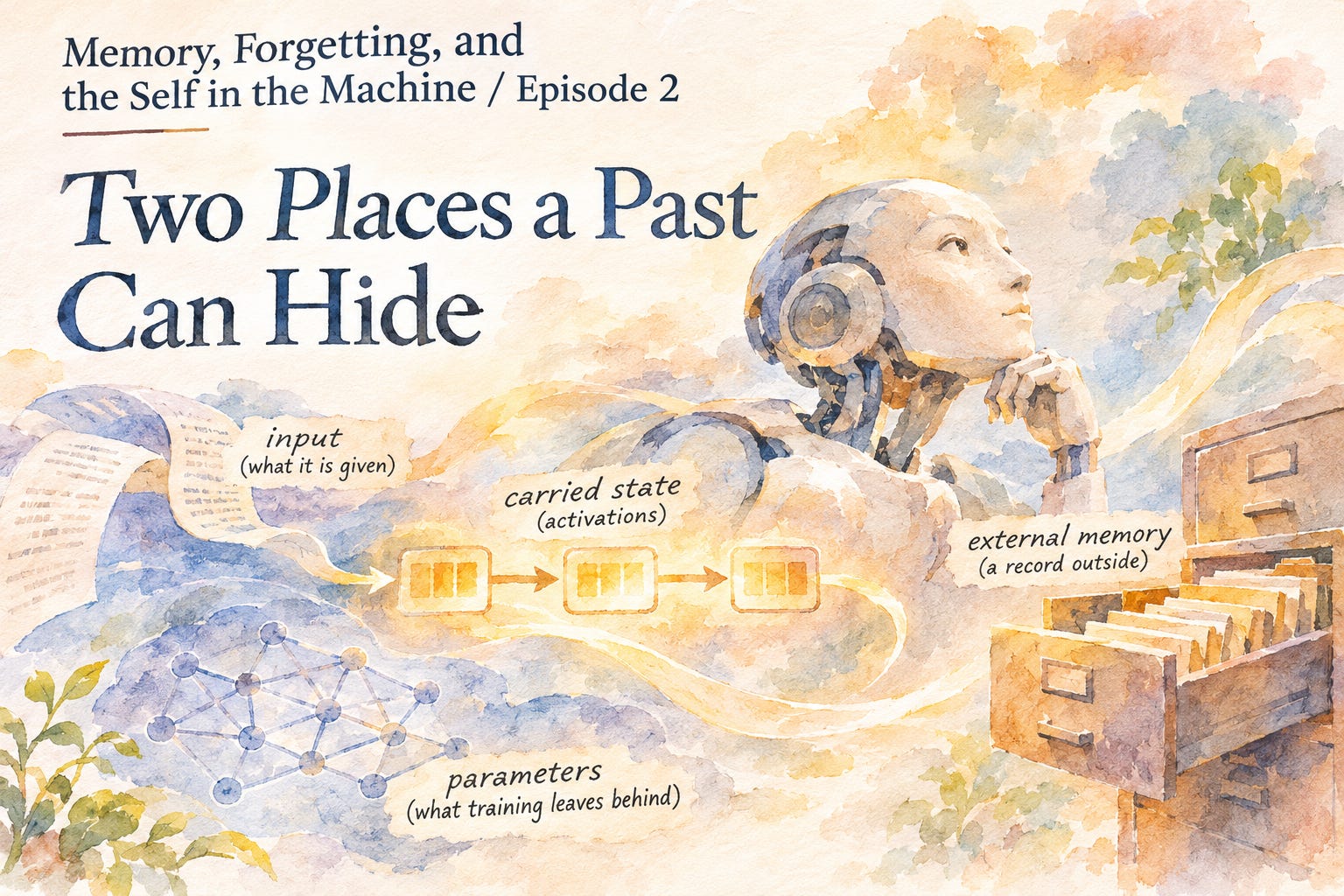
That line in a methods section points to something larger. A trained model can bring its past into a later moment in two familiar ways. The first is through its parameters, the millions of numbers that training adjusted and that shape how it responds to anything. The second is through its input, the text in front of it at the moment it answers. There are two more ways. A process can carry a state forward from one step to the next, and a system can keep a record somewhere outside itself. Both get called memory. In neither case does the past reach the next answer just because it exists. A carried state counts only while someone lets it be carried, and an outside record counts only when something reads it back in. Whoever runs the system sets the terms for both.
The numbers that travel
Hochreiter and Schmidhuber’s paper opens by naming the route it cares about: “Recurrent networks can in principle use their feedback connections to store representations of recent input events in form of activations (’short-term memory’, as opposed to ‘long-term memory’ embodied by slowly changing weights).”
Here is what that means in plain terms. A recurrent network reads its input one piece at a time. At each step it computes a fresh set of internal numbers, its activations, from two things: the new piece of input and the activations it had a moment earlier. The numbers it passes along are its carried state. This is the difference between a system that answers from the present input alone and one that answers from the present input together with a summary of what came before. Give the second kind the same input twice with different states behind it, and it can respond differently. That difference is the past arriving.
The paper uses “memory” in two senses at once. “Short-term memory” is the activations, which change at every step. “Long-term memory” is the weights, which change slowly during training. LSTM was designed so that the activations could keep something useful across long stretches of a sequence. Whatever the network kept, it did not decide when the state ended. The protocol decided that. At the reset the weights stayed as they were, so the network kept everything training had taught it and lost only the trail of what it had just read.
The paper’s lines on the reset state the practice, not a reason for it. Our reading is this. A carried state shapes later steps only for as long as it is kept, and the one who runs the system chooses when to clear it. This is a fact about the state, not a flaw in it. A state that is never cleared lets yesterday’s sequence leak into today’s. A state that is always cleared makes every sequence the first one. Neither is correct in general. The choice belongs to whoever defines what counts as one task.
