

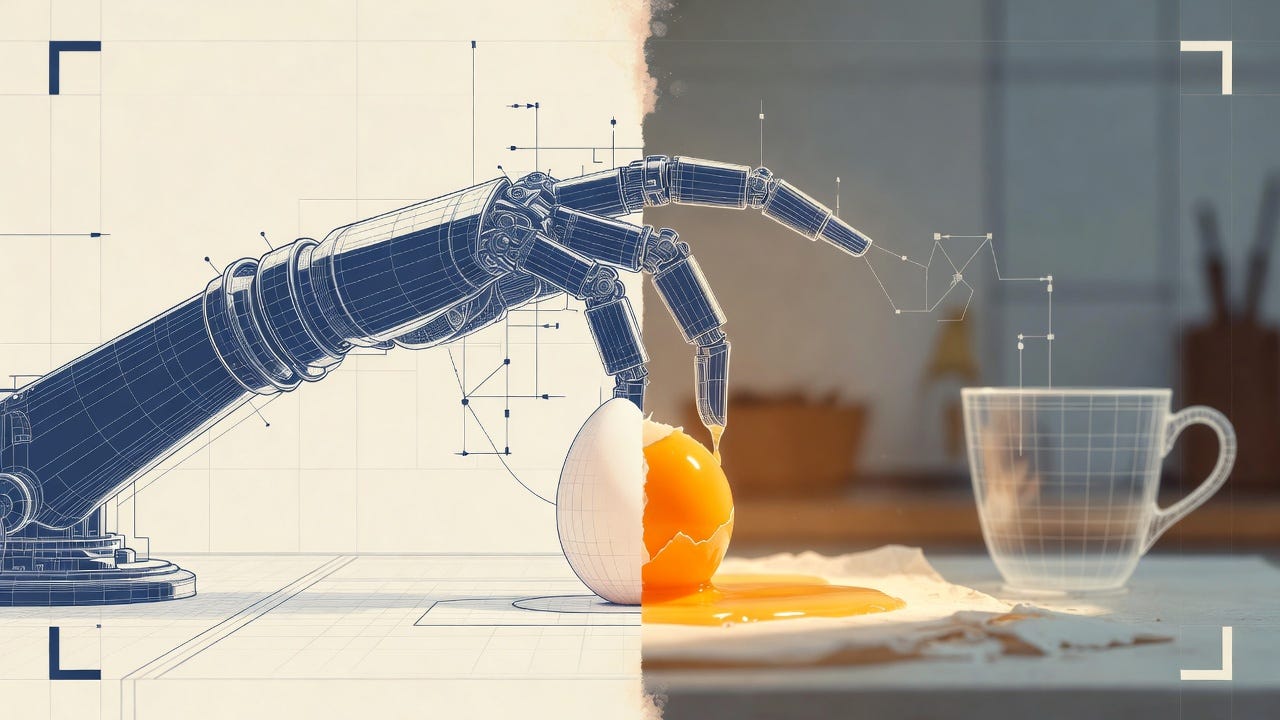
The egg does not break.
That is the thing you notice in every robotics demo. The robot reaches across the counter, its fingers close around the egg with something that looks like care, and it does not break. The crowd exhales. The video ends. The company posts it online, and for a day or two, the comment sections fill with people writing some variation of the same sentence: the future is here.
The egg never breaks in the demo. In your kitchen, with your countertop, your eggs, your specific and unrepeatable clutter, the story would be different.
On March 12, 2026, a robotics startup called Sunday announced a $165 million funding round. Coatue led the round. Tiger Global, Benchmark, and Fidelity joined. The valuation reached $1.15 billion. The announcement contained a sentence that read like a statement of strategy but functions, if you look at it carefully, as an admission: “We raised our Series B to stop giving demos.”
The CEO, Tony Zhao, built some of the most influential robot learning research of the past decade at Stanford. He knows what demos are and what they are not. He is now betting $165 million that the industry can cross from one to the other. This is the bet every serious robotics company is making in 2026. It is the right bet. It is also the hardest bet in technology.
The Demo as a Genre
The robotics demo has become its own art form, with conventions as recognizable as a sonata.
It opens on a clean surface. The objects are arranged with care. The lighting is even. The robot approaches, pauses, moves with deliberate precision. It completes the task. Someone in the background says “wow” or the equivalent. The video is cut to exclude the twelve attempts that came before.
This is not dishonesty. Within the current structure of the technology, building toward peak performance under specific conditions is the only way to show that progress has been made. If you cannot do the task perfectly in a controlled environment, you cannot do it anywhere. The demo is a necessary intermediate step.
The problem is that it has become a substitute for deployment rather than a step toward it. Companies have discovered that a good demo raises capital, generates press, and attracts engineers as effectively as a deployed product. The incentive to build demos has separated from the incentive to build things that actually work in the world. Demos beget demos.
The companies that funded Sunday have seen this cycle. Thomas Laffont of Coatue put it plainly in the announcement: what matters is not the last demo but the velocity toward real deployment. Sunday has set a target of shipping to actual homes before Thanksgiving. That target will expose, in a few months, whether the gap between demo and deployment can be closed with $165 million and the best robot learning team Stanford has produced.
The Gap Has a Number
Ken Goldberg has spent more than thirty years at the intersection of robotics and mathematics at UC Berkeley. In August 2025, he published a paper in Science Robotics that put a precise figure on the central problem in the field.
The large language models that power ChatGPT and its successors were trained on roughly 100,000 years’ worth of text and images: every book, every webpage, every photograph that could be scraped from the internet, converted to tokens, and fed into a neural network. The sheer volume of that data is what allowed language models to generalize across topics, languages, tones, and contexts in ways that seemed almost magical when they appeared.
Robot manipulation data does not exist at anywhere near that scale. The amount of data collected by all robot learning labs combined, as of 2025, represents something closer to a few years of robot experience: limited environments, limited objects, limited tasks. The gap between what language models have seen and what robots have seen is, by Goldberg’s calculation, on the order of 100,000 years.
This is not a gap that can be closed by working harder or raising more money. It is a structural asymmetry. Text and images are cheap to collect. Physical manipulation data requires a robot, in a real environment, performing a real task, with sensors recording every joint angle and force measurement. You cannot download physical reality from the internet.
The consequences are specific. A robot trained to fold a t-shirt in a Stanford lab, with Stanford’s folding table and Stanford’s exact t-shirts, may fail entirely when presented with a different table, a different t-shirt, or a kitchen that happens to have an unusual amount of counter clutter. The manipulation policy has not learned to fold laundry. It has learned to fold that specific configuration of objects in that specific setting. Generalization, the ability to transfer skills to new situations, remains the fundamental unsolved problem.
This is what makes “no more demos” harder than it sounds. Stopping demos means shipping to a thousand homes with a thousand different floor plans, a thousand different lighting conditions, a thousand different ways people leave their kitchens at the end of the day. Every one of those variations is a distribution shift the robot has never seen.
The obvious response is simulation. If real manipulation data is expensive to collect, generate synthetic data in virtual environments: render a million kitchens, run a million virtual grasps, train on the output. This is exactly how robotics solved locomotion. Boston Dynamics and Unitree train walking and jumping behaviors in simulation because the physics of balance and contact forces can be approximated well enough that skills transfer to the real world. For mobile navigation, simulation works. For dexterous manipulation, it largely does not. The reason is contact. Grasping a raw egg requires modeling the precise deformation of the shell under finger pressure, the microscopic friction between skin and calcium carbonate, the shifting center of mass as the robot lifts. Current physics engines cannot reproduce these interactions with sufficient fidelity. Policies trained in simulation on manipulation tasks tend to fail at the boundary where the robot meets the object, which is precisely the boundary that matters. The 100,000-year gap cannot be simulated away.
What the Numbers Say
In February 2026, Epoch AI published the most rigorous public assessment of where autonomous robots actually stand. The researchers evaluated robot performance on fourteen specific tasks across three domains: industrial work, household tasks, and navigation.
The results divide cleanly.
Navigation is commercially deployed at scale. Delivery robots operate on college campuses and in some urban neighborhoods. Warehouse transport has been automated across major fulfillment centers. These systems work because navigation is, in a precise sense, forgiving. A small error in position can be corrected before it causes failure. The environment can be mapped in advance. The robot does not have to touch anything fragile.
Manipulation is not commercially deployed. The closest thing to an exception is warehouse picking: robots that sort packages in a controlled environment, handling thousands of object types reliably. This works because the environment is stable and can be designed around the robot. Odd objects can be excluded. Lighting can be optimized. The physical world is engineered to match what the robot knows.
Move outside that envelope and the picture changes. Of the six household tasks Epoch AI assessed, cooking was classified as early research stage. Cleaning a kitchen was classified as having significant limits even in lab conditions. Folding laundry was the most optimistic result, classified as validated in lab, meaning scientists have demonstrated the capability under controlled conditions, but commercial deployment could only be considered.
The Epoch AI report identifies the core constraint: a 95 percent success rate in a lab translates to fifty failures per thousand picks daily in a production environment. Industrial customers require 95 to 99 percent uptime. The math does not close.
Waymo’s Decade
There is a comparison that people in robotics make quietly and companies in robotics avoid making publicly. It is the comparison to self-driving cars.
In 2009, Google launched the project that became Waymo. The technology demonstrably worked. The cars drove hundreds of thousands of miles. The demonstrations were impressive. Progress was real.
Commercial robotaxi service in San Francisco began in 2023. That is fourteen years from impressive demo to paying passengers in one city.
Fourteen years is not a failure. It is an accurate account of what crossing from demonstration to reliable deployment requires. Every edge case has to be discovered, usually by being encountered. Every failure mode has to be characterized, usually by occurring. The data that makes a system reliable comes from operating in the real world, which means that reliability can only be built through the deployment it is supposed to precede.
Waymo worked for a decade in the gap between demos and deployment. What came out the other end is a real product. What went in was an enormous and sustained engineering effort that no demo could substitute for.
Sunday’s robot Memo is wheeled, not bipedal, which is an important choice. Wheeled platforms fail in fewer ways than walking ones. The manipulation arms are designed for household objects, not the full range of industrial tasks. The company’s founders developed diffusion policy at Stanford, one of the most effective techniques currently known for teaching robots to learn from human demonstrations. The Skill Capture Glove they built to collect training data costs $200 and has collected around 10 million movement episodes across more than 500 homes. The approach is serious.
It is still going into the fourteen-year gap.
The Data Flywheel
Here is what makes the bet coherent, even if it cannot be won by Thanksgiving.
Goldberg’s 100,000-year gap is not a fixed ceiling. It is the current state of the data available to train robot policies. The gap can be closed, in principle, the same way it was closed for language: by accumulating more data. The mechanism is deployment.
A robot in a real home, making real mistakes, collecting real sensor data, is generating the kind of information that lab experiments cannot. Every novel object it encounters, every surface it misjudges, every task it fails and recovers from, adds to a dataset that makes the next version more capable. The robot learns from being out in the world in a way it cannot learn from staying in the lab.
Sunday calls this the data flywheel. It is not a novel concept, but it is the correct concept. Waymo’s cars are better than they were in 2009 because they have driven billions of miles in real conditions. Ambi Robotics’ package-sorting systems have sorted more than 100 million real packages and accumulated 22 years of robot operating data over four years of commercial deployment. The data came from doing the thing, not from demonstrating it.
The logic of stopping demos is exactly this: demos do not generate the data that improves the robot. Only deployment does. The $165 million is not a claim that the problem is solved. It is a bet that you can get into the gap early enough that the flywheel starts before the competitors’ flywheels do.
Moravec’s Paradox
Hans Moravec was a roboticist at Carnegie Mellon who noticed, in the 1980s, something that became known as Moravec’s Paradox. The things that computers found hardest were the things humans found easiest. Playing chess was tractable. Picking up a chess piece was not.
The paradox survives into 2026 in full force. A language model can write a poem, explain a legal contract, and debug a Python script. It cannot pick up a wine glass without knowing in precise three-dimensional detail where the glass is, how its surface will respond to grip pressure, and how the arm must move to avoid knocking over the water bottle next to it.
The reason is evolutionary. Language is recent. Human dexterity took hundreds of millions of years to evolve. The brain regions that handle manipulation are ancient, deeply optimized, and almost entirely unconscious. We have no good record of how to do what we do when we pick things up, because the record was never written in language. It is encoded in reflex arcs and motor programs that run below conscious access.
There is no internet of physical manipulation to scrape. That data has to be made, one gripper at a time, in contact with the actual world.
Sunday’s $200 glove is an attempt to start writing that record. Every household task a human performs while wearing it is a lesson the robot can learn from. The question is whether enough lessons can be accumulated quickly enough to make Memo useful before the capital runs out.
The Shape of the Bet
What “no more demos” actually requires is not a company announcement. It is a theory of how the data gap closes fast enough to produce a product people want to pay for, before the money runs out and the next round of funding requires proof of the thing that is still being built.
The companies that will survive the transition from demo to deployment are the ones that find environments constrained enough to work reliably, but useful enough that customers pay for them, and then use those constrained deployments to generate data for the next, slightly less constrained environment. Waymo started with freeways, moved to mapped urban grids, expanded to new cities. The envelope grows from the inside out.
For home robots, the equivalent might be: start with tasks that have low failure costs and high repetition rates. Loading the dishwasher is more forgiving than cooking eggs. Picking up laundry from the floor is more forgiving than folding it. The first version of Memo is probably not the robot that makes your breakfast. It is the robot that, while you are asleep, moves your shoes from the hallway to the closet a hundred times, and gets better at it each time.
That is a less exciting demo. It is also the thing that has to happen before the exciting demos become real products.
The egg will break. It will break in ways that were not anticipated. The data from each break, stored and learned from, is what eventually builds the robot that does not break the egg when you are not watching, in a kitchen it has never seen, on a morning when you have already left for work.
That robot does not exist yet. The bet is that it can be built. The deadline is Thanksgiving.
Sunday’s Series B announcement was made March 12, 2026. Ken Goldberg’s paper, “Good old-fashioned engineering can close the 100,000-year data gap in robotics,” was published in Science Robotics on August 27, 2025. The Epoch AI report “Where Autonomy Works: Evaluating Robot Capabilities in 2026” was published February 10, 2026.
Awesome article, but the Hype machine will always roar i guess.