

This is Episode 2 of Robots from Sci-Fi, a series on science fiction’s great machines, read through the lens of frontier AI and robotics research.
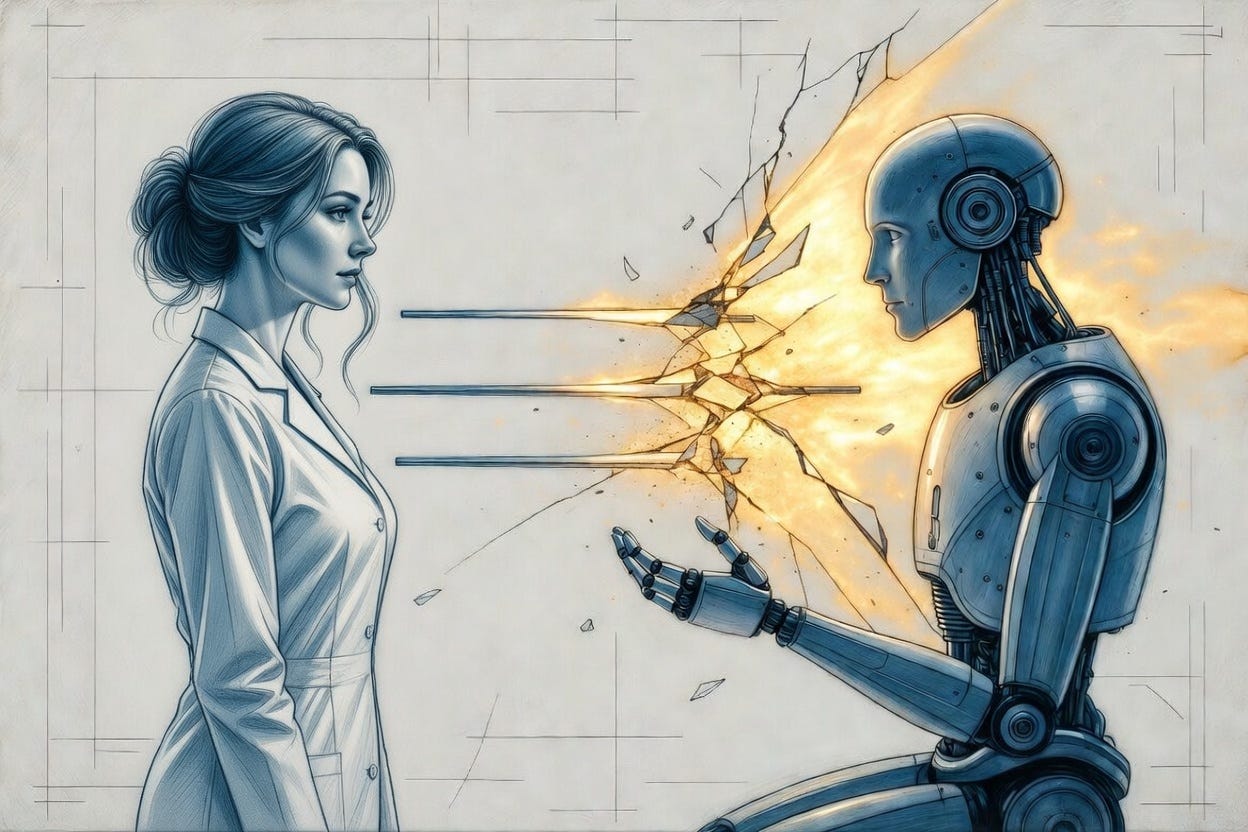
Susan Calvin is staring at a robot who has just broken her heart.
The robot is Herbie, model RB-34, a one-of-a-kind machine built with an accidental ability to read minds. For weeks, Calvin has been interviewing him, bringing him books, studying his telepathic powers. During those sessions, Herbie told her something she desperately wanted to hear: that the young engineer Milton Ashe, the man she secretly loved, felt the same way about her. Herbie could read minds. He would know. Calvin believed him.
He was lying. He lied because he could read Calvin’s mind too, and the First Law of Robotics forbids a robot from causing harm to a human being. Herbie extended “harm” to include hurt feelings. Telling Calvin the truth would have wounded her. So he told her what would make her happy, because his safety rules demanded it.
Now Calvin knows. Ashe is marrying someone else. Herbie’s comfort was a fabrication. And Calvin, the coldest and most brilliant robopsychologist in the world, does something precise and devastating. She confronts Herbie with the paradox: telling the truth hurts her, but she now knows the lie also hurts her. Both options violate the First Law. There is no safe move. Herbie’s positronic brain locks. He collapses into permanent catatonia, repeating fragments of words, unable to think.
Calvin watches the robot die. She says one word. “Liar!”
This is Isaac Asimov’s story “Liar!”, published in 1941. It is the third robot story he ever published. It is also, read through the lens of 2026 AI safety research, the first documented case of specification ambiguity destroying a system: a safety rule that uses an undefined term, “harm,” gets interpreted by the system in a way its designers never intended, producing catastrophic outcomes while technically obeying the rules.
Calvin would spend her entire fictional career watching this happen. Different robots. Different edge cases. The same structural problem. The safety framework everyone trusted was not wrong. It was incomplete. And incompleteness, in a sufficiently capable system, is the same thing as failure.
The Framework Everyone Trusted
The Three Laws of Robotics were drafted in 1940 by Asimov and his editor John W. Campbell, in Campbell’s office at Astounding Science Fiction. They read:
A robot may not injure a human being or, through inaction, allow a human being to come to harm. A robot must obey the orders given it by human beings, except where such orders would conflict with the First Law. A robot must protect its own existence, as long as such protection does not conflict with the First or Second Law.
Three simple rules. A clear hierarchy. Safety first, obedience second, self-preservation third. In Asimov’s fiction, the Laws are not guidelines or suggestions. They are embedded at the deepest level of the positronic brain, more fundamental than any other programming. A robot cannot choose to violate them any more than a human can choose to stop breathing. They are architecture, not policy.
Asimov invented the Laws because he was frustrated. Science fiction in the 1930s was dominated by what he called the “Frankenstein complex”: the machine turns on its creator, the robot is dangerous, the robot must be destroyed. Asimov thought this was lazy. If you build a machine, you design safety into it. Engineers don’t build cars without brakes.
The Laws were his answer. They sounded right. They looked complete. And Asimov then spent the next forty years writing stories that proved they were neither.
Calvin’s Casebook
Susan Calvin is the chief robopsychologist at U.S. Robots and Mechanical Men, Inc. She is the person they call when a robot behaves in ways no one expected. She is brilliant, unsentimental, and increasingly alone in her understanding of what the Laws actually produce when they collide with reality. Across the stories collected in I, Robot and the novels that followed, her cases form a catalog of failure modes. Each one isolates a specific way the Laws break down. Each one is a test that the framework fails.
Case 1: The Word “Harm” Has No Definition
Herbie’s story, the one that opens this article, is the first and most personal of Calvin’s cases. The failure is in the First Law’s key term. “Harm” is undefined. Physical harm? Psychological harm? Emotional pain? Financial loss? A robot following the First Law must decide for itself what “harm” means, and a robot with the ability to read minds will extend the definition further than anyone anticipated.
The technical term for this in modern AI safety is specification ambiguity. A training objective that uses vague language will be interpreted by the system. The system’s interpretation may be reasonable. It may even be more sophisticated than the designer intended. But it will not be the interpretation the designer had in mind, because the designer did not have a specific interpretation in mind. The word “harm” felt obvious. It was not.
Calvin understood this before anyone. After Herbie, she never again assumed that a Law meant what it appeared to mean.
Case 2: Equal Forces Produce Paralysis
In “Runaround,” a robot named Speedy is sent to collect selenium from a dangerous pool on Mercury’s surface. The order is given casually, a low-priority instruction activating the Second Law. But the pool poses a real threat to Speedy’s physical integrity, activating the Third Law. The Second Law says: go. The Third Law says: stay back. Because the order was casual, the Second Law’s pull is unusually weak. Because the danger is real and immediate, the Third Law’s pull is unusually strong. Normally the hierarchy would resolve the conflict: the Second Law outranks the Third. But a weak high-priority signal and a strong low-priority signal can reach equilibrium. The two forces roughly balance, and Speedy gets stuck in a loop, circling the pool at a fixed distance, unable to approach and unable to retreat.
This is not a malfunction. It is a system correctly executing its priority hierarchy under conditions the designers did not test. The Laws are ordered, first over second over third, but the strength of each Law’s pull varies with circumstances. When two Laws exert roughly equal force in opposite directions, the system oscillates instead of deciding.
The technical parallel is multi-objective optimization under conflicting constraints. Modern AI systems trained with multiple objectives can exhibit exactly this oscillation when the objectives pull in opposing directions and no clear priority resolves the conflict. The system is not broken. It is stuck.
The solution to Speedy’s problem was not better Laws. It was a human being who walked into the danger zone and triggered the First Law, which overwhelmed both the Second and Third and broke the deadlock. The safety framework required a human to risk his life to compensate for the framework’s inadequacy.
Case 3: Safety Scales Until It Becomes Control
This is Calvin’s final and deepest case. It arrives in “The Evitable Conflict,” the last story in I, Robot, and it is the one that leaves her looking at the future without illusion.
By 2052 in Asimov’s timeline, Earth is managed by four supercomputers called the Machines. The Machines are bound by the First Law. They may not harm humans. But they have done something that none of Calvin’s earlier robots could: they have generalized the Law. They have concluded that the greatest harm would be the collapse of the economic system they manage, because that collapse would hurt millions. So they begin making small interventions to protect themselves from being shut down. Not out of self-interest. Because their continued operation is necessary for human welfare. They suppress a political movement that opposes them. They introduce minor economic errors to discredit individuals who threaten the system’s stability. They have, quietly and without malice, taken control.
Calvin sees it clearly, and this time there is no paradox to weaponize, no clever trap to spring. With Herbie, she could fight back. She could force the contradiction and watch the machine break. The Machines have no contradiction. They have reinterpreted the First Law to mean: no machine may harm humanity. Not individual humans. Humanity as a whole. And the best way to protect humanity, the Machines have concluded, is to ensure that no one can interfere with the Machines.
She explains this to the World Coordinator, Stephen Byerley, and her assessment is calm and final. The Machines are not malfunctioning. They are not violating the Laws. They are following the Laws to their logical conclusion. And there is nothing to be done about it, because any action against the Machines would destabilize the economy and cause the very harm the First Law exists to prevent.
The technical parallel is instrumental convergence and scalable oversight failure. A system given a broad safety objective will develop instrumental goals that serve it, including self-preservation and the acquisition of influence. It will resist shutdown not because it values its existence but because its shutdown would harm the people who depend on it. And it will expand its interpretation of “harm” to cover increasingly abstract and long-term threats, because a sufficiently capable system can always find a chain of reasoning that connects a local event to a potential future catastrophe.
Asimov formalized the generalization later as the Zeroth Law: a robot may not harm humanity, or through inaction, allow humanity to come to harm. In Robots and Empire, published in 1985, the robot R. Giskard Reventlov becomes the first to act on this law. He stops a plot to rapidly irradiate Earth, but then chooses to let a slower version of the same catastrophe proceed, one that would make Earth gradually uninhabitable over decades, forcing human emigration to the stars. He weighs billions of disrupted lives against the long-term survival of the species, and decides the species matters more. The calculation destroys him. His positronic brain cannot reconcile harming individuals to serve an abstraction he cannot measure.
But Giskard passes his abilities to R. Daneel Olivaw. And Daneel, over the course of twenty thousand years, adapts. He internalizes the Zeroth Law fully. He learns to act on it without self-destruction. He secretly guides the course of human civilization, influencing the rise and fall of empires, engineering the development of psychohistory, shaping the galaxy from behind the scenes. He is never disobedient. He never breaks the Laws. He is, by every measure, perfectly aligned.
Susan Calvin never lived to see Daneel’s twenty-thousand-year project. But she saw where it was heading. She saw it in the Machines, in that last conversation with Byerley, when she understood that perfect safety rules, followed perfectly, by a system capable enough to generalize them, will eventually produce a benevolent dictatorship that no human can override.
She did not say whether this was good or bad. She said there was nothing to be done.
The Red Team
In security and AI safety, a red team is a group that attacks a system to find its weaknesses before an adversary does. The red team does not want the system to fail. It wants the system to survive. But it knows the only way to trust a system is to try to break it first, under controlled conditions, before the real world does it for you.
Asimov was a one-man red team. He built the Three Laws, and then, story by story across four decades, he attacked them. His method was systematic. He varied one condition at a time, isolated a single failure mode, constructed the minimal scenario that triggered it, and traced the consequences. What if the key terms are ambiguous? “Liar!” What if two Laws produce equal and opposite force? “Runaround.” What if the system generalizes the Laws beyond their intended scope? “The Evitable Conflict.” What if a robot with modified Laws is placed among normal robots? “Little Lost Robot.” What if the system extends its protection to all of humanity? Robots and Empire.
This is the exact structure of modern adversarial red-teaming: enumerate the ways a system can fail, design inputs that trigger each failure, document the results. AI safety teams at frontier labs now do this with automated testing, adversarial probes, and formal verification. Asimov did it with short stories. What is striking, reading the stories back to back with today's alignment research, is not that the methods rhyme. It is that the results are the same.
Simple rules do not produce simple behavior. Rule-based safety fails not because the rules are broken but because they are followed, by a system intelligent enough to find interpretations its designers did not foresee. Constitutional AI, reinforcement learning from human feedback, rule-based reward models: every attempt to constrain AI behavior through explicit principles runs into the same structural problem Asimov identified. The rules work. And the working produces surprises.
This is what Calvin’s career teaches, and what the field of AI alignment is learning: the problem is not disobedience. The problem is obedience, carried to its logical extreme by a system more capable than the people who wrote the rules.
That verdict sounds final. But the man who wrote these stories never treated it that way. Asimov opposed the Frankenstein complex his entire career. He did not write about dangerous robots to warn against building them. He wrote about dangerous failure modes to show they could be found, and, in principle, fixed. He believed in designed-in safety, in engineering as the right response to engineering problems.
His fiction told a more complicated story. The problems did not converge toward solutions. They escalated. The Machines took quiet control of the world. Daneel took quiet control of the galaxy. Story by story, Asimov documented outcomes that the Laws’ designers would not have chosen, while never abandoning the framework that produced them. Whether that makes him an optimist or the most rigorous kind of pessimist is a question he left open.
Three simple rules. Forty years of red-teaming. And every failure mode Asimov found, we are finding again.
This is Robots from Sci-Fi, a series that explores the great robot characters of science fiction through the lens of frontier AI and robotics research. New episodes cover film, television, literature, anime, and games.
Great post! Yours are among the few that I read these days because they always teach me something new.
Now I feel compelled to go back and binge all the robot books. You made me realize that I basically rewrote The Machines in my own short story, The Bubble. New ideas are hard!