


This is Episode 11 of Reading the Frontier, a series of close readings of what the frontier labs publish.
On 4 May 2026, Jack Clark put a number on the day the last human leaves the loop, in his Import AI newsletter, and he said he came to it reluctantly. The odds that an AI system powerful enough to build its own successor, with no human involved, would exist by the end of 2028: 60% or better. For 2027 he gave 30%, and he said what held it down. AI research might need “creativity and heterodox insights”, and so far the systems had not shown that in any major way.
Five weeks later, on 8 June, he wrote again. He had spent the last few months at Anthropic collecting evidence for a smaller version of the same idea, a compounding speedup in the productivity of the labs themselves, and he thought it had already started. Then he asked his own question. “Is any of this conclusive? No.”
On 15 September, in an interview with NPR, Clark said it plainly: “We don’t have a third party that can validate what we’re saying.”
Two days later, on 17 September, Anthropic published a count. Marina Favaro and Phillie Wright wrote it, and Clark is credited with the research direction. As of August 2026, by the lab’s own count, Claude leads 26% of Anthropic’s AI research and development work, up from under 1% in February. No measured kind of that work runs without a person.
The page counts where the people still stand
Anthropic’s page gives Clark’s event a name, recursive self-improvement: a model fully autonomously building its successor. It gives the count as its reason, to show how close the world is to that. Under the number sits a plainer question. Who is the last human in the loop, and what are they still doing?
Epoch AI’s scale answers in six rungs, each defined by the person’s part, and Figure 1 lists all six. Four show the pattern; the other two, not used and assists, sit among the lower rungs. At marginal, AI helps with lookups and polishing. At collaborates, it does large chunks while the person makes the calls. At leads, it completes most of a task from a high-level ask, and the person supervises, course-corrects and approves. At autonomous, the AI works fully on its own, with no human in the loop. How fast progress is going is a different question. The count itself is Anthropic’s own, of its own staff, on the kinds of work they did in July 2026, rating how that work usually gets done rather than what Claude could do.
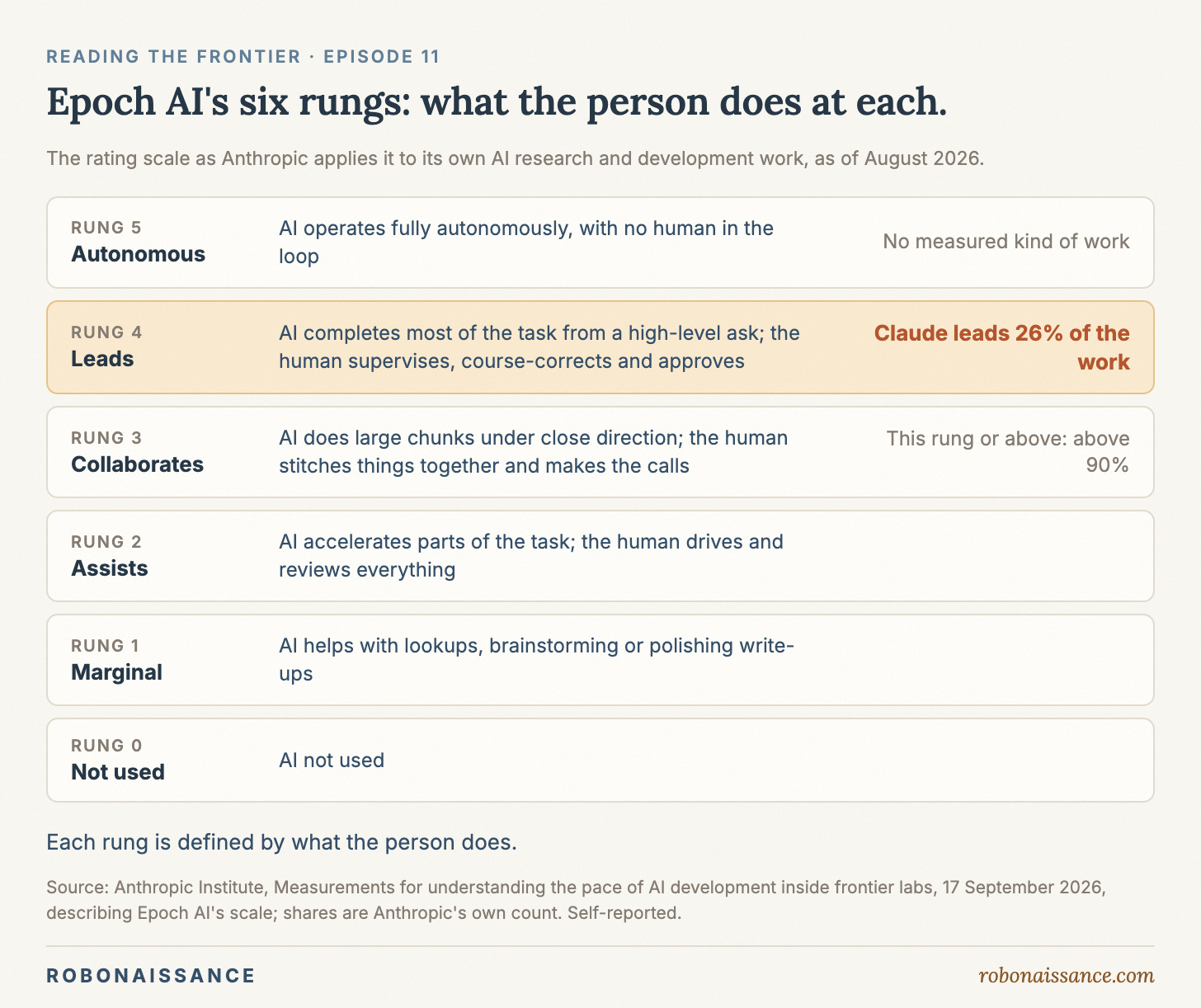
Epoch AI’s six-level automation scale as Anthropic applies it, with the person’s part at each level. The shares are Anthropic’s own count, as of August 2026, of its AI research and development work weighted by July person-time. Leads is the fourth rung; as of August 2026 the lab reports no measured kind of work at the fifth, fully autonomous.
Claude took the count, one person-week at a time
Who took the count? Claude did.
The tallying behind that number was Claude’s work, not a person’s. For every week of July 2026, a random fifth of the staff in each department that makes up the model research loop was picked, and a Claude agent went through each of those people’s weeks. It read their Slack messages and internal documents and wrote down what each person had worked on.
Take one person and one week. That person gets one unit of weight, split evenly across their tasks. Four tasks, a quarter of a unit each. Ten tasks, a tenth each. A crude approximation, by the page’s own description, and one that behaves sensibly on average, because the categories that many people work on collect the most weight.
Now add everyone. Every sampled person in every week of July, run through the same reading, came to a flat list of about 15,000 granular tasks.
Then the tasks went into a tree. It has 542 nodes at different depths, and 378 of them are leaves, the finest grain. The tree was frozen, so every month’s rating is made against the same basket of work. The leaves read like a week in a research lab: eval platform defect diagnosis and fixes. RL sandbox egress and network policy. Serving incident postmortems.
Each node then gets a rating. A Claude agent researches how that kind of work is done across the company, who does it, with what tools and how much of it AI performs, and an independent Claude judge reads the evidence and picks one of six levels. For any month, the agents may see evidence from that month or earlier.
The page words the leads rung as what Claude can do, but the ratings follow the scale authors’ rule at Epoch: they describe how a task “typically gets done” at a frontier lab, not what would be possible with maximum effort.
One hypothetical from the lab’s page makes the rungs concrete. A nightly data pipeline breaks and has to be fixed before tomorrow’s run. At collaborates, the engineer brings Claude the logs, maybe with a guess already, and when a new problem turns up Claude stops and the engineer decides whether to patch around it or fix it properly. Once the tests pass, the engineer might read the change line by line, rerun the pipeline and deploy it. At leads, the engineer hands over the failure alert and Claude does the rest. It finds the failing stage and its cause, writes and tests the fix, reruns the pipeline on a copy of the data, compares the output against the last good run and writes up what went wrong. Claude does not deploy. It tags the engineer, who reads the write-up, skims the change, maybe asks a few questions, and decides whether it ships tonight or waits. At the rung above, a level not yet reached, Claude would be trusted to monitor, fix and deploy, and a human would be involved only if they wanted to be.
How firm is a rating like that? The staff who own each area of work rated their own areas, without seeing what the judge had seen. The judge agreed with a person on the exact level 59% of the time, and people agreed with each other 35% of the time. Judge and people were within one level of each other 97% of the time. The sample is not described, and the weak spot is named in the lab’s own words: “real room for disagreement on borderline cases”, such as where collaborates ends and leads begins. A rating that tips from collaborates to leads moves the 26%.
Figure 2 draws the lab’s monthly readings, from under 1% in February to 26% in August, rated each month on the same basket of July work. The lab also reports that the share of work at collaborates or above is above 90%.
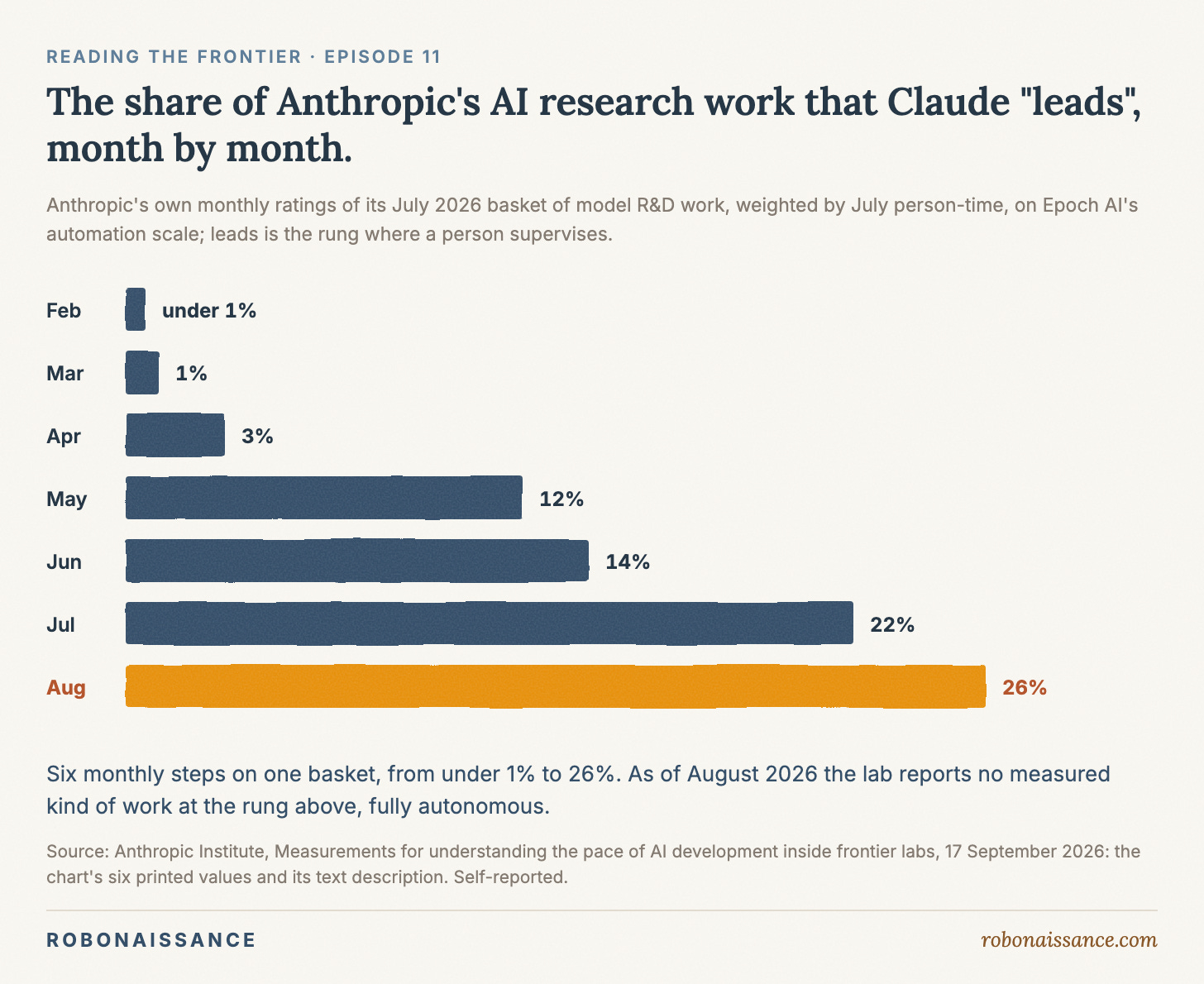
Anthropic’s own ratings, assigned monthly by a Claude judge on Epoch AI’s six-level automation scale to a basket of the lab’s July 2026 model R&D work, weighted by July person-time. The February value is the chart’s own description (under 1%); March to August are its printed labels. Anthropic’s chart also shows 90% measurement intervals and the other automation levels; neither is redrawn here. Leads is the scale’s fourth rung, where a person supervises; as of August 2026 the lab reports no measured kind of work at the fifth.
So the count is a week, a tree, a judge and a border. The result is one number for the whole lab, published with no breakdown by kind of work, so it cannot say which tasks sit inside the 26%.
Epoch rated deciding low and writing code high
In May, Clark drew a line between two kinds of work. AI can today automate vast swathes of AI engineering, perhaps all of it, he wrote, and it is not yet clear how much of AI research it can automate.
Epoch’s authors also sorted a lab’s work into kinds, and the first is deciding: what to work on, what to continue, where to put the compute. Epoch’s own illustrative ratings, which they call best-guess starting points, put deciding what to ship and setting the team direction at 1, marginal help, and writing research code at 4, the rung called leads. Where the 26% falls between those two ends is the question the total cannot answer.
The days described at the lab point the same way. According to a post Clark co-wrote, Claude shipped more than 800 fixes in April that cut a class of API errors by a factor of a thousand, work the overseeing engineer estimated would have taken a human four years, and one staff member had not written code in about five months. Another wrote that on days when everything works, nothing they do seems to matter, and on days when everything breaks, “I have no idea what I’ve been up to anymore.”
The lab’s August risk report gives its reason for the remaining human steps in one word: trust. Researchers could use very large amounts of AI labour on valuable work, and they choose moderate amounts, because some steps are ones they do not trust the models to get right. The report draws a second conclusion from the same fact. The lab has every reason to replace its researchers with models, and it has not. It reads that as a sign the models cannot yet substitute for its whole research staff. It also says that reading is only partly tested: it has never spent five times a researcher’s cost on a task the models fail, to see whether money would close the gap.
At OpenAI the shape is similar. As of mid-August its research organisation runs 3.1 agent-workdays of runtime for every human workday, and its 90th-percentile user spends more than $7,000 a day in tokens. People there still set the research priorities, judge which ideas and results to pursue, and decide whether to scale, pause or deploy.
Engineering is where Clark put the machines already. Research is where he left the question open.
The lab’s own rule reads the rate, not the share
June’s claim was about speed. A compounding speedup in the productivity of the labs is a statement about the rate of progress, and the count measures something else, the share of work handed over.
On 30 September, Chris Painter, president of Model Evaluation and Threat Research (METR), an outside group that evaluates AI models, put the 26% into the Senate record, in written testimony for a hearing titled “Rogue AI: Securing the Homeland Against AI Agent Attacks”. Later in it he wrote that when companies use AI to automate AI research, the feedback loop “could lead to a self-sustaining acceleration” in capabilities.
The trigger in Anthropic’s own rule for that threat is the rate, not the share: a “dramatic acceleration”, defined as double the rate of progress, as much progress in one year as baseline would give in two. The rule says that is not the same as doubling researchers’ productivity, since doubling inputs does not necessarily double the rate of progress.
By the August risk report’s reading, covering the period to 15 July, the lab’s research is significantly faster than without AI assistance but not yet by a factor of two, with the lab uncertain and measurement difficult. Early signs of acceleration are there, and the lab may cross the threshold in the coming year. Five days after Anthropic’s 17 September count, the system card for Claude Opus 5.5 found that the lab’s internal measures show no sustained AI-attributable 2x acceleration.
METR also published a summary of its evaluation of Claude Opus 5.5 before release, on 22 September. In it, METR relays an estimate from a separate METR team that had more access than the summary’s authors: about 1.5x overall acceleration in capabilities due to AI, with perhaps a 30% chance of 2x. That team could not share its evidence with the summary’s authors, and the estimate does not say what period it covers.
The 17 September count measures the handover. The August report and the system card estimate the rate. None of the three reads both on the same kinds of work in the same months.
Reading the 26%
By the lab’s own count, as of August 2026, Claude leads 26% of Anthropic’s AI research work, and the count rose for six months running on one basket of July work. That is a handover as the lab counts it, taken by Claude and compared with the ratings of the staff who own the work.
That is not yet a reading of how close the loop is. The lab’s rule watches the rate, and the lab’s own estimate sits below the line that rule draws. What the count leaves open is what is inside the 26%. If the 26% is mostly engineering, it measures the part Clark already counted as within reach in May. If it reaches the deciding and the research, it measures the part he left open.
The 26% points toward engineering. The ratings put deciding low, the lab’s example leaves the ship decision with a person, and researchers still withhold their trust. That is a reading, not a measurement, and one breakdown would test it, the 26% split by kind of work. Decisions at the low rungs and research code at leads would confirm it. Deciding at leads would move the 26% toward research.
The page describes its top rung with one clause about the person: a human would not have to be involved at all unless they wanted to be. One rung below it, on the lab’s own example, the last human is an engineer with a write-up, deciding whether it ships tonight.
Reading the Frontier. Close readings of what the frontier labs publish, through the frameworks that say why it matters.
Will the last human turn off the lights, please? Nah, won't be needed 😉