

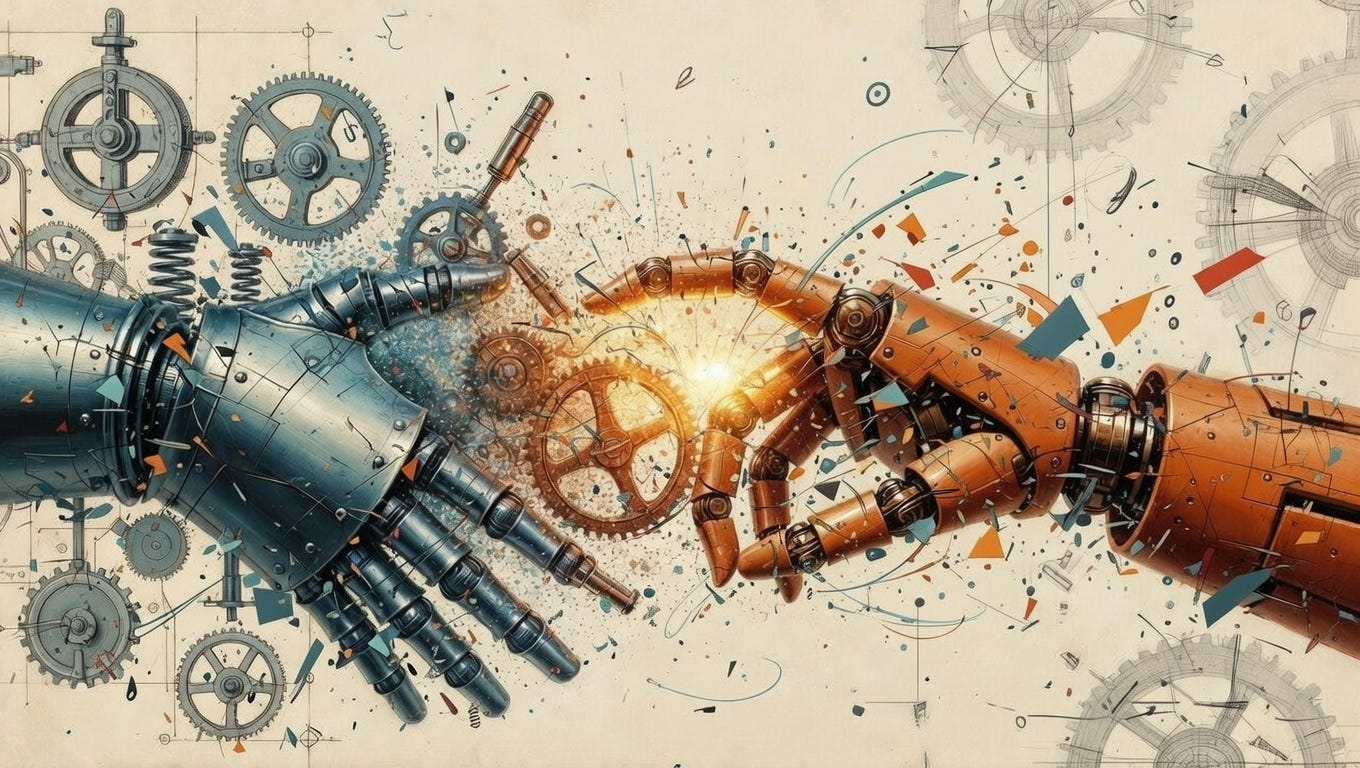
Chapter 1 of A Brief History of Embodied Intelligence
“It has no eyes. It doesn’t know if the part is there or not. It just assumes the part is there.” — Joseph Engelberger, watching Unimate
On a September morning in 1961, a two-ton machine made history by doing something utterly mundane: it picked up a piece of hot metal and put it down somewhere else.
The machine was called Unimate, and it stood on the factory floor of a General Motors plant in Trenton, New Jersey. Its job was to tend a die-casting machine, pulling freshly molded metal parts from the press and stacking them for cooling. The work was dangerous, repetitive, and mind-numbing. It was also, for the first time in history, being done by a robot.
George Devol and Joseph Engelberger watched from behind the safety line as their creation went through its motions. Devol was the inventor. He had filed the original patent for a “Programmed Article Transfer” device back in 1954. Engelberger was the entrepreneur who saw commercial potential where others saw an expensive curiosity. Together, they had spent years trying to convince anyone that robots belonged in factories.
General Motors had finally said yes, mostly because the die-casting line was a nightmare to staff. The work involved reaching into machinery that could crush a hand, handling metal hot enough to burn through gloves, and doing it hundreds of times per shift. Workers quit constantly. The union complained. A machine that could do this job without complaint, without injury, without ever needing a bathroom break. That was worth a try.
Unimate performed flawlessly. It repeated the same sequence of motions, hour after hour, with a precision no human could match. The arm swung to the die-casting machine, the gripper closed on the part, the arm swung back, the gripper released. Again. Again. Again.
“It has no eyes,” Engelberger observed, watching the mechanical arm move through its program. “It doesn’t know if the part is there or not. It just assumes the part is there.”
This wasn’t a limitation they were embarrassed about. It was the whole point.
The Automaton Tradition
To understand why the first successful industrial robot was deliberately designed to be blind, deaf, and incapable of responding to anything unexpected, we need to go back further, to the centuries of mechanical dreams that preceded it.
Humans have imagined machines that move like living things for as long as we’ve been building machines at all. The ancient Greeks told stories of Talos, a giant bronze automaton that guarded the island of Crete. Medieval churches featured mechanical angels and devils that moved during religious performances. The dream of artificial life runs deep in human culture.
But dreams and engineering are different things. The first serious attempts to build moving machines came during the Renaissance, when clockwork mechanisms reached new levels of sophistication.
Leonardo da Vinci, around 1495, sketched designs for a mechanical knight. The drawings, scattered across his notebooks and not fully understood until the twentieth century, show a suit of armor animated by an ingenious system of pulleys, cables, and gears. The knight could sit, stand, raise its visor, and move its arms independently. Modern engineers who have reconstructed Leonardo’s design confirm that it would have worked.
Whether Leonardo actually built his knight, we don’t know. What we do know is that he was grappling with a problem that would occupy engineers for the next five centuries: how do you make a machine that moves with the fluidity of a living body?
The Digesting Duck
The eighteenth century was the golden age of automata: intricate mechanical figures that could write, draw, play music, and perform other seemingly intelligent behaviors. These weren’t toys. They were serious technical achievements that drew crowds across Europe and sparked genuine debates about the nature of life and mind.
The most famous automaton builder was Jacques de Vaucanson, a French inventor who scandalized and delighted Paris in the 1730s. His most celebrated creation was the Digesting Duck, a mechanical bird that could flap its wings, drink water, eat grain, and, most remarkably, appear to digest the food and excrete the remains.
The duck was a sensation. Voltaire called Vaucanson “a new Prometheus.” Audiences paid handsomely to watch the mechanical bird go through its routines. Philosophers debated whether it proved that life itself was merely mechanical.
It was also, in a crucial sense, a fraud.
The duck didn’t actually digest anything. The “excrement” was pre-loaded into a separate compartment and released on cue. The mechanical intestines were for show. Vaucanson had created a brilliant illusion of a biological process, but he hadn’t replicated the process itself.
This distinction matters because it reveals something important about the automaton tradition. These machines were theatrical performances, not functional tools. They were designed to create the appearance of life-like behavior in controlled conditions. The duck worked because Vaucanson knew exactly what it would be asked to do: eat this specific grain, at this specific moment, in this specific way. There were no surprises.
The Jaquet-Droz automata, built by a Swiss father-and-son team in the 1770s, pushed this approach to its limits. Their most famous creation, “The Writer,” was a mechanical boy who could dip a quill pen in ink and write any message up to forty characters long. The message could be changed by adjusting a wheel of cams inside the figure. Audiences watched in amazement as the boy’s eyes followed the movement of his hand across the page.
The Writer survives today, still functional after 250 years. It remains one of the most sophisticated examples of pre-electronic automation ever built. It is also, fundamentally, a very elaborate way to write forty characters.
The automata tradition demonstrated that machines could produce complex, coordinated movements. It could not demonstrate that machines could respond to circumstances their creators hadn’t anticipated. Every motion was pre-programmed. Every outcome was determined before the performance began.
The Stored Program
The industrial revolution changed the question. Suddenly the goal wasn’t to amaze aristocratic audiences with mechanical marvels. It was to do useful work at scale.
The crucial breakthrough came from an unexpected direction: weaving.
In 1804, Joseph Marie Jacquard unveiled a loom that could automatically weave complex patterns in silk. The secret was a chain of punched cards, each card representing one row of the pattern. Holes in the card allowed certain hooks to pass through, lifting specific threads, creating the pattern one row at a time.
The Jacquard loom was not a robot in any modern sense. It didn’t move through space or manipulate objects. But it introduced a concept that would prove essential: the stored program. For the first time, a machine’s behavior was controlled by an abstract representation that could be changed without rebuilding the machine itself. Want a different pattern? Use different cards.
This idea would flow directly into computing. Charles Babbage designed his Analytical Engine to use punched cards inspired by the Jacquard loom. Ada Lovelace, writing about Babbage’s machine, noted that “the Analytical Engine weaves algebraical patterns just as the Jacquard loom weaves flowers and leaves.” A century later, the first electronic computers would still use punched cards for input.
But the Jacquard loom also pointed toward industrial automation. The same principle, a stored program controlling a machine’s operations, would eventually enable factories full of robots doing different tasks, each programmed for its specific job.
The Salesman and the Inventor
It took another 150 years to get from the Jacquard loom to Unimate. The gap wasn’t primarily technical. It was conceptual.
George Devol filed his patent for a “Programmed Article Transfer” device in 1954. The concept was straightforward: a mechanical arm whose movements were controlled by a stored program, capable of picking things up and putting them down in a predetermined sequence. The program could be changed to accommodate different tasks. The arm could work continuously without fatigue.
Devol spent years trying to sell this idea. Nobody was interested.
The problem wasn’t that the technology didn’t work. The problem was that nobody could see why they needed it. Factory work in the 1950s was done by people, lots of people, working for low wages, in conditions that would be illegal today. Why invest in an expensive machine when labor was cheap and abundant?
Joseph Engelberger saw something different. A young engineer who had read Isaac Asimov’s robot stories as a teenager, Engelberger believed that robots were inevitable, and that whoever built the first practical ones would create an industry. He licensed Devol’s patent, founded a company called Unimation, and set out to find customers.
The die-casting industry became his target. Die-casting involved exactly the kind of work robots could do: repetitive motions in a fixed location, handling dangerous materials, in an environment that could be precisely controlled. The machine didn’t need to see because the parts were always in the same place. It didn’t need to think because the sequence never varied. It didn’t need to adapt because nothing unexpected ever happened.
This wasn’t a limitation of the technology. It was the key to making the technology work.
Automate the Automation
Engelberger understood something crucial: the value of a robot depends entirely on its environment.
Consider the die-casting line where Unimate first worked. The robot arm had exactly one job: pick up part from location A, move to location B, release part. The die-casting machine delivered parts to the same spot every time. The cooling rack received them at the same spot every time. The timing was fixed. The sequence was fixed. Everything was fixed.
In this environment, blindness was actually an advantage. A robot with vision would need to process images, identify parts, calculate positions, all adding complexity, cost, and potential points of failure. A blind robot just executed its program. If the environment was controlled tightly enough, that was all it needed to do.
Engelberger called this “automating the automation.” The trick wasn’t just to build a capable robot. It was to design the entire work cell: the robot plus everything around it. The goal was to make the robot’s limited capabilities sufficient. Fix the environment to fit the machine, rather than building a machine that could handle any environment.
This insight would define industrial robotics for the next half-century.
Japan’s Robot Kingdom
Unimate’s success at General Motors opened the floodgates. Slowly at first, then with gathering momentum. American car manufacturers adopted industrial robots through the 1960s and 1970s. The machines spread to welding, painting, and assembly operations where their combination of precision, endurance, and consistency outperformed human workers.
But the real explosion happened elsewhere. In Japan.
Japan’s manufacturing sector in the 1970s faced different constraints than America’s. Labor was expensive and increasingly scarce as the economy boomed. The workforce was aging. Immigration wasn’t a cultural option the way it was in the United States. Japanese manufacturers needed to increase productivity without increasing headcount.
Robots were the answer.
Japanese companies didn’t just adopt American robots. They transformed them. Fanuc, founded in 1956 to develop numerical control systems for machine tools, began producing its own robots in 1974. Yaskawa, an electrical equipment manufacturer, pivoted to robotics and became a global leader. Kawasaki licensed Unimate technology and improved upon it relentlessly.
By 1980, Japan had more industrial robots than the rest of the world combined. Japanese factories became showcases of automation, with robots performing tasks that American manufacturers still assigned to human workers. The productivity gains were enormous.
What made Japan so receptive to robots?
Part of the answer was economic necessity: the labor constraints were real. Part was cultural. Japanese manufacturing embraced continuous improvement (kaizen) as a philosophy, and robots were tools for achieving ever-greater precision and consistency. There was less cultural anxiety about machines replacing workers, partly because lifetime employment practices meant automation could be introduced through attrition rather than layoffs.
But the deeper answer was that Japanese manufacturers understood Engelberger’s insight better than anyone. They didn’t just install robots; they redesigned their entire production systems around robotic capabilities. The Toyota Production System, which would become the model for manufacturing worldwide, treated robots as one element of a carefully orchestrated whole.
The factory became a controlled environment, as precisely specified as the inside of a Jacquard loom. And in that environment, blind, deaf, unintelligent robots thrived.
The Limits of Blindness
By the 1990s, industrial robots had conquered the factory floor. Millions of mechanical arms assembled cars, welded steel, painted surfaces, and moved materials in facilities around the world. The technology had matured from curiosity to commodity.
And then progress stalled.
Not in any absolute sense. Industrial robots kept getting faster, cheaper, more precise. But the fundamental paradigm didn’t change. Robots still operated in carefully controlled environments, executing pre-programmed sequences, with no ability to respond to the unexpected.
The world outside the factory remained robot-free.
Why? Because the world outside the factory is messy.
A home has furniture that moves. A hospital has patients who don’t stay in one place. A warehouse has products of different shapes and sizes, arriving unpredictably, stored wherever there’s space. A city street has pedestrians, vehicles, weather, construction, and a thousand other variables that change minute by minute.
None of these environments could be controlled tightly enough to make Engelberger’s strategy work. You couldn’t “automate the automation” of a kitchen or a sidewalk. The environment was the environment. Take it or leave it.
The robots of the twentieth century had to leave it.
The Missing Ingredient
What would it take to make robots work outside controlled environments?
The answer, it turned out, was everything industrial robots deliberately avoided. Vision to perceive the environment. Intelligence to understand what they were seeing. Decision-making to choose appropriate actions. Adaptability to adjust when things didn’t go as expected.
In short: robots would need to become genuinely smart.
This was a different kind of problem. Not an engineering problem of building precise mechanisms, but an artificial intelligence problem of creating systems that could perceive, reason, and act in the real world. The blind robot that served General Motors so well was exactly the wrong starting point.
The next chapter explores why this problem was so much harder than anyone initially expected, and why a chess-playing computer that could beat the world champion still couldn’t walk across a room.
What the Mechanical Dream Achieved
But before we leave the mechanical dream, it’s worth pausing to appreciate what was actually achieved.
From Leonardo’s sketches to Vaucanson’s duck to Jacquard’s loom to Unimate’s assembly line, the story of pre-intelligent robots is a story of humans learning to extend their physical capabilities through machines. The machines couldn’t think, but they could do. With a precision, consistency, and endurance that no human could match.
Industrial robots transformed manufacturing. They made products better, cheaper, and more consistently than human workers could manage. They took over the most dangerous, grueling, and monotonous tasks. They helped create the material abundance we now take for granted.
They did all this by being very good at a very narrow thing: repeating precise motions in controlled environments, over and over, without variation, without thought, without any need to adapt.
The question that would dominate the next era was whether robots could learn to do something harder: operate in the real world, where nothing stays the same, where surprises are constant, where success requires not just precision but genuine intelligence.
The mechanical dream had achieved more than its creators ever imagined. The dream of intelligent machines was just beginning.
Notes & Further Reading
On Unimate and the birth of industrial robotics: The definitive account of George Devol and Joseph Engelberger’s partnership is found in Engelberger’s own Robotics in Practice (1980), which remains a fascinating primary source. For a more recent treatment, see “The Origin of Industrial Robots” in the IEEE Robotics & Automation Magazine. Engelberger’s observation about Unimate having “no eyes” comes from interviews collected in the Robotics History Project at Carnegie Mellon University.
On Leonardo’s mechanical knight: Mark Rosheim’s Leonardo’s Lost Robots (2006) provides the most thorough reconstruction of Leonardo’s automaton designs, including the mechanical knight. Rosheim, a NASA roboticist, built a working replica based on the scattered notebook sketches.
On Vaucanson and the automaton tradition: Jessica Riskin’s The Restless Clock: A History of the Centuries-Long Argument over What Makes Living Things Tick (2016) offers an excellent cultural history of automata and their philosophical implications. For Vaucanson specifically, see the essays collected in The Mechanical Body: Automata and Artificial Life (2003).
On the Jacquard loom and its computational legacy: James Essinger’s Jacquard’s Web: How a Hand-Loom Led to the Birth of the Information Age (2004) traces the surprisingly direct line from Jacquard’s punched cards to Babbage’s Analytical Engine to modern computing. Ada Lovelace’s observation about “weaving algebraical patterns” appears in her famous 1843 notes on Babbage’s machine.
On Japan’s robotics dominance: The economic and cultural factors behind Japan’s embrace of industrial robots are analyzed in Martin Kenney and Richard Florida’s Beyond Mass Production: The Japanese System and Its Transfer to the U.S. (1993). For the Toyota Production System specifically, Taiichi Ohno’s Toyota Production System: Beyond Large-Scale Production (1988) remains essential reading.
On the “automate the automation” insight: This phrase and concept appear throughout Engelberger’s writings and speeches. The broader idea, that robotic success depends on environmental design as much as robot capability, is developed rigorously in Robot Motion: Planning and Control edited by Brady et al. (1982).
On the limits of industrial robotics: The contrast between factory robots and the challenges of unstructured environments is explored in Rodney Brooks’s Flesh and Machines: How Robots Will Change Us (2002), which argues for a fundamentally different approach to robotics, one we’ll encounter in subsequent chapters.