

Chapter 9 of A Brief History of Embodied Intelligence
China’s advantage is in the hard parts: manufacturing, cost, speed. The challenge is in the soft parts: basic research, high-end chips, foundational models. The question is whether one can buy time for the other.
In late 2023, at the World Robot Conference in Beijing, a crowd gathered around a humanoid robot named “Tiangong.”
The robot walked smoothly across an uneven surface, picked up objects with surprising dexterity, and responded to voice commands in Mandarin. It looked polished, professional, ready for prime time. What caught visitors’ attention wasn’t just what the robot could do, it was the price tag.
“Less than one million yuan,” said a representative from the Beijing Humanoid Robot Innovation Center. About $140,000. A fraction of what comparable American robots would cost.
A few booths away, Unitree displayed its latest humanoid, the H1. The company had made its name selling quadruped robots, four-legged machines that looked like Boston Dynamics’ Spot but cost a tenth as much. Now they were making the same bet on humanoids. The H1 was priced at $90,000. Unitree was already working on something cheaper.
Across the exhibition hall, more than a dozen Chinese companies displayed humanoid robot prototypes. Some were rough, clearly early-stage. Others looked remarkably capable. All of them were cheaper than their Western counterparts.
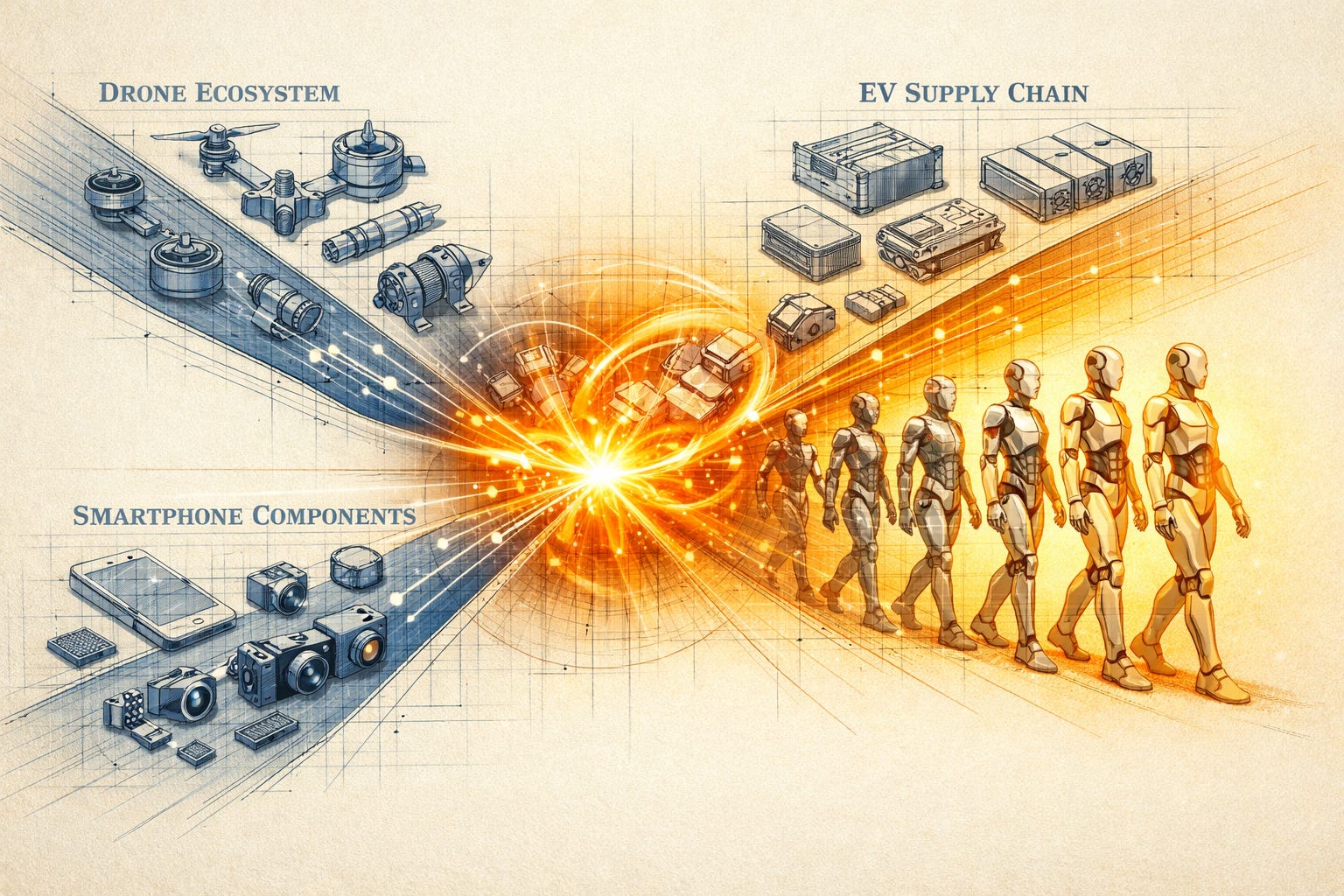
The robot race that had ignited in Silicon Valley was spreading to Shenzhen, Shanghai, and Beijing. And China was bringing something the American startups couldn’t match: the manufacturing ecosystem that had already transformed electric vehicles, smartphones, and drones.
The question was whether the playbook that worked for hardware could work for machines that needed to think.
The Cost Revolutionary
Wang Xingxing didn’t set out to disrupt the robotics industry. He just wanted to build a robot dog that people could actually afford.
Wang was born in 1990 in Ningbo, Zhejiang. He studied mechatronics at Zhejiang Sci-Tech University, where, as a freshman, he built his first bipedal robot for 200 yuan, about thirty dollars, using hand tools and scavenged parts.
For his master’s at Shanghai University, he focused on quadruped robots, obsessed with the videos coming out of Boston Dynamics. Their machines moved with animal-like grace, handling terrain that would trip up wheeled robots. But they cost hundreds of thousands of dollars. They were research tools, not products.
Wang saw an opportunity in the gap between capability and cost.
“Boston Dynamics uses custom actuators,” Wang explained in an interview. “Each motor costs tens of thousands of dollars. They’re optimized for performance, not manufacturing.”
Wang took a different approach. He adapted motors from the drone industry, mass-produced components that cost a few hundred yuan instead of tens of thousands. The performance was lower, but it was good enough. And the cost reduction was dramatic. During his master’s, he spent about 20,000 yuan developing a prototype quadruped called XDog. It won a competition prize, went viral online, and caught the attention of investors.
After graduating in 2016, Wang briefly joined DJI, then resigned to start his own company. He founded Unitree Robotics in Hangzhou with a small team and two million yuan in angel funding. For the first three years, there were times they couldn’t make payroll. Their early robots were crude compared to Spot. But they walked. And they cost a fraction of the price.
By 2023, Unitree had sold more quadruped robots than any company in the world. Its robot dogs accounted for roughly two-thirds of global sales. Their entry-level model, the Go1, retailed for under $3,000, less than a high-end laptop. The company had raised hundreds of millions of dollars and was valued at over a billion, with Sequoia China and other top-tier investors on its cap table.
The same approach that had worked for drones was working for robots. Mass production, aggressive cost reduction, “good enough” performance at revolutionary prices.
“We don’t need to be the best,” Wang said. “We need to be good enough to be useful, at a price people will pay.”
The price revolution was about to accelerate. In early 2025, Unitree unveiled the G1 humanoid, shorter and more compact than the H1, at $16,000, the cost of a used car. Within months, the base price had fallen to $13,500. An even smaller model, the R1, went on sale for under $6,000. TIME named it one of the best inventions of 2025.
Then came the moment that turned a robotics company into a household name. In February 2025, sixteen Unitree H1 humanoids performed a synchronized dance on China’s Spring Festival Gala, a broadcast watched by hundreds of millions, choreographed by Zhang Yimou, the director of the 2008 Beijing Olympics opening ceremony. The robots moved in precise formation, their motions fluid enough to pass for dancers in silhouette. It was a surreal collision of worlds: one of China’s most celebrated filmmakers directing machines on live television, the audience unsure whether to applaud the artistry or the engineering. Social media erupted. Wang Xingxing, the kid who had built his first robot for thirty dollars, was soon meeting with heads of state. President Xi Jinping invited him to a private enterprise symposium, where Wang sat alongside Ren Zhengfei, Jack Ma, and other tech leaders. Unitree’s valuation climbed toward seven billion dollars as the company prepared for an IPO.
A $6,000 humanoid robot. A dance on national television. A seat with the most powerful business figures in the country. It had taken nine years from a Hangzhou startup with missed payrolls to here.
The Internet-Famous Engineer
Peng Zhihui took a different path to robotics fame.
Known online as “稚晖君” (Zhihui Jun), Peng had become a celebrity on Bilibili, China’s equivalent of YouTube, by posting videos of his engineering projects. He built a self-balancing bicycle that could navigate itself through traffic. He designed a robotic arm inspired by Iron Man. He created a mechanical watch from scratch. Each project demonstrated extraordinary technical skill and an ability to explain complex concepts to general audiences.
By 2022, Peng had over two million followers and a reputation as one of China’s most talented young engineers. Born in 1993 in Ji’an, Jiangxi Province, he had studied biomedical engineering at the University of Electronic Science and Technology of China, worked briefly at OPPO’s AI lab, then joined Huawei in 2020 as part of their “genius youth” program, a prestigious track for exceptional technical talent that paid him two million yuan a year.
Then he left to start a humanoid robot company.
Agibot, co-founded in February 2023 with Deng Taihua, a former Huawei vice president, attracted immediate attention. Peng’s celebrity gave the company visibility that most startups spend years building. His technical credibility, and Deng’s corporate experience, gave investors confidence. Within a year, Agibot had raised over a billion yuan at a valuation exceeding seven billion, roughly a billion dollars.
“The hardware is something we know how to do,” Peng said in an interview. “Manufacturing, cost optimization, rapid iteration, this is China’s strength. The AI is harder, but we’re learning fast.”
How fast became clear in December 2025, when Agibot rolled its five-thousandth robot off a Shanghai production line: 1,742 full-size humanoids, 1,846 compact models, and 1,412 task-optimized industrial machines, deployed across manufacturing, logistics, cleaning, and security. An industry report ranked it first globally in humanoid robot shipments, with nearly 40 percent of the world market. Peng Zhihui, the Bilibili celebrity who had left Huawei barely three years earlier, had built the world’s leading humanoid robot factory before turning thirty-three.
The Patient Pioneer
If Wang was the young disruptor and Peng the internet-famous prodigy, Zhou Jian was the veteran who had been building robots before either of them started.
In 2008, Zhou visited a technology fair in Japan where he saw Honda’s ASIMO for the first time. The humanoid robot walked, waved, and climbed stairs. Zhou was captivated, and frustrated. ASIMO wasn’t for sale. Renting one cost $150,000 a month. Zhou, who had studied wood processing engineering at Nanjing Forestry University and built a career in marketing and sales, saw the same gap Wang would later see with quadrupeds: extraordinary machines that no ordinary person could afford.
Zhou spent the next four years in Shenzhen teaching himself robotics, burning through 50 million yuan of his own savings, selling his cars and apartments to keep going. The bottleneck, he discovered, was servos: the joint actuators that let humanoid robots move. Quality servos from Japan and Europe cost thousands of dollars each, and a humanoid needed dozens. Zhou’s team eventually cut servo costs to a fraction of the market price.
In 2012, he incorporated UBTECH with 10 million yuan in registered capital. In 2014, UBTECH’s first humanoid robot, the Alpha 1S, launched at $499, a sixteen-inch tall machine with sixteen servo joints that could dance, tell stories, and somersault. It was a toy, essentially. But it was a humanoid robot that actual families could buy.
Revenue grew from two million yuan in 2014 to 300 million yuan by 2016. That year, 540 Alpha 1S robots performed a synchronized dance at China’s Spring Festival Gala, the same stage where, nine years later, Unitree’s full-size humanoids would steal the show. UBTECH became a unicorn after its Series B funding from CITIC Securities and CDH Investments.
By 2023, UBTECH had a decade of humanoid design experience, hundreds of patents, and a track record that none of the newer entrants could match. When they listed on the Hong Kong Stock Exchange that December, the first humanoid robotics company to do so, it was a validation of patience. While others were still prototyping, UBTECH had been iterating for eleven years.
The payoff came in 2025. UBTECH began mass deliveries of its Walker S2 humanoid to real factories, with orders exceeding 800 million yuan from BYD, Geely, Foxconn, and other industrial giants. The Walker S2 could swap its own batteries without human help, a mundane-sounding feature that meant it could work around the clock. UBTECH planned to deliver five hundred units by year’s end, five thousand by 2026, ten thousand by 2027. The robot that had started as an educational toy was now working the production line at some of China’s largest automakers.
The Manufacturing Ecosystem
In Shenzhen’s Huaqiangbei electronics market, a sprawling complex of towers and stalls that functions as the world’s largest electronics bazaar, you can source almost any component a robot needs within a single afternoon. Brushless motors in one building. LiDAR sensors in the next. Battery cells, IMUs, cameras, controllers, cables, casings, all within walking distance, all available in quantities from one to one million.
This is what Chinese robotics companies were building on. Not just a market, but an ecosystem that had been developed across multiple industries over decades.
Motors came from suppliers who had scaled up to serve the drone industry. DJI’s dominance in consumer drones had created a supply chain for small, efficient, affordable actuators, exactly what robots needed. A motor that cost $5,000 from a specialized robotics supplier might cost $200 from a drone component manufacturer.
Batteries came from the electric vehicle boom. CATL, BYD, and other Chinese battery giants had invested billions in manufacturing capacity, driving down costs and improving energy density. A robot that needed a full day’s charge could draw on the same cell technology that powered EVs.
Sensors came from the smartphone supply chain. LiDAR sensors that had cost tens of thousands of dollars were now available for hundreds, as companies like Livox and Hesai competed for the autonomous vehicle market. Cameras, IMUs, and other components followed similar cost curves.
And the engineers who designed and assembled these components were abundant. China’s universities produced hundreds of thousands of engineering graduates each year. Many had grown up watching Boston Dynamics videos and dreamed of building something similar.
This ecosystem had already transformed multiple industries. Chinese companies had gone from irrelevant to dominant in smartphones, from negligible to leading in EVs, from nonexistent to overwhelming in drones. The pattern was consistent: start with cost advantage, iterate rapidly, improve quality over time, eventually compete at the high end.
Whether robots would follow the same trajectory depended on a problem the hardware ecosystem couldn’t solve.
The Intelligence Gap
In a lab at Agibot’s Shanghai headquarters in late 2024, a team of engineers was running a test that illustrated both the promise and the challenge of Chinese robotics AI.
Over a hundred identical robots, arranged in rows like an assembly line of learners, were performing the same manipulation tasks simultaneously: picking up objects, sorting components, folding fabric. Each robot’s experience fed into a shared dataset. When one robot figured out a better grip angle, all of them benefited. By the end of a day, the fleet had generated more training data than a single robot could produce in months.
This was the idea behind AgiBot World, an open-source dataset that Agibot released in early 2025 containing over one million manipulation trajectories across 217 tasks. It was an order of magnitude larger than any existing robotics dataset, and Agibot gave it away for free, inviting researchers worldwide to download, use, and improve upon it. Alongside the data, they released GO-1, Genie Operator-1, a foundation model for robotic manipulation that could learn from both robot demonstrations and ordinary internet videos of humans performing tasks. In benchmarks, policies trained on Agibot’s data outperformed those trained on Google’s Open X-Embodiment dataset by 30 percent. The paper was nominated for a best paper award at IROS 2025, one of robotics’ top conferences.
It was a bold move, and a calculated one. In language models, China trailed American companies in raw capability. OpenAI, Google, and Anthropic had larger models, more compute, and deeper research benches. But robotics AI was a younger field where the rules hadn’t been written yet. By flooding the ecosystem with data and open-sourcing their foundation model, Agibot was making a bet: that in robotics, the company with the most real-world training data would win, and that China’s ability to manufacture and deploy robots at scale would become an AI advantage, not just a hardware one.
“American companies can throw compute at problems,” one Agibot engineer explained. “We have to be smarter about data.”
This was the optimistic version. The pessimistic version was that the intelligence gap ran deeper than data could fix. The large language models that powered systems like RT-2 had been developed primarily in the United States. Chinese models, Baidu’s ERNIE, Alibaba’s Qwen, startups like DeepSeek and Zhipu AI, were catching up in benchmarks but still lagged in the reasoning capabilities that mattered for robots operating in unstructured environments.
The chip restrictions made everything harder. In October 2022, Washington banned exports of Nvidia’s A100 and H100 chips to China, the processors that powered large-scale AI training. Nvidia designed a degraded alternative, the H20, specifically for the Chinese market, but it was far weaker. Huawei’s domestic alternative, the Ascend 910B, offered roughly a third of the H100’s computational performance. Its successor, the 910C, closed some of the gap on paper, but DeepSeek’s own researchers concluded it still performed only about 60 percent as well as the H100 in real-world training workloads. And the supply was constrained: SMIC, China’s most advanced chipmaker, couldn’t produce enough 910Cs to meet domestic demand, limited by its inability to manufacture below the 7nm process node.
Chinese AI teams adapted. DeepSeek’s R1 model demonstrated that clever architecture design could partially compensate for weaker hardware, achieving near-frontier performance with efficiency tricks that American labs hadn’t prioritized. The techniques traveled fast across the ecosystem. But “doing more with less” was a strategy born of constraint, not choice. For robotics, where foundation models needed to process vision, language, and action simultaneously in real time, the compute gap meant Chinese systems would be slower to train and less capable at the edge cases that separated a demo from a deployment.
Whether this mattered depended on the application. For a robot sorting batteries on an assembly line, a controlled environment with predictable objects, the intelligence gap barely registered. For a robot navigating a stranger’s kitchen and cooking an unfamiliar recipe, the general-purpose dream that everyone was chasing, it might be the difference between success and failure.
The Geopolitical Shadow
The competition existed within a larger context that neither side fully controlled.
In May 2025, every member of the U.S. House Select Committee on Strategic Competition with China, Republicans and Democrats, signed a bipartisan letter demanding that Unitree be added to the Commerce Department’s Entity List, citing national security concerns.
It was the Huawei and DJI playbook, applied to robots. The same pattern that had restricted Chinese drones, telecom equipment, and surveillance cameras from American markets was now targeting the robotics industry. For Wang Xingxing, who had built his company selling affordable robot dogs to hobbyists and researchers, the accusations reframed Unitree overnight, from scrappy startup to national security threat.
For Chinese companies, the restrictions accelerated efforts toward self-sufficiency. Huawei’s experience, cut off from advanced chips, forced to develop domestic alternatives, served as both warning and inspiration. Better to build domestic capabilities now than be vulnerable later.
For American companies, the situation created competitive complications. Restricting Chinese robots from the U.S. market protected domestic firms from price competition but also removed the pressure that drove innovation. And it did nothing about the markets where the real competition would play out, Southeast Asia, Africa, Latin America, the Middle East, where a factory owner choosing between a $16,000 Chinese humanoid and a $100,000 American one would make the calculation on price, not geopolitics.
“In five years, there might be two completely separate robot worlds,” predicted Kai-Fu Lee, the AI investor and former head of Google China. “American robots using American AI, Chinese robots using Chinese AI. They might not even be compatible.”
This bifurcation seemed increasingly likely. And the consequences extended far beyond robotics. If the global manufacturing base split into two technological ecosystems, one built on American chips and models, one on Chinese alternatives, it would reshape supply chains, trade patterns, and the economic geography of the developing world for decades.
The EV Parallel
Everyone in Chinese robotics talked about electric vehicles, and for good reason. The EV industry had followed a pattern that robotics companies hoped to replicate: Chinese companies had started behind, with products that Western observers dismissed as cheap imitations. But they had iterated relentlessly, improved quality, and leveraged cost advantages. By 2023, BYD had become the world’s largest EV manufacturer. Chinese companies dominated the global battery market. Tesla’s own success in China depended on local suppliers and manufacturing capabilities.
Could robots follow the same path?
The optimists pointed to similarities. Like EVs, robots were hardware-intensive products where manufacturing capability mattered. Like EVs, robots could benefit from China’s supply chain ecosystem and engineer pool. Like EVs, robots had a clear cost curve that Chinese companies could ride downward faster than competitors.
The pessimists pointed to a critical difference. EVs were primarily mechanical and electrical systems. The “intelligence” in an EV, the self-driving capability, remained an unsolved problem, and notably, Chinese companies hadn’t solved it any better than American ones. Robots were intelligence-intensive from the start.
“The EV comparison is seductive but misleading,” argued Yuke Zhu, a roboticist at the University of Texas at Austin who studies manipulation learning. “In EVs, you can ship a great car with mediocre self-driving. In robots, the AI isn’t optional. It’s the whole point.”
The truth probably lay somewhere between the extremes. For specific applications, factory automation, logistics, security, Chinese robots might achieve dominance through cost and manufacturing excellence, even with less sophisticated AI. For general-purpose robots that needed to operate in unstructured environments, the intelligence gap might matter more.
The Race Within
The competition wasn’t just China versus America. It was also Chinese companies versus each other.
Unitree, Agibot, UBTECH, Fourier Intelligence, Xiaomi, CloudMinds. Each was racing to establish position in a market that didn’t fully exist yet. They competed for talent, poaching engineers from each other and from tech giants. They competed for capital, as investors from Tencent to Alibaba to BYD tried to pick winners. They competed for customers, offering robots to factories willing to experiment. And increasingly, they competed for the prestige of being first to IPO, a race that would determine which companies had the capital to survive the long road to profitability.
The speed of iteration was unlike anything the global robotics industry had seen. A company that fell behind in one generation of robots might lose its best engineers to competitors. A company that couldn’t demonstrate progress might lose access to capital. The pressure was relentless, and it produced results. In 2024, total global humanoid robot shipments numbered in the low thousands. By 2025, Omdia estimated the figure had climbed to approximately 13,000 units, with Chinese companies accounting for the majority.
The contrast with America was striking. Figure AI, one of the leading U.S. humanoid startups, had raised its latest round at a valuation of $39 billion, more than five times Unitree’s. But the Chinese companies were shipping thousands of robots per year. The Americans were valued on promise; the Chinese were valued on production.
What Comes Next
In a factory in Dongguan, a Unitree robot dog patrolled the aisles at night, checking for safety hazards and security breaches. It wasn’t glamorous work. It wasn’t the humanoid future that science fiction had promised.
But it was real. The robot worked. It generated data that would train the next generation. It proved that Chinese companies could build machines that operated in the physical world, day after day, without breaking down.
A few kilometers away, an Agibot humanoid was being tested on an assembly line, picking up components and placing them with increasing precision. At a BYD plant, UBTECH’s Walker S2 was swapping its own batteries between shifts, working hours no human could sustain.
This was how the Chinese robot industry operated: not waiting for perfection, but shipping, learning, iterating, and shipping again. The approach had costs. Products sometimes went out before they were ready. Technical debt accumulated. The intelligence gap remained real, and the geopolitical risks were growing.
But the Chinese robot army was no longer assembling. It had arrived.
Whether it would conquer global markets or remain confined by technology gaps and geopolitical walls, that question was still open. The answer depended on whether manufacturing speed could outrun the need for artificial intelligence, whether open-source data strategies could close the gap with American research labs, and whether two technological ecosystems could coexist in a world that had grown accustomed to one.
The rest of the world was still debating whether it would happen. China was shipping.
Notes & Further Reading
On Unitree and Wang Xingxing: Wang studied mechatronics at Zhejiang Sci-Tech University before completing his master’s at Shanghai University, where he developed the XDog quadruped prototype. After a brief stint at DJI, he founded Unitree in August 2016. The company’s journey from Hangzhou startup to global leader in affordable quadruped robots is documented in numerous Chinese tech media outlets; English coverage in IEEE Spectrum, CNBC, and The Robot Report provides accessible overviews. The 2025 Spring Festival Gala performance (directed by Zhang Yimou) and subsequent IPO preparations were widely covered internationally. Wang’s participation in President Xi Jinping’s February 2025 private enterprise symposium, seated alongside Ren Zhengfei, Jack Ma, and other tech leaders, was reported by SCMP, Xinhua, and others. The G1’s price trajectory ($16,000 → $13,500) and the R1’s sub-$6,000 pricing were confirmed in product announcements; TIME’s best inventions recognition appeared in its 2025 edition.
On Peng Zhihui (稚晖君) and Agibot: Born in 1993 in Ji’an, Jiangxi Province, Peng studied biomedical engineering at the University of Electronic Science and Technology of China (UESTC), worked at OPPO’s AI lab, then joined Huawei’s “Genius Youth” program in 2020 before co-founding Agibot in 2023 with former Huawei VP Deng Taihua. Coverage in Chinese media (36Kr, PingWest) and internationally (South China Morning Post, VnExpress, Interesting Engineering) tracks his transition from internet celebrity to CTO of the world’s highest-volume humanoid robot manufacturer. Agibot’s December 2025 announcement of its 5,000th production unit was reported by PR Newswire, Yicai Global, and others.
On Agibot’s AI strategy: The AgiBot World dataset (over 1 million trajectories across 217 tasks) and the GO-1 (Genie Operator-1) foundation model were released in March 2025 and described in Bu et al., “AgiBot World Colosseo: A Large-scale Manipulation Platform for Scalable and Intelligent Embodied Systems” (arXiv:2503.06669), nominated for Best Paper at IROS 2025. The paper introduces the Vision-Language-Latent-Action (ViLLA) framework, which enables pre-training on internet-scale video data alongside robot demonstrations. GO-1 outperformed prior state-of-the-art (RDT) by 32% on complex manipulation tasks. The dataset and model are open-sourced on GitHub and HuggingFace under CC BY-NC-SA 4.0.
On UBTECH and Zhou Jian: Zhou saw Honda’s ASIMO at a 2008 technology fair in Japan; the origin story is documented in TechNode’s 2017 profile (”This Chinese unicorn wants to put humanoid robots into every home”). Zhou spent four years and approximately 50 million yuan of personal savings developing servo technology before incorporating UBTECH in March 2012. The 2016 Spring Festival Gala performance with 540 Alpha 1S robots preceded Unitree’s 2025 performance by nine years. UBTECH’s December 2023 Hong Kong IPO raised HK$1 billion. Walker S2 mass production and delivery milestones (orders exceeding 800 million yuan by late 2025) were documented in PR Newswire, South China Morning Post, and Robotics & Automation News.
On the chip restrictions: The October 2022 export controls banned Nvidia’s A100 and H100 from China; subsequent rounds in October 2023 tightened thresholds further. Nvidia’s China-specific H20 was designed to comply. Huawei’s Ascend 910B and 910C chips, manufactured at SMIC’s 7nm node, offer lower performance (the 910C achieves approximately 60% of H100 real-world performance per CFR and DeepSeek’s own assessments). SMIC cannot currently produce chips below 7nm due to export controls on advanced lithography equipment. Analysis from the Council on Foreign Relations (December 2025), RAND (August 2025), and Epoch AI provides detailed technical comparisons.
On China’s robotics ecosystem: Reports from CITIC Securities, Goldman Sachs, and Omdia provide detailed analysis of the competitive landscape. Omdia’s 2025 report on global humanoid robot shipments (approximately 13,000 units) is a key industry benchmark. The China Robot Industry Alliance publishes annual production and deployment data. The Morgan Stanley vs. lower-end market forecasts reflect the enormous uncertainty about how quickly general-purpose robots will achieve commercial viability.
On the EV parallel: BYD surpassed Tesla as the world’s largest EV manufacturer by units sold in 2023. Coverage in publications like The Information and analyses by Morgan Stanley examine how Chinese companies came to dominate the EV supply chain, and whether robotics will follow a similar trajectory.