
The Robot Renaissance: May 5 – 11, 2026
The week the humanoid industry started looking like the auto industry

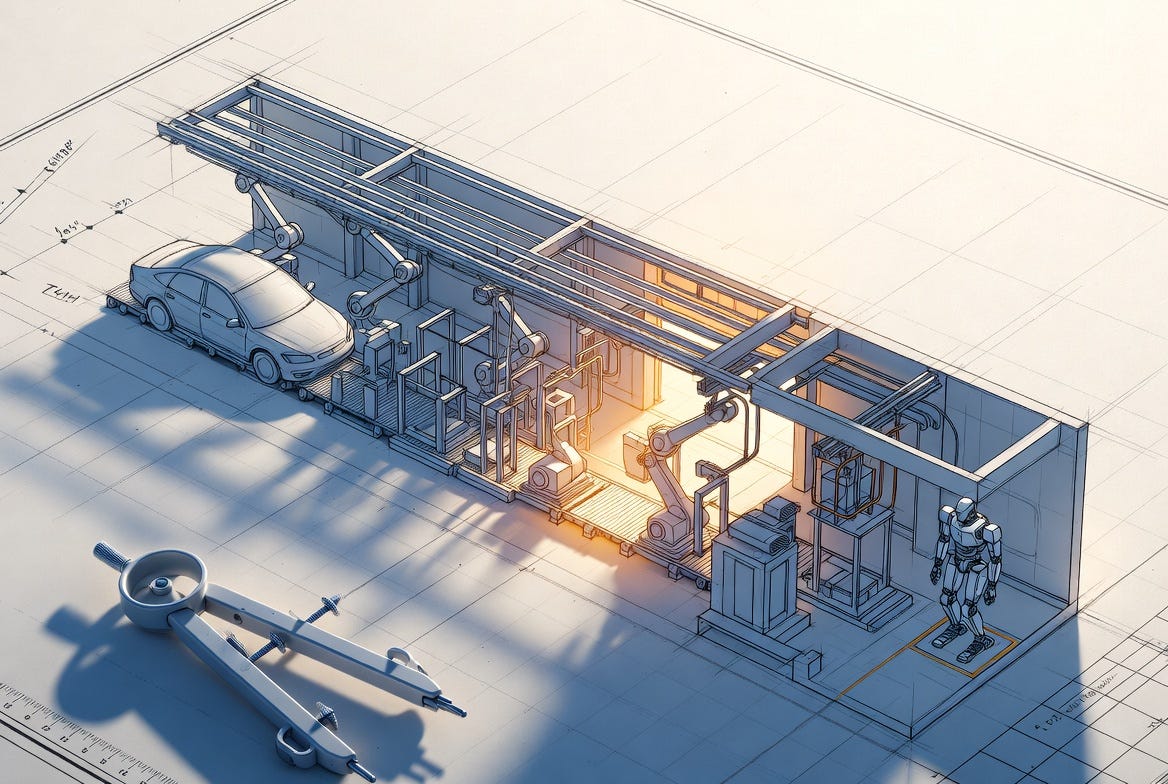
Every emerging hardware sector eventually faces the moment its commercial structure stops being novel. The robots-as-research-projects era has been ending for a year, but this week the auto-industry shape underneath finally became impossible to miss. On Saturday, Tesla rolled the last Model S and Model X off the Fremont line so the floor could be torn down and rebuilt as a humanoid factory targeting one million units a year. On Thursday, Unitree opened the world’s first humanoid motion app store, a deliberate echo of how smartphones became platforms. On Friday, ROBOTERA closed a $200 million round backed by SF Express, Alibaba, and Geely’s capital arm, with logistics deployments already running across China Post’s network. And Morgan Stanley told clients on Wednesday that humanoids will carry China’s next decade of export dominance, the way EVs carried the last. The componentry, the financing, the playbook, and the throwaway phrases like “Robot-as-a-Service” all converged this week on a shape we already know.
The last Model S
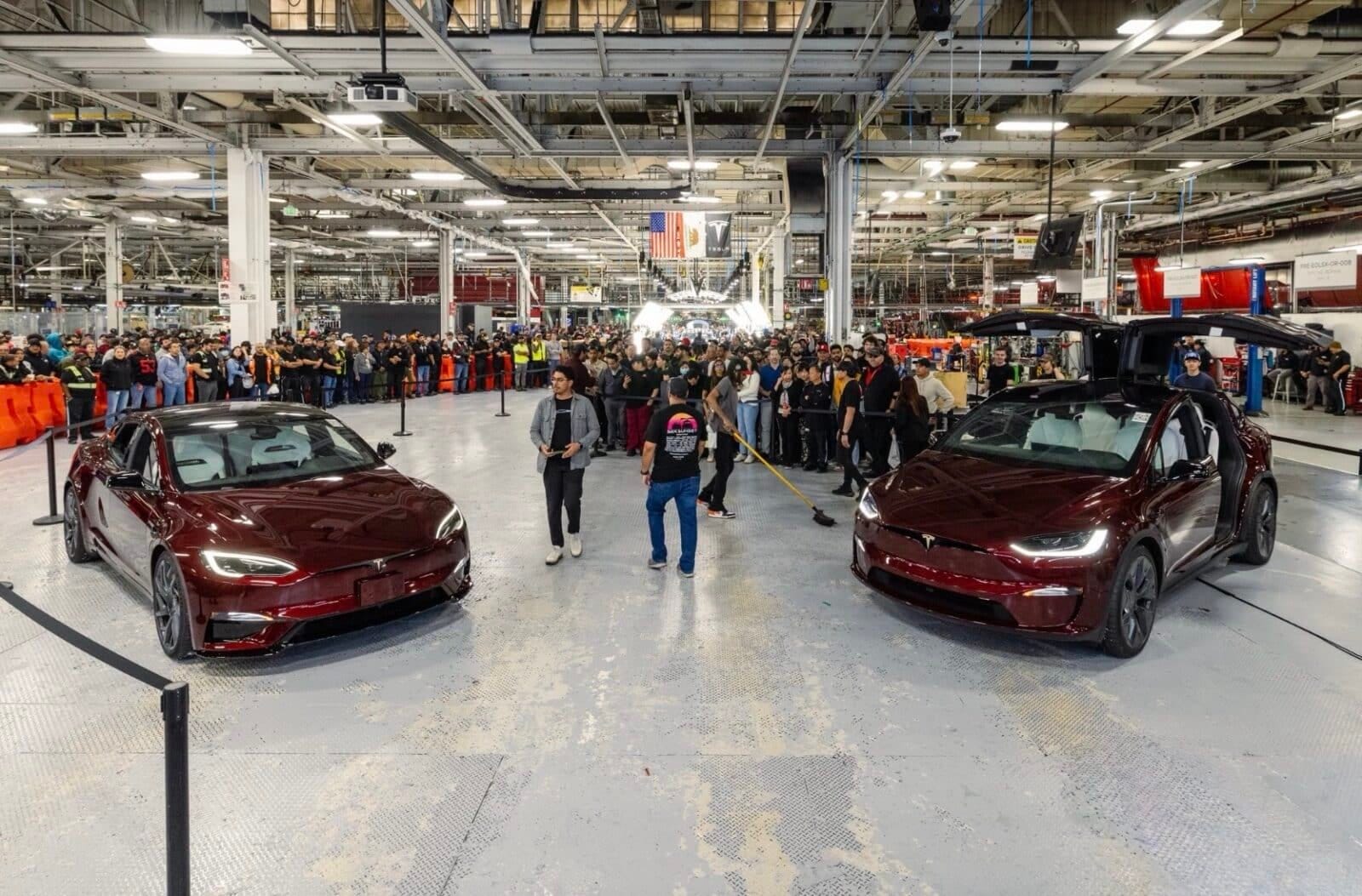
The longest-running car in Tesla’s lineup ended where it began. On Saturday May 9, Tesla closed out the last Model S and Model X off the Fremont line after 14 and 11 years respectively. The cars were always profitable; the floor space is now more valuable as something else. Per the company’s Q1 2026 update letter, the freed-up assembly area becomes a first-generation Optimus production line targeting one million robots a year, with site preparation already underway for a second factory at Giga Texas designed for ten million units annually. Musk warned on the Q1 earnings call that initial output will be “quite slow” given Optimus has 10,000 unique parts on an entirely new line, and that predicting a 2026 production rate is “literally impossible.” The honesty matters less than the gesture. A company famous for converting capital expenditure into productive capacity faster than its peers has decided the highest-value use of its flagship sedan line is to dismantle it for humanoids. The internal forecast that justifies that decision is the story, not the timing.
An app store on legs
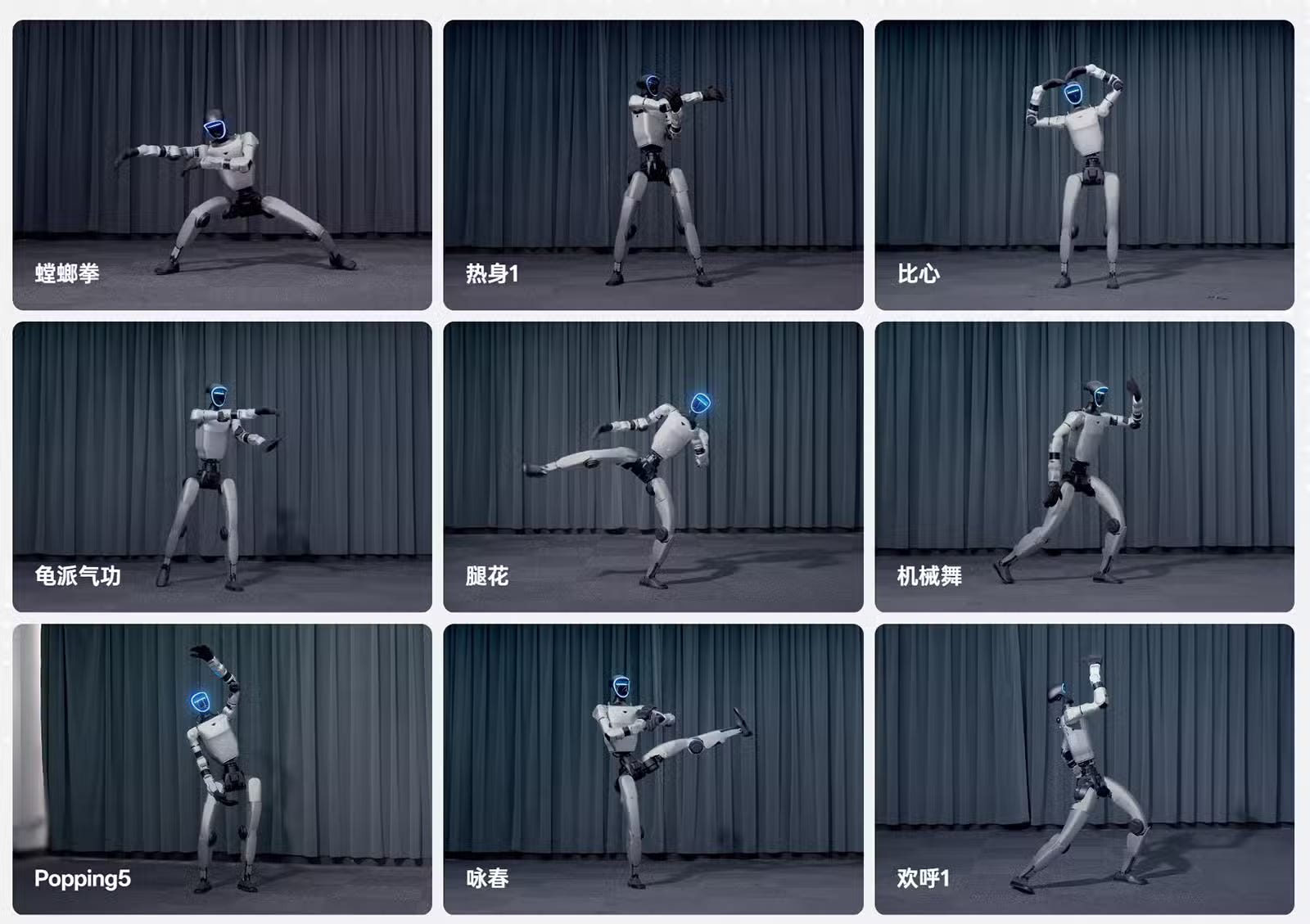
The bigger conceptual move of the week happened in Hangzhou. On Thursday, Unitree launched UniStore, what it describes as the world’s first humanoid robot motion app store, where customers download behaviors the way they download apps on a phone. Dancing, boxing, and walking are live at launch; the platform currently supports the G1 platform. The framing is the strategic interesting part: Unitree is no longer positioning humanoids as fixed-function appliances. It is positioning them as upgradeable software products where the post-deployment business sits inside a marketplace. That is the iPhone playbook, applied to legged hardware. UniStore arrived eight days after Unitree released its R1-A5 and R1-A7 dual-arm upper-body humanoids starting at $4,290, the lowest-priced humanoid platform in commercial sale anywhere. The lower-end models drop legs entirely in exchange for an order-of-magnitude cost reduction and modular fixed or wheeled bases. The combined message: hardware affordability and software distribution, the two pillars that turn an industry from prototype to platform. Western analyst commentary has spent most of 2026 asking whether Chinese humanoid makers can compete on autonomy. The more interesting question this week is whether American humanoid makers can compete on platform economics.
Capital follows the playbook
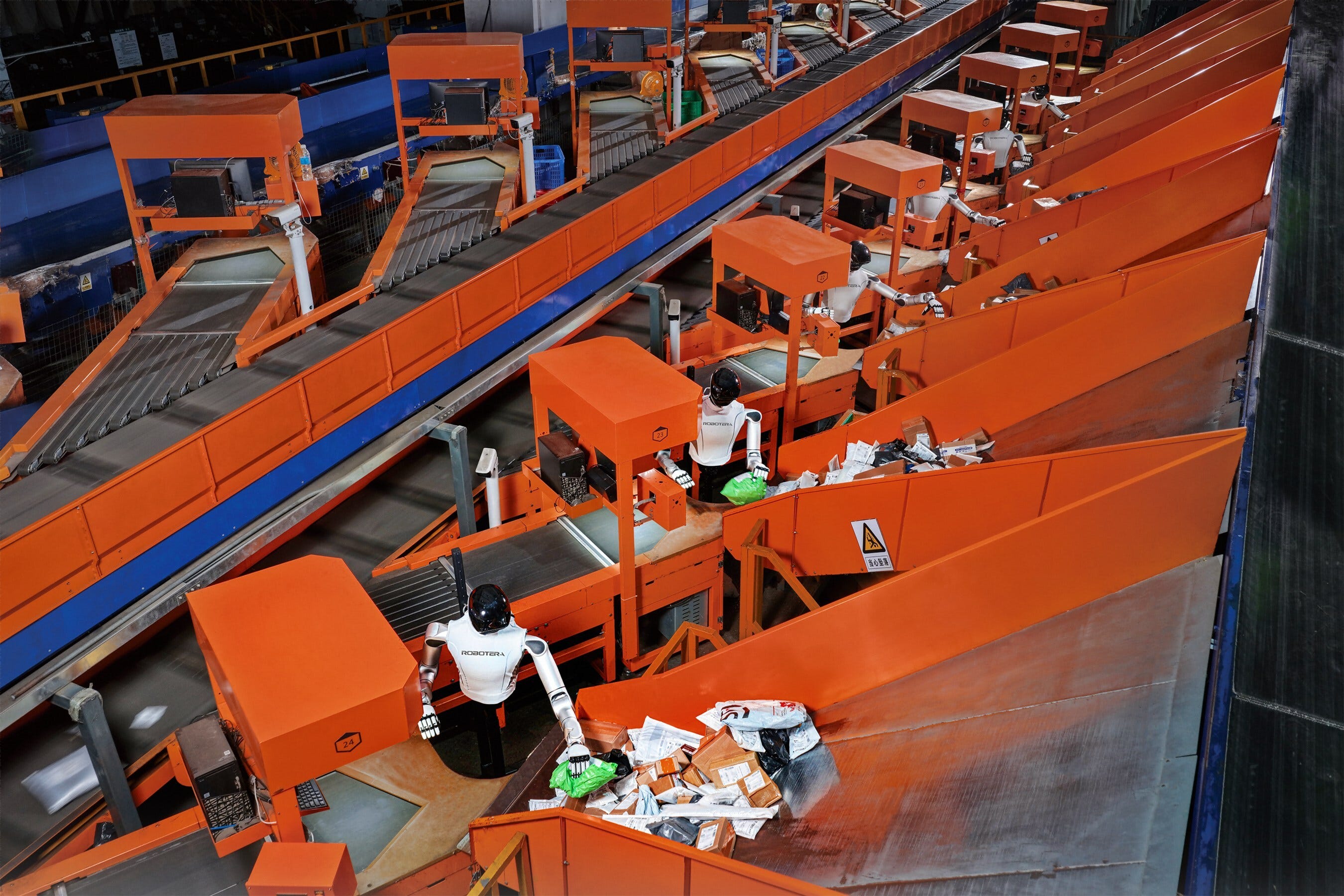
Money moved in the same direction. On Friday, Beijing-based ROBOTERA closed over $200 million in a round led by SF Group, with HSG, IDG Capital, Hillhouse, CDH, CICC, Alibaba, Geely Capital, Lenovo, Haier, and BAIC all participating. The investor list itself is the thesis: logistics operators, automakers, EV component makers, and consumer-electronics manufacturers, alongside the financial syndicate. Embodied intelligence is increasingly being underwritten by the customers who will actually deploy the units, not just by venture funds. ROBOTERA’s humanoids are already running in more than ten logistics centers in partnership with China Post and SF Group; the company also showcased its L7 full-size and Q5 wheeled platforms at CES 2026. That structure, where the strategic backers double as anchor customers, is exactly how China’s EV champions scaled. Capital, supply chain, and demand co-located inside a single industrial planning loop. Western humanoid funding has tended to be venture-led with strategic participation; the Chinese ROBOTERA round inverts the ratio.
A different geometry
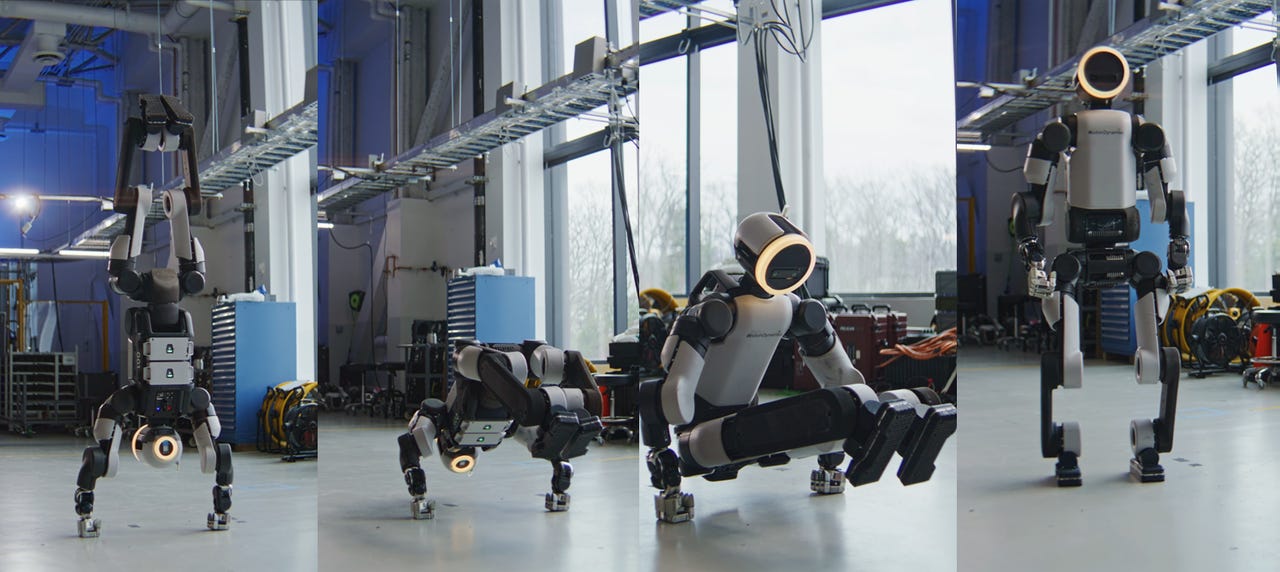
While the platform plays accelerated, the engineering arms race continued. Boston Dynamics on Wednesday published its first production-model Atlas footage, showing the new electric robot performing a near-vertical handstand and an L-sit, holding its body weight on two hands for roughly five seconds. The clip matters less for the gymnastics than for what is being demonstrated. CES 2026 attendees reportedly noted that the prototype walking on stage during the Atlas reveal was teleoperated; this week’s video is the production-spec unit moving autonomously through high-difficulty calisthenics. Atlas is fully spoken for through 2026 to Hyundai and Google DeepMind, with Hyundai planning manufacturing capacity for up to 30,000 Atlases per year by 2028. The Hyundai and Google DeepMind framework, with Atlas as the hardware and Gemini Robotics as the cognition layer, is a meaningfully different commercial geometry from Tesla’s vertically integrated approach or 1X’s consumer-first vertical integration in Hayward. Three Western humanoid playbooks, three different bets on which layer of the stack captures the margin.
Beijing’s export theory of humanoids
Morgan Stanley named the larger pattern explicitly. In a research note released Wednesday, the bank’s Chief Asia Economist Chetan Ahya argued that humanoid robotics will carry China’s next phase of global manufacturing share expansion, projecting the country’s slice of global exports to rise from 15% to 16.5% by 2030, on the same trajectory EVs traced over the past decade. Chinese makers already account for roughly 90% of the 13,000 to 16,000 humanoid units shipped globally in 2025. The pieces of the policy-engineered industrial flywheel that worked for EVs are all in place again: vertically integrated Yangtze Delta supply chains, an MIIT-led standardization committee that began publishing humanoid lifecycle standards in March, the 15th Five-Year Plan’s elevation of embodied intelligence to a top “new industry track,” and state-affiliated venture funds writing the early checks. The downstream demand exists too, with Japan Airlines beginning humanoid trials at Haneda using Chinese-made Unitree G1s, and KB Financial Group unveiling a Unitree-derived senior care humanoid in Seoul on Friday. Korean and Japanese deployments running on Chinese hardware is the early phase of the export thesis becoming literal.
Signals in the noise
A few other items rounded out the week. Meta’s Superintelligence Labs completed its acquisition of Assured Robot Intelligence, an early-stage lab focused on foundation models that let robots predict and adapt to human behavior in dynamic environments, the second robotics-aligned acquisition Meta has logged in two quarters. NVIDIA’s Isaac robotics stack continued to find its way into nearly every Western humanoid pipeline, with 1X confirming that every NEO rolling off the Hayward line will run NVIDIA Jetson Thor as its onboard brain. And the wider funding ecosystem continued its concentration pattern: pure-play robotics companies have raised $2.25 billion across 23 disclosed equity rounds in the trailing twelve months, per an industry tracker, with the top three deals capturing 57% of total dollars and the top ten capturing 90%. Robotics, as an asset class, is behaving like a power-law category. Companies are not the bottleneck; capacity to absorb capital at scale is.
A factory line that built sedans for fourteen years comes down. An app store for robot behaviors goes up. A two hundred million dollar funding round closes inside a consortium of the customers that will actually use the products. A bank tells clients to underwrite the next decade of Chinese export power on legs. Each piece is small. The pattern they describe is not. Six months ago, the humanoid industry talked about itself in the language of research labs and demo videos. This week it talked about itself in the language of supply chains, platforms, and unit economics. The transition from one vocabulary to the other is the transition from a category that might become an industry to a category that already is.
The Robot Renaissance is accelerating. You’re now up to speed.