

Chapter 7 of A Brief History of Embodied Intelligence.
“People see the demos and think we’re almost there. We’re not. We’re at the very beginning.” — Jonathan Hurst, Agility Robotics
In late 2022, in a warehouse in Sunnyvale, California, Brett Adcock watched his team bolt together the first prototype of a humanoid robot.
The scene was unglamorous. Exposed wiring. Machined aluminum parts that didn’t quite fit. A torso suspended from a gantry because the legs couldn’t yet support its weight. Adcock had founded Figure AI just months earlier, pulling engineers from his previous company, Archer Aviation, an air taxi startup, into this new venture.
His investors thought he was crazy. Air taxis were already speculative. Humanoid robots seemed like science fiction.
“Everyone asks me why I switched from aircraft to robots,” Adcock told a visitor. “My answer is simple: the aircraft market is tens of billions of dollars. The general-purpose robot market is tens of trillions.”
The math, if you believed it, was compelling. There were roughly 350 million jobs in the developed world that involved physical labor. If robots could do even a fraction of those jobs, the market would dwarf anything in technology history. Smartphones were a trillion-dollar industry. This could be ten times larger.
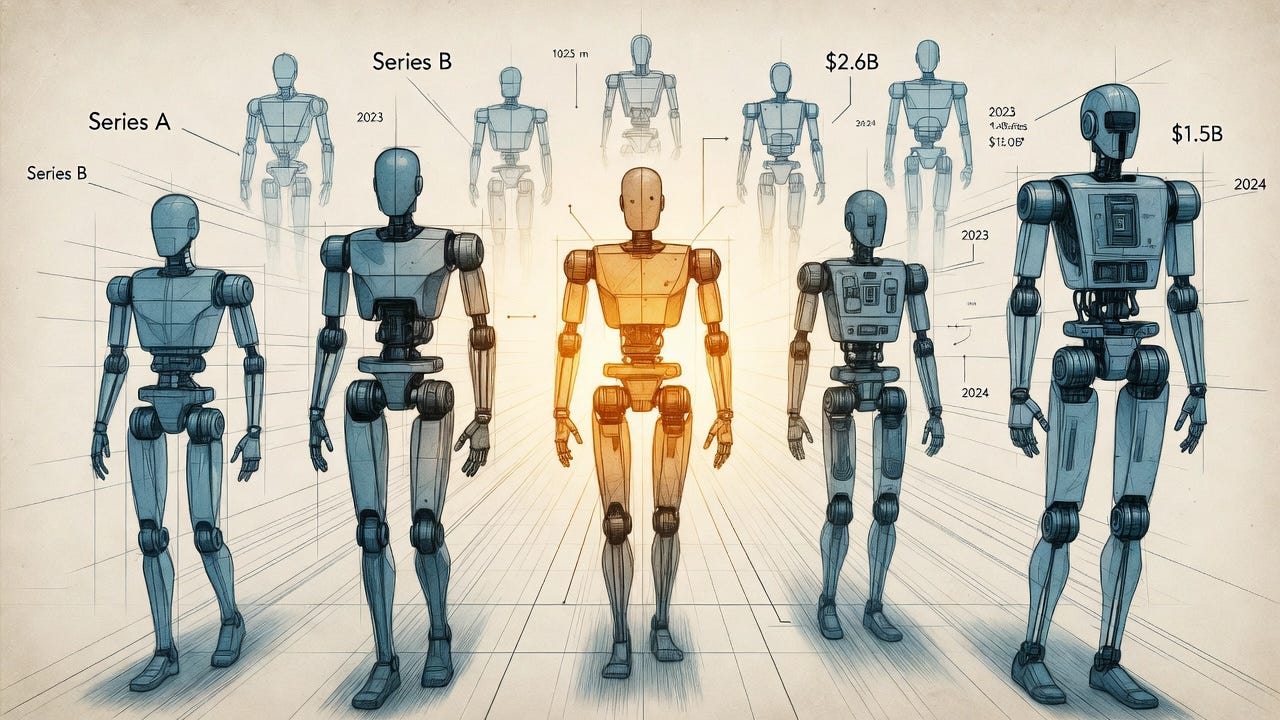
A year later, Figure completed a $675 million funding round at a $2.6 billion valuation. Microsoft, OpenAI, and Jeff Bezos all invested. During the same period, more than a dozen humanoid robot startups raised hundreds of millions of dollars. Venture capitalists who had ignored robotics for years were suddenly fighting to get into deals.
2023 was being called “Year One of Humanoid Robots.”
The question was whether it was the beginning of a revolution or heading toward the peak of a bubble.
Why Now?
The timing wasn’t accidental. Several trends had converged to make the moment feel uniquely promising.
The first was the language model breakthrough. ChatGPT’s release in late 2022 had demonstrated that AI systems could understand and respond to natural language in ways that seemed almost human. For robotics, this mattered enormously. The hardest problem, giving robots common sense, helping them understand what humans actually wanted, suddenly seemed solvable. Google’s RT-2 and PaLM-E had shown that language models could be connected to robot actions. The missing ingredient was no longer missing.
The second was hardware cost. As Chapter 4 described, motors, sensors, and batteries had all improved dramatically while falling in price. A capable humanoid robot that might have cost millions of dollars a decade earlier could now be built for tens of thousands. The components existed. The manufacturing knowledge existed. Someone just had to put them together.
The third was macroeconomic pressure. Populations in developed countries were aging. Birth rates had fallen below replacement in most of Europe, East Asia, and increasingly in the Americas. Labor shortages were appearing in warehouses, factories, construction sites. Companies that had relied on abundant human workers were starting to worry about where future workers would come from.
And the fourth was a shift in investor psychology. The previous decade had produced a handful of technology companies, Apple, Google, Amazon, Microsoft, Nvidia, worth trillions of dollars. Investors were looking for the next platform, the next wave. Robotics, long dismissed as perpetually five years away, was suddenly being compared to the early days of deep learning.
“Investing in robots now,” one prominent venture capitalist argued, “is like investing in deep learning in 2010. The technology is finally ready. The question is who will figure out how to commercialize it.”
The Norwegian Outsider
Not everyone was racing to build humanoid robots from scratch.
In a suburb of Oslo, a company called 1X Technologies had been quietly building robots for years, but with a very different philosophy.
Bernt Børnich, the company’s founder, was a serial entrepreneur who had sold his previous startup to Google. He had been interested in robots since childhood, but when he started 1X in 2014, he made a counterintuitive decision: instead of trying to build fully autonomous robots, he would start with teleoperation.
Teleoperation meant humans controlling robots remotely. The robot had a body, cameras, and manipulators, but a human operator made the decisions. It seemed like a step backward. Wasn’t the whole point of robots to replace human labor?
Børnich saw it differently. “Everyone wants to jump straight to full autonomy,” he explained. “But that’s like trying to build a self-driving car before you’ve built a regular car. You need to understand the problem first. You need data.”
1X’s robots were deployed as security guards, rolling through warehouses at night, checking doors, monitoring for intruders. Human operators, often located thousands of miles away, watched through the robots’ cameras and intervened when needed. It wasn’t glamorous work. But every hour of operation generated data: what the robots saw, what decisions the operators made, how the environment responded.
By 2023, when the humanoid robot craze hit full force, 1X had something most competitors lacked: a working product generating real revenue, and millions of hours of operational data. They used this data to train AI systems that could handle increasingly complex situations without human intervention. The autonomy was emerging gradually, task by task, rather than being designed all at once.
OpenAI invested $23.5 million in the company. The strategy that had seemed cautious now looked prescient.
The Cognitive Robot Vision
Geordie Rose took a different approach entirely.
Rose was a physicist who had co-founded D-Wave, one of the first quantum computing companies. He had spent years working on problems at the edge of what was computationally possible. When he founded Sanctuary AI in 2018, he brought that ambition with him.
“We’re not building robots,” Rose liked to say. “We’re building minds that happen to have bodies.”
Where most robotics companies focused on physical capabilities, walking, grasping, manipulating, Sanctuary focused on cognition. Their thesis was that the hard part wasn’t making a robot move; it was making a robot think. A robot that could reason, plan, and understand context could eventually learn any physical skill. A robot that could only perform pre-programmed movements would always be limited.
Sanctuary’s robots were humanoid, but their most distinctive feature was invisible: a cognitive architecture designed to mirror aspects of human reasoning. The company called it the “Carbon” system, and Rose described it as an attempt to create artificial general intelligence in embodied form.
This was either visionary or delusional, depending on whom you asked. Critics pointed out that artificial general intelligence remained an unsolved problem, and betting a company’s future on solving it was risky. Supporters argued that embodiment itself, having a physical body that interacted with the real world, might be essential to developing genuine intelligence, and that Sanctuary was one of the few companies taking this seriously.
By 2023, Sanctuary had raised over $100 million and had deployed robots in partnerships with major companies. Whether their cognitive architecture worked as advertised was hard to verify from outside. But the vision attracted talent and capital in a market hungry for big ideas.
The Data Flywheel
Across the startup landscape, one concept appeared again and again: the data flywheel.
The idea was simple in principle. A robot deployed in the real world generates data: what it sees, what it does, what works and what fails. This data can be used to train better AI models. Better models make the robot more capable. More capable robots get deployed more widely, generating more data. The cycle accelerates.
The company that could start this flywheel spinning first would have a potentially insurmountable advantage. Each turn of the wheel would increase the gap between them and their competitors. It was the same dynamic that had made Google dominant in search and Facebook dominant in social networking. Network effects applied to physical robots.
But starting the flywheel required solving a chicken-and-egg problem. You needed deployed robots to generate data, but you needed data to build robots worth deploying. Most startups were stuck trying to figure out how to get the wheel moving at all.
Figure AI’s approach was to partner with leading AI companies. Their collaboration with OpenAI aimed to integrate state-of-the-art language models with physical robot control. The hope was that OpenAI’s models could provide the common sense and reasoning that would make Figure’s robots useful enough to deploy, generating the data needed for further improvement.
1X’s approach was to start with simpler tasks, security, monitoring, that didn’t require full autonomy. Their teleoperation model generated data from day one, even before the AI was sophisticated enough to operate independently.
Covariant, a warehouse robotics company that had been operating since 2017, took yet another approach. They had spent years deploying robots that picked and packed items in fulfillment centers. This wasn’t humanoid robotics, their machines were arms mounted on rails, but it generated enormous amounts of manipulation data. In 2024, they would pivot to building what they called the “Robotics Foundation Model,” attempting to leverage years of accumulated data into a general-purpose system.
Each approach had trade-offs. Partnerships could accelerate progress but meant sharing the eventual value. Starting simple generated data but might not scale to more complex tasks. Foundation model approaches required massive computational resources and years of prior data collection.
The question of who would win the data flywheel race remained unanswered.
Agility’s Long Road
Not every humanoid robot company was a startup.
Agility Robotics had been working on bipedal robots since 2015, a spinout from Oregon State University’s robotics lab. Their robot, Digit, looked unlike the humanoids emerging from newer companies. It had backward-bending legs, like a bird, and a relatively small head. The design prioritized stability and efficiency over human-like appearance.
By 2023, Agility had something most competitors lacked: actual customers paying actual money for actual robots.
Amazon had ordered Digit robots for testing in its warehouses. The robots moved totes, plastic bins filled with products, from one location to another. It was repetitive, physically demanding work that humans found exhausting. Digit could do it for hours without complaint.
The deployment was small, a pilot program, not a full rollout, but it represented a threshold that few robotics companies had crossed. Digit wasn’t a demo video or a prototype shown at conferences. It was a product, with a price, doing real work.
Jonathan Hurst, Agility’s co-founder and chief robot officer, had spent two decades working on legged locomotion. He was cautious about the hype surrounding humanoid robots.
“People see the demos and think we’re almost there,” Hurst said. “We’re not. We’re at the very beginning. The robots you see today are like the first automobiles: unreliable, expensive, limited to specific conditions. It will take decades to reach mass deployment.”
This skepticism made Agility an outlier in a field dominated by bold predictions. But Hurst had seen enough failures in robotics to be wary of overpromising. His approach was to focus on specific use cases, prove the technology worked in controlled environments, and expand gradually.
Whether the gradual approach would win against faster-moving competitors remained to be seen.
The Bubble Question
By mid-2024, the signs of froth were unmistakable.
Humanoid robot startups with no revenue and no deployed products were raising hundreds of millions of dollars. Valuations were based on the assumption of trillion-dollar markets decades in the future. Companies competed to release impressive demo videos, knowing that media attention translated into investor interest.
The pattern was familiar from previous technology bubbles. The internet boom of the late 1990s had produced countless companies with grand visions and no business models. The electric vehicle boom of the early 2020s had seen dozens of startups go public through SPACs, many of which subsequently collapsed. The crypto and NFT bubbles had demonstrated how quickly speculative capital could inflate and deflate.
Critics argued that humanoid robots were following the same trajectory. The technology was genuinely improving, but the gap between demo videos and commercial viability remained enormous. A robot that could perform a task once in controlled conditions was very different from a robot that could work reliably for thousands of hours in unpredictable environments.
“Most of these companies will fail,” one robotics researcher told me. “That’s not pessimism. It’s history. Most startups fail, especially in hardware. Most of the capital being invested will be lost.”
But defenders of the current boom pointed to an important difference: the underlying technology had genuinely changed. Previous robot hype cycles had collapsed because the fundamental problems weren’t solvable with available techniques. This time, the combination of large language models, improved hardware, and sim-to-real learning had created real breakthroughs. The question wasn’t whether capable robots were possible, but when and by whom they would be built.
“Yes, most companies will fail,” a venture capitalist countered. “But the winners will be among the most valuable companies ever created. That’s the bet we’re making.”
Startups vs. Giants
The startups faced a fundamental question: could they survive long enough to matter?
Building humanoid robots required enormous capital. The hardware was expensive. The iteration cycles were slow. You couldn’t deploy code to a robot the way you could to a smartphone app. Manufacturing at scale required expertise that most startups lacked. And the incumbents, Tesla, Google, Amazon, Chinese giants like Xiaomi and BYD, had resources the startups couldn’t match.
Tesla’s Optimus, whatever its current limitations, was backed by a company with $30 billion in annual revenue, established manufacturing capacity, and experience building complex electromechanical products at scale. Google had the world’s best AI research teams and computing infrastructure. Amazon had warehouses that needed robots and the capital to wait for the technology to mature.
Against these giants, what advantages did startups have?
Speed was one. Large companies moved slowly, weighed down by bureaucracy, legacy systems, and the need to protect existing businesses. Startups could take risks that would be unacceptable at established firms. They could focus entirely on robots while Google and Amazon juggled dozens of priorities.
Focus was another. The humanoid robot companies had assembled teams whose entire purpose was building humanoid robots. At Google, robotics was one project among many, competing for attention and resources. At Figure or 1X, it was everything.
And talent, perhaps surprisingly, was often on the startups’ side. The best roboticists and AI researchers wanted to work on the most exciting problems, and building humanoid robots was more exciting than incremental improvements to existing products. Several companies had recruited top talent from Google, Tesla, and academia by offering the chance to work on something genuinely new.
But these advantages came with a time limit. Startups needed to show progress before their funding ran out. They needed to reach commercial viability before the giants caught up. They were racing against both technology and capital, trying to establish positions that couldn’t be easily displaced.
“The next two or three years will determine everything,” Adcock said. “Either we’ll prove that startups can lead in this space, or the big companies will roll over us.”
The Optimist’s Case
Despite the risks, there were reasons for optimism.
The technology was genuinely improving faster than skeptics expected. Google’s RT-2 had shown that language models could give robots common sense. Sim-to-real transfer had proven that skills learned in simulation could work in the real world. Hardware costs were falling along predictable curves. Each year brought robots that were more capable and less expensive than the year before.
The market need was real. Labor shortages weren’t theoretical. They were already affecting industries from warehousing to agriculture to construction. Companies were desperate for solutions that didn’t depend on finding human workers willing to do difficult physical jobs. If robots could fill even a fraction of this need, the demand would be enormous.
And the capital was available. Unlike previous waves of robotics enthusiasm, which had been funded by small research grants and hopeful venture investors, the current wave had attracted serious money from serious sources. Companies like Microsoft, Amazon, and Nvidia were making strategic investments. Sovereign wealth funds were participating. The financial infrastructure existed to fund the long development cycles that robotics required.
The comparison to autonomous vehicles was instructive. A decade earlier, self-driving cars had been dismissed as fantasy. Today, Waymo operated commercial robotaxi services in multiple cities, and Tesla’s Full Self-Driving was logging millions of autonomous miles. The technology had taken longer than optimists predicted but had arrived faster than pessimists expected. Humanoid robots might follow a similar trajectory.
The Pessimist’s Case
But there were also reasons for caution.
The history of robotics was littered with promising technologies that never reached mass deployment. Research demonstrations routinely showed capabilities that proved impossible to commercialize. The gap between “works in the lab” and “works in the real world” had defeated countless companies.
Humanoid robots faced particular challenges. Bipedal locomotion was inherently less stable than wheeled or tracked alternatives. Human-like form factors were designed for human aesthetics, not engineering efficiency. Building a robot that looked like a person might actually make many tasks harder, not easier.
The regulatory environment was also uncertain. Robots operating alongside humans raised safety questions that hadn’t been fully addressed. Who was liable when a robot injured someone? How should robots be tested and certified? These questions had slowed autonomous vehicle deployment for years; they might slow robot deployment as well.
And the economics remained unproven. Building capable humanoid robots was clearly possible. Building them cheaply enough to compete with human labor was another matter. A robot that cost $100,000 and required constant maintenance might not be economically viable even if it technically worked.
“The technology will continue to improve,” one skeptical researcher argued. “But ‘better than before’ isn’t the same as ‘good enough to deploy.’ We might be decades away from robots that work reliably in unstructured environments.”
Year One
Whatever the eventual outcome, something had clearly changed.
A field that had been backwater of technology, interesting to researchers, ignored by investors, irrelevant to the broader economy, had suddenly become one of the most watched sectors in the world. Companies that hadn’t existed a few years earlier were raising billions of dollars and recruiting top talent. Technologies that had seemed purely academic were being commercialized.
The startup surge might prove to be a bubble that would eventually deflate. Or it might be the beginning of a transformation as significant as electricity or the automobile, technologies that reshaped not just industries but the structure of daily life itself. The honest answer was that no one knew.
What was certain was that a remarkable number of smart, ambitious people were betting their careers and fortunes on humanoid robots succeeding. They were building companies, hiring engineers, raising capital, and shipping prototypes. Whether or not they succeeded, their efforts would shape the field for years to come.
Notes & Further Reading
On Figure AI and Brett Adcock: Coverage in Bloomberg, Forbes, and The Information documents the company’s rapid rise. Adcock’s previous company, Archer Aviation, provides context for his approach to building hardware companies.
On 1X Technologies: The company’s Norwegian origins and teleoperation-first strategy are covered in European tech media. OpenAI’s investment announcement provides details on their AI collaboration.
On Sanctuary AI and Geordie Rose: Rose’s background with D-Wave and his vision for cognitive robots are documented in various interviews and conference presentations. The company’s “Carbon” cognitive architecture is described in their technical publications.
On Agility Robotics: Academic papers on Digit’s design, plus coverage of their Amazon partnership, provide both technical and business context. Jonathan Hurst’s research at Oregon State predates the company.
On the data flywheel concept: The strategic importance of data in AI development is well documented. Specific applications to robotics are discussed in various industry analyses and venture capital presentations.
On robotics investment trends: PitchBook, CB Insights, and similar services track venture funding. Multiple analyses have attempted to characterize the 2023-2024 surge in humanoid robot investment.
On the bubble question: Historical comparisons to previous technology bubbles are discussed in financial media. For the opposing view, see optimistic analyses from robotics-focused investors and researchers.