
The Thermodynamics of Intelligence, Part 2: The Valley Floor
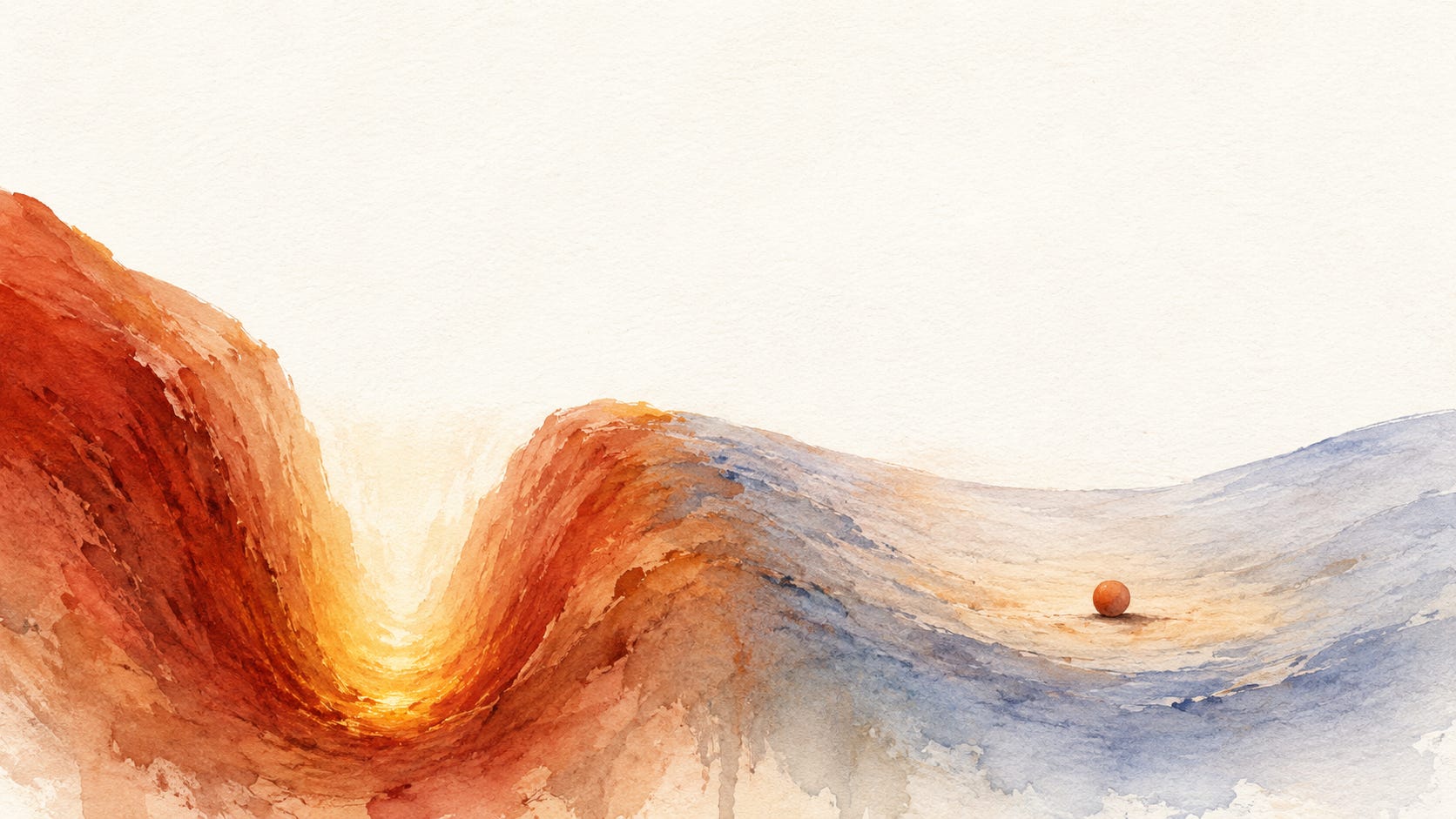
Store a memory and you carve a valley. Recall is rolling downhill. But the landscape invents valleys nobody dug, and heat turns out to be the cure. Memory has a melting point.

Three Notes
You are in a supermarket, somewhere between the coffee and the bread, and three notes come out of the ceiling speakers. Before the fourth note arrives you have the whole song, and with the song comes a summer, a particular car, a person you have not thought about in fifteen years. None of that was in the three notes.
Consider how strange this is as an engineering specification. No filing system you have ever used behaves this way. A database wants the key before it gives you the record; ask it with a corrupted key and it returns nothing at all, politely. Your memory did the opposite. It took a fragment, filled in the rest without being asked, and delivered a whole that dwarfed the cue.
Part 1 of this series ended with the reason this is possible, at least in the artificial case. Memory in a Hopfield network is not stored in a place. It is stored as the shape of an energy landscape, a terrain of hills and valleys, with each remembered pattern sitting at the bottom of its own valley. Recall is not a lookup. It is a descent.
This installment walks into that landscape and finds three things that are not obvious from the outside. Memories that live everywhere and nowhere. Valleys that nobody dug, holding memories that never happened. And a cure for those false valleys that sounds like a mistake: heat.
