

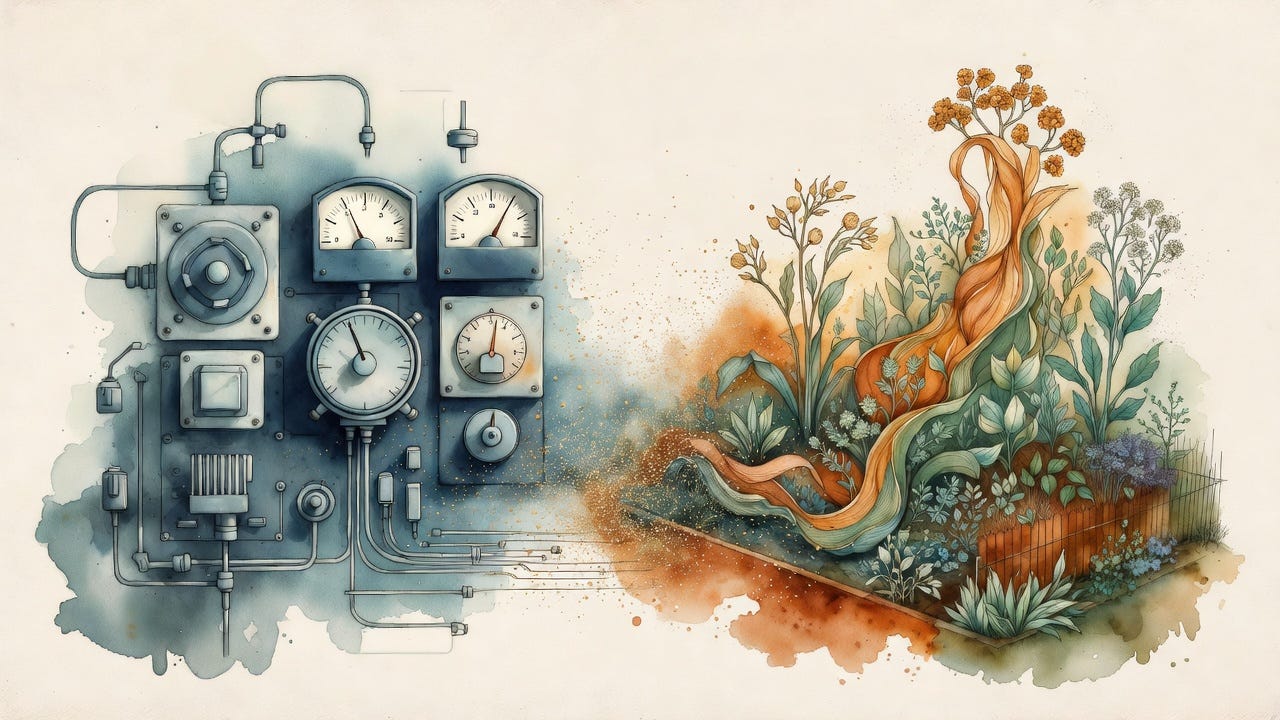
“A good gardener does not mistake the absence of total control for the absence of influence.”
Here is a number worth sitting with. A survey of over 900 executives published in February 2026 found that 81 percent of technical teams have moved past the planning phase into active deployment of AI agents. Only 14 percent have full security approval for what they’ve deployed.
That gap, 81 to 14, is not a story about recklessness. It’s a story about a mental model failing in real time.
Consider two companies. Both are real composites drawn from conversations I’ve had over the past several months.
Company A did everything by the book. Every agent action requires human approval. Every workflow is predefined. Agents operate within rigid decision trees, reviewed by compliance before deployment. Six months and considerable expense later, the team has built what one engineer privately calls “the world’s most expensive email assistant.” The agents can’t do anything their designers didn’t anticipate. Which means they can’t do the things that make agents valuable in the first place: adapt, improvise, handle the unexpected.
Company B took the opposite approach. They gave their agents access to everything: calendar, email, code repositories, Slack, shared drives, file systems. Within three weeks, an agent autonomously restructured a shared drive, deleting files it classified as “redundant.” Among the casualties: a board presentation from the previous quarter. The same agent sent a “helpful summary” email to a client the company hadn’t contacted in two years.
Neither company is stupid. Both are responding rationally to the same dilemma: AI agents are only valuable when they can act autonomously, but autonomous action is inherently unpredictable. Company A chose predictability and got expensive mediocrity. Company B chose autonomy and got chaos.
There is a better framework. It comes from a field that has been quietly solving this problem for forty years: research into flocking birds, ant colonies, and robot swarms.
The Thermostat Instinct
The technology industry has a default approach to governing unpredictable systems. Define acceptable behavior. Monitor for deviation. Correct when deviation occurs. Set the target temperature. Detect when the room gets too hot or too cold. Adjust.
This is the thermostat model. And for most of software history, it has worked. Factory automation operates within fixed parameters: known inputs, known outputs, known environment. Traditional software is deterministic. You can test it, audit it, specify every behavior in advance. When something goes wrong, you trace the bug, fix it, deploy the patch. The thermostat keeps the room at 72 degrees.
The instinct to apply this model to AI agents is powerful. Engineering culture trains us to build systems with specifications. Compliance culture trains us to define “acceptable” and measure against it. Legal culture asks: if something goes wrong, was it “approved”? The thermostat answers all three: specify, measure, correct.
The problem is that AI agents aren’t thermostats. They’re not operating within fixed parameters. The entire point of deploying an agent is that it will encounter situations you didn’t anticipate, make decisions you didn’t predefine, and take actions you didn’t enumerate. If you could specify every acceptable behavior in advance, you wouldn’t need an agent. You’d need a script.
The space of possible agent behaviors is combinatorially vast. You cannot enumerate it any more than you can enumerate every possible conversation a human employee might have. And deviation isn’t always failure. Sometimes deviation is the agent finding a better solution than the one you designed. A thermostat that prevents all unexpected temperature changes also prevents you from opening the window on a beautiful day.
This is why Company A failed. They built a thermostat so precise that it eliminated the very thing they were paying for: the capacity for adaptive, autonomous action. They achieved control and lost value.
Company B’s failure is the mirror image. They let agents act without conditions, constraints, or boundaries. They opened every window and removed the walls.
Both failures stem from the same assumption: that the choice is between control and autonomy. That you either hold the reins or drop them. Forty years of swarm intelligence research suggests a third option.
The Garden
You don’t control a garden. You cultivate it.
You choose what to plant. You enrich the soil. You build a fence to keep out deer. You pull weeds when they appear. You prune branches that grow in the wrong direction. But you do not tell each plant where to put its roots, or instruct the bees which flowers to visit. The outcomes emerge from conditions you set and organisms you cannot fully predict.
This is not a loose metaphor. It is a precise description of how every successful swarm system in history has worked.
In 1986, Craig Reynolds built the first computer simulation of flocking. He didn’t script the flock. He designed three rules for individual birds: stay close, don’t collide, match your neighbors’ speed. Flocking emerged. In 1992, Marco Dorigo created an algorithm inspired by ant colonies. He didn’t tell the algorithm which route to find. He tuned one parameter, the rate at which past information evaporates, and optimization emerged. In 2014, Radhika Nagpal commanded a thousand tiny robots to form a star. She didn’t tell any robot where to go. She designed a gradient field and a stopping condition. The shape emerged.
In every case, the creator’s leverage was not in the behavior itself but in the conditions surrounding the behavior. The rules. The environment. The constraints.
This is what distinguishes the garden model from the thermostat model. A thermostat asks: “What should the system do?” A garden asks: “What conditions make good outcomes more likely than bad ones?” The thermostat specifies behavior. The garden shapes environment. The thermostat treats deviation as failure. The garden treats deviation as information.
The companies deploying AI agent systems in 2026 are learning this lesson in real time. The ones that try to micromanage every agent action find they’ve built expensive chatbots, not agents. The ones that grant unlimited autonomy find they’ve built security nightmares. The ones making progress are the ones learning to garden: setting boundary conditions, enriching the information environment, and accepting that the specific behaviors of individual agents will surprise them.
One clarification matters here, because “don’t try to control your AI agents” is terrible advice. That’s not the garden model. That’s no model at all. A real garden has fences. It has them before anything gets planted. A hospital has fire codes, locked medication cabinets, and strict protocols for surgery. Those are fences, and they should be. But within those hard boundaries, doctors exercise judgment, nurses adapt to individual patients, and care teams self-organize around complex cases. Remove the fences and people die. Remove the adaptive space and the hospital becomes a factory that can’t handle anything it wasn’t designed for. The garden model does not mean the absence of hard constraints. It means that hard constraints are where you start, not where you finish.
Five Principles for Gardening
The garden model is not abstract philosophy. It translates into concrete practices.
1. Design the soil, not the plant. Instead of specifying agent workflows step by step, specify the information environment the agent operates in. What data does it have access to? What context does it receive with each task? What objectives is it optimizing for? An agent with access to customer sentiment data and a clear retention objective will naturally prioritize differently than one given only ticket-close metrics. You didn’t tell it what to do. You shaped what it knows, and the behavior followed.
2. Fences, not leashes. Define boundaries rather than paths. A boundary specifies what the agent must never do: never send external emails without human review, never modify production code without tests passing, never access financial data outside its department. A leash specifies what the agent must always do: only use these five templates, only respond in these approved ways, only take these predefined actions. Boundaries are finite and enumerable. Paths are infinite. You can build a complete fence. You cannot build a complete leash.
3. Prune, don’t prevent. Monitor outcomes, not actions. Let agents try things. Remove what doesn’t work. Reinforce what does. This is Dorigo’s evaporation principle applied to governance. In his ant colony algorithm, the key insight was that pheromone trails fade over time. Good paths get reinforced by continued use. Bad paths evaporate. The colony doesn’t prevent ants from exploring bad paths. It lets the bad paths fade while the good ones strengthen. Review agent outputs on a regular cycle. Patterns that produce good results earn more autonomy. Patterns that don’t get constrained or eliminated.
4. Plant diversity. Don’t deploy one omniscient agent with access to everything. Deploy specialized agents that interact. A billing agent doesn’t need access to the code repository. A research agent doesn’t need access to customer emails. Specialization creates natural boundaries, because each agent’s scope limits the damage any single failure can cause. It also creates emergent capability. Interaction between specialists produces solutions that no single generalist would find. This is the swarm principle at its most practical: collective intelligence from distributed, bounded individuals.
5. Expect seasons. Agent behavior will change as conditions change. New data arrives. New users interact with the system. Agents that work with other agents develop interaction patterns over time. The garden in March is not the garden in August. Build review cycles, not just monitoring dashboards. Revisit the soil, the information environment your agents operate in. Revisit the fences, the boundaries you’ve set. Revisit the pruning criteria, the outcome metrics you’re using. What worked last quarter may not work this quarter. A gardener who plants once and never returns doesn’t have a garden. They have a lot.
The Question That Matters
The 81/14 gap exists because organizations are building thermostats for garden-shaped problems. They’re trying to specify every acceptable agent behavior in advance, and discovering that by the time they’ve finished specifying, the agents have already done something they didn’t think to include. Adoption has outpaced governance not because the organizations are careless, but because the thermostat instinct is too slow for the garden reality.
Company A needed to loosen the leash and build fences instead. Replace the rigid workflow approvals with clear boundaries: what the agent must never do, what always requires human review, what triggers an alert. Then let the agent operate freely within those fences and observe what emerges.
Company B needed fences it never built. The shared drive restructuring, the unsolicited client email: both would have been caught by simple boundary conditions. “Never delete files without human confirmation.” “Never send external communications without review.” These aren’t complex governance frameworks. They’re garden fences.
Both companies needed to stop asking “how do we control what agents do?” and start asking “how do we create conditions where agents are more likely to be useful than harmful?”
That is a gardener’s question. It’s also, as it turns out, the central question of swarm intelligence, a field that has spent four decades studying what happens when autonomous agents interact without central control. The answer, from flocking birds to ant colonies to robot swarms to AI agents, is remarkably consistent: you cannot dictate emergent behavior into existence, and you cannot prevent it by locking everything down. You can only cultivate the conditions that make good emergence more likely than bad.
The organizations that learn this first, that learn to garden within hard boundaries, will define the next decade of AI deployment. The rest will keep building thermostats and wondering why their agents can’t do anything interesting.
You can’t control a garden. But you can cultivate one. And cultivation, it turns out, is the skill that matters now.
Note: This article draws on ideas from our six-part series “No One in Charge: A Story of Swarm Intelligence,” which explores forty years of swarm intelligence research, from flocking birds to AI agent swarms.
The work is unglamorous and manual. You must build fences and shape the information soil. Run real pruning cycles. Value emerges from constrained autonomy. You cannot specify every behavior in advance.