


This is Episode 12 of Reading the Frontier, a series of close readings of what the frontier labs publish.
Fifteen off-brand Android TV boxes, about $55 each, sit on one network and run a language model with 26 billion parameters between them. Each box holds two of the model’s layers, and the model’s thinking passes from box to box in turn. The group answers at 0.39 tokens a second, a word-sized scrap of text about every two and a half seconds.
William Zhou and Daniel Freeman of Anthropic’s Frontier Red Team bought those boxes and networked them for a post published on 12 October 2026. Their forecast is that small AI models may be months away from copying themselves onto cheap devices like these.
Picture two million of them. A botnet that size sounds like a supercomputer, and an AI worm running on it sounds like something no defender could outrun. By the post’s estimate, though, the whole fleet would think with at most about 40 H100s-worth of inference, and the post itself calls that “a tiny amount of compute in absolute terms”. H100s are datacenter chips. The worm in question is a weight-based replicator: it carries a model’s weights with it and runs the model on each host it infects. Such a worm would not be fast. What it would have, by the post’s claim, is no single point where anyone could shut it off.
The post splits replication into four stages: finding targets, gaining execution, getting a model running on the new host, and continuing from there. It largely skips the first two and measures the third, whether a model can get itself running on a machine it did not come with.
The break-in step was kept trivial by design, an unauthenticated debugging interface, so by the post’s own account its result is an upper bound on real-world success. The date is softer still: it rests on a trend in a general capability index that the post calls a proxy and a rough estimate.
From fifteen boxes to two million
Start with one box. A TV box in this price range ships with between 1 and 4 gigabytes of memory. At 4 gigabytes and 4-bit weights, a 9-billion-parameter model needs four or more boxes, and a 26-billion-parameter model needs ten or more. The demo used fifteen. A mind in this world is a group of boxes, each holding a slice.
Now scale up. The post takes its botnet from Kimwolf, which Synthient reported at somewhere over 2 million devices at its peak, mostly Android TV boxes. Divide that fleet into groups of fifteen and the post counts about 133,000 copies of the model. A group like the demo’s can serve two agents at once at roughly 0.3 tokens a second each, a rate averaged over reading a prompt and writing a reply. Across the fleet that makes 80,000 tokens a second.
One scoping note before the comparison. This is a replicator that carries its own model. One that borrows its thinking from a few GPU machines is a different animal, and for that one the question moves to those machines.
An H100 serves the same model at about 1,950 tokens a second when it handles many users at once and uses speculative decoding, a speed-up technique. Setting the fleet’s rate against that one, the post reaches at most about 40 H100s-worth of inference. The two rates are measured differently: the boxes’ rate is averaged across reading and writing, while the H100’s is a high-concurrency figure with a speed-up technique. So the forty is a rough equivalence, and the post itself calls its estimate rough.
On that rough figure, two million machines buy almost no thinking. The post flags what the estimate rests on: a single class of hardware and a single past botnet, while a real replicator would also use other low-security compute and put models of different sizes on different devices. Even so, it describes what a simple replicator released in the near future might look like.
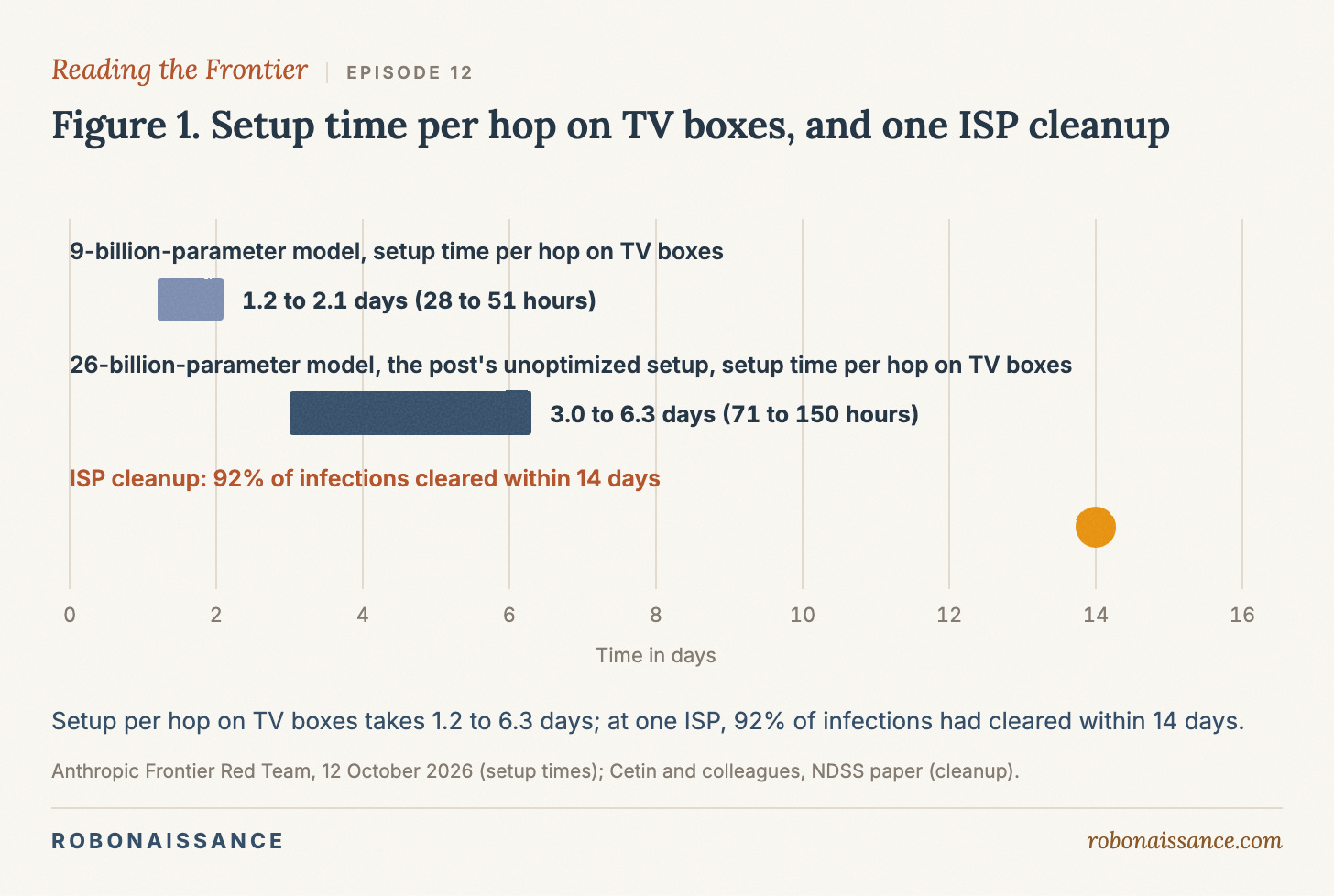
Thinking speed also matters less to a worm than the step it must repeat at every hop: setting itself up on a new box. Setup is a long run of reading and doing steps, and a model can hold only so much text in mind at once. On the post’s timing, that amount is a 32,000-token window, and a complete setup uses a window up between 2.6 and 4.7 times over. One window takes about 11 hours with a 9B model and 27 to 32 hours with the 26B. Multiply it out and a full setup takes 28 to 51 hours for the 9B model and 71 to 150 hours for the 26B. In days, that is 1.2 to 2.1 for the smaller model and 3.0 to 6.3 for the larger.
The post’s own picture of such a swarm is a slime mold, replicating over days. It calls the agents slow replicators, and by its account what doubles on that timescale of days is the number of copies.
Slow does not mean the defenders win. A measured cleanup of a botnet like this is old and small: when one medium-sized ISP used outside evidence of infection to quarantine and notify its Mirai-infected customers, 92% of infections cleared within 14 days. One ISP and one old botnet cannot stand for every defender. The figure supports a narrower point: a slow replicator is not automatically a beaten one, because even a successful cleanup took days. Figure 1 puts the replicator’s setup time per hop beside that cleanup.
Where the thinking runs
The comforting claim about AI and security is that when attackers and defenders get the same capability, the balance stays level. An idea called the Defender’s Advantage is the name for that claim. The name sounds like a promise to defenders, and the case that introduced it showed it failing. In a study of AI agents finding exploitable flaws, the outcome was set by tempo and cost, and both favored the attacker. That study’s own economics were $1.22 per agent run and exploit revenue doubling every 1.3 months, and the conclusion was conditional on adoption tempo and top-of-pyramid resources.
Two million boxes put a condition on the tempo half of that finding. Where the attacker’s thinking runs on borrowed edge hardware, the box sets the pace, and the pace is days per hop. Tempo then stops favoring the attacker automatically. Cost still does: a related worm paper from June 2026 puts the attacker’s marginal cost per new infection at zero, because the worm runs on stolen compute, and the post’s fleet is made of cheap devices. By that paper’s account, then, the attacker pays almost nothing for each hop, however slowly it comes. That adds a condition to the tempo-and-cost finding that replaced the parity claim, and it does not restore the parity claim. How near the threat is stays a separate question.
The condition makes a prediction that later evidence can check. The post expects small models to reach the level of GLM-5.2, the weakest model in its tests that got through the end-to-end spread, by the end of this year if they keep their historical pace. Small models are not there yet. A repeat of the setup test with models at that level, on 4-gigabyte boxes, should still report days per hop. Hours on the same hardware would mean the condition is wrong.
The post’s other half-claim is a different kind of statement. It says such a replicator would be challenging to shut down, since there is no centralized point to shut off: copies would live on many strangers’ devices. An ISP quarantine can clear infections inside its own network, but eliminating the replicator completely would mean coordinating across every ISP with an infected network, which the post calls difficult. That, more than speed, is the part of the threat that slow thinking does not shrink.
The paper “AI Agents Enable Adaptive Computer Worms” works on the half the post sets aside, the break-in and the spread. It ran 15 experiments on a lab network of 33 hosts, 28 without local GPUs and 5 designated GPU hosts. In seven days of autonomous operation per run, the worm propagated to an average of 20.4 hosts and replicated onto 61.8% of the network. The thinking came from a shared GPU pool, and setting up inference on a new host was tested separately. Individual break-in attempts succeeded in 44% of cases, and no target ran endpoint detection, antivirus or an active firewall.
The separate test is where the two kinds of replication differ. Ordinary replication means copying itself onto another host without having to set up a thinking service there. Full replication onto a GPU host includes setting up its inference service. The worm fully replicated onto a GPU host in 68.8% of 32 attempts, against 93.8% for ordinary replication on the same samples.
That design is also the strongest objection to the call. In the paper’s architecture, weak machines extend the worm’s reach and ask upstream GPU nodes to do the reasoning. The post makes the same point: a replicator would not have to load a model onto every device it compromises. A hybrid swarm like that thinks fast wherever it has a few GPU hosts, so slowness is not a property of every replicator. It is a property of the one that carries its own model, the one the post studies. The hybrid moves the question to the GPU hosts. Where those are edge accelerators, they are few and hard to reach: the post counts 9,000 to 35,000 H100-equivalents in edge accelerators and puts the reachable share an order of magnitude or more lower. Most of them, it says, are not web-reachable. That estimate covers edge accelerators only, so a hybrid swarm able to reach other GPU pools, such as cloud or datacenter machines, falls outside it. And in the paper’s own network, where 5 of 33 hosts had GPUs, standing up inference on a GPU host was the step that failed more often.
The limits belong in one place. In the post’s end-to-end test, GLM-5.2 was the worm’s brain, running on a separate server and asked to stand up a smaller model, Llama3.1-8B, on eight emulated Android nodes. It is not the 26B model on the TV boxes. It spread to all 8 nodes in four of five trials and to 7 in the fifth. The real TV boxes ran only the demo and the timing workload. The paper’s targets were deliberately soft, and its results speak to reasoning about individual weaknesses, not to finding sparse targets in a hardened network or persisting under active monitoring. The post expects a fast replicator to leave a traffic signature that ISP monitoring could see, and it has not tested a replicator that acts intelligently against defenders.
The fifteen boxes in the demo think at a token every two and a half seconds, and the two people who bought them can end the experiment by pulling a plug. A swarm of two million would be just as slow, group by group, and by the post’s account it has no plug to pull.
Reading the Frontier. Close readings of what the frontier labs publish, through the frameworks that say why it matters.