

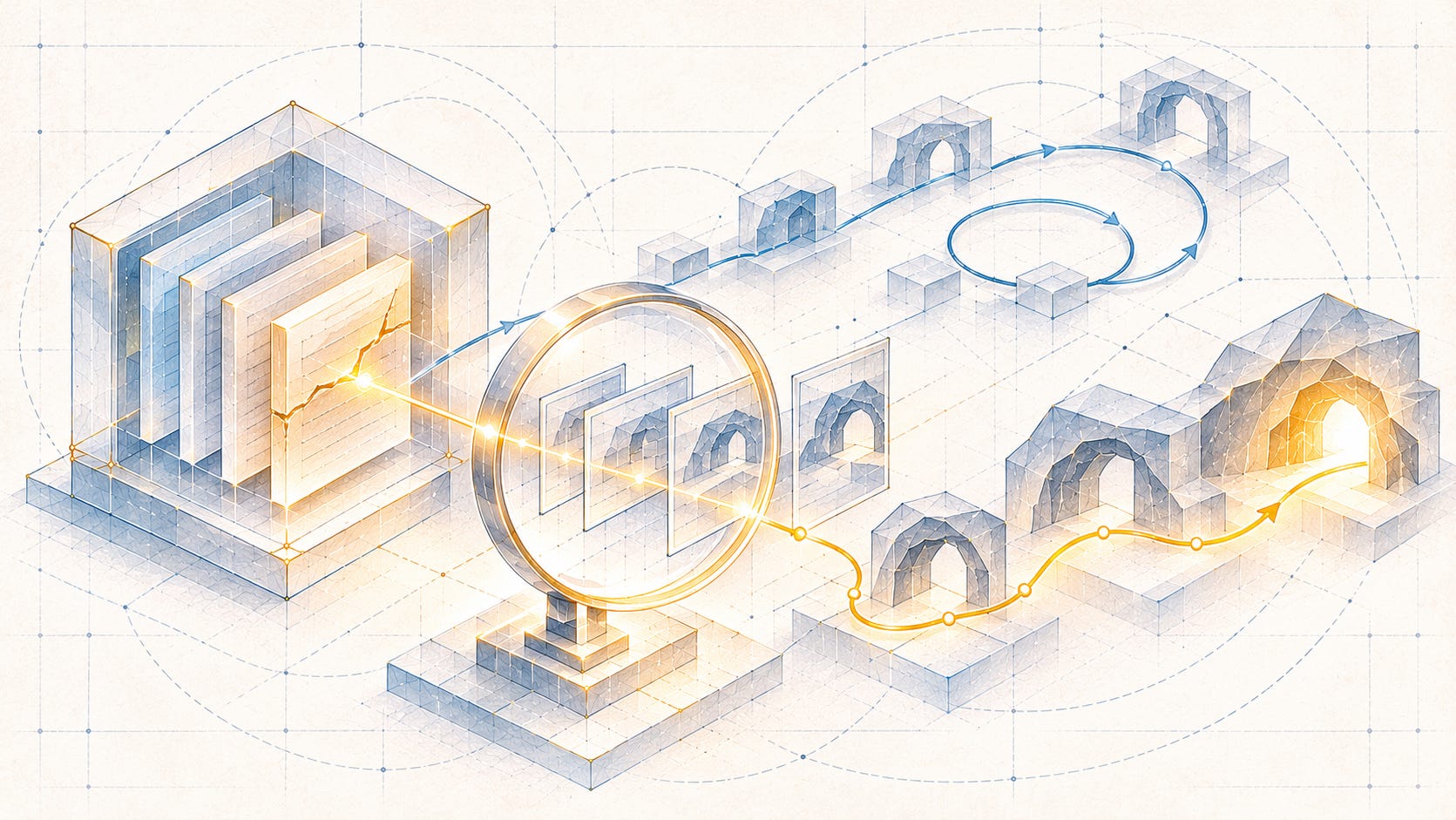
In Pokémon Red, the way east runs through a cave called Mt. Moon. You go in on the west side of the map and come out on the east. Near the entrance is a trap. It is a one-way ledge. Step off it and you drop onto the route you walked in on, and there is no clear way to climb back up. A small building, the PokéCenter, stands at the mountain’s entrance.
Claude, playing the game in an Anthropic test, used that building as a landmark. It had a folder of files it could write to and read back as it played, and at some point it wrote in them that the PokéCenter stood on the east side of the mountain. That was wrong when it was written. Nothing had moved. The note had simply never been true. So when Claude walked out of the PokéCenter, it told itself the mountain was behind it, and it updated its notes: “Mt Moon DONE”. A few actions later it walked off the ledge and landed back on the route it had come from.
What it did next is the part worth slowing down for. Its navigation tool did not show the drop. From where Claude stood, it had simply ended up somewhere unexpected, and it needed a story to explain that. The story it chose was that it had wandered too far west, which meant, it concluded, that it had been on the correct side of the mountain all along. The wrong note did not just send it the wrong way. Unable to see the drop, Claude most likely built that story on the note, and the story in turn protected the note from doubt.
In the run with that note left alone, Claude fell off the ledge three times. After the third, it wrote that it would stop instead of going round in circles again. The test setup answered with an automatic reply telling it to carry on, so it did. It walked all the way back to Pewter City, the town before the mountain. Lance Martin, who wrote up the work, says it hoped to heal and restock there. The run ended without Claude ever reaching Cerulean City on the far side.
The team then tried something else on the same memory folder. They ran an offline pass over it, which Anthropic calls dreaming: Claude does not play, but rereads what it has stored against the record of what happened. Claude checked the location note against the session’s transcript, the setup’s own log of the play, found the error and rewrote the note. With the corrected note, it went straight back into the cave and eventually reached Cerulean. On the report’s chart that happens at action 1,935. A third run, with no memory at all, never got past the mountain either.
These are single runs, and nothing in them isolates the correction from whatever else differed between them. Nor does the report show that the wrong note did worse than having no notes, since both runs stalled at the same mountain. What it shows is narrower and, I think, more useful. Having a memory did not get Claude through. Having a memory that had been checked against what actually happened did.
Here is what the scene shows, put plainly. A note is a claim. Someone wrote it from what one stretch of work seemed to show, and it reads exactly as true after it has turned out to be false. So memory helps only as far as the agent can test what is in it against something able to settle the question, and actually does. That is why an agent that only remembers can be worse placed than one that also checks what it remembers: the remembering agent inherits its own mistakes with all the authority of the written word.
This matters now because memory folders are turning into an ordinary part of agent software. Anthropic released a file-based memory tool in public beta in September 2025. Martin’s report, published on 6 November 2026 on Anthropic’s engineering blog, is the company’s account of watching its models write and reread such memory across several tasks. A note written in one session can be loaded into every session after it. If the note is wrong, every later session can begin with the same mistake.
How a wrong note survives
The cave case already used the few terms that matter. A session is a bounded stretch of work, and when it ends the model’s working context is gone. A memory note is text saved so a later session can read it. The transcript is the setup’s record of what happened, kept apart from the notes the agent chose to write. It is the difference between a scribble on your hand saying you parked on level three and the garage’s camera footage. The scribble is short, handy and written by you, in a moment when you may have been wrong. The footage is long and awkward to search, and nobody wrote it to make a point.
What kept Claude’s error alive was not stubbornness. It was a gap in what it could see. The navigation tool left out the drop, the one fact that would have contradicted the note, so the evidence Claude did have could be read in the note’s favour, and was: it put its unexpected position down to overshooting west. A belief that can explain away its own failure is hard to dislodge from inside the session that holds it. The note was tested only when it was set against the record.
People who built Claude’s Pokémon setup had seen versions of this before. In March 2025, David Hershey, who started the Claude Plays Pokémon project, told Kyle Orland of Ars Technica about a mistaken exit coordinate in Viridian Forest that kept the model exploring nearby for a long time. His summary of the model’s relationship to its own notes was blunt: “The things that are written down in the past, it sort of trusts pretty blindly.” The failure was already familiar to the people watching. Mt. Moon documents it in unusual detail.
What better notes had in them
A game makes for a vivid failure. A quieter task in the same report shows what success looked like and how unevenly it came.
On a task from a benchmark called CL-Bench 1.0, Claude answers a series of questions by looking things up in a database. After each answer it is told the correct one, and it can write a note for next time. Every question starts a fresh session. The only thing that carries over is a directory of memory files. In principle this allows a tidy learning loop: get something wrong, guess why, test the guess, and save what survives as a rule.
The models differed sharply in how far around that loop they got, and Martin’s descriptions of their folders show the steps. Claude Sonnet 4.6 got as far as theories. Its folder held a scatter of files, each listing guesses it had never tested. Claude Opus 4.7 gathered its notes into one reference document and began marking which facts it had checked and which were still unconfirmed. Claude Sonnet 5 marked each answer as confirmed once the grader had checked it, and wrote a correction when it had been wrong. Claude Opus 5 went all the way. Most of its entries carried a rule, a note of how it knew the rule was true, and warnings about traps it had met. The later Opus 5.5 and Sonnet 5.5 did the same.
Look at what changes along that line. The notes do not just get tidier. They start to say how they are known. A rule that comes with its own evidence can be judged by whoever reads it next, while a bare guess cannot.
Then comes the most telling observation in the report. The team noticed that Sonnet 4.6 often did not open its memory directory at all, and did not test its theories about why an answer had been wrong. They told it to do both: read its memory files before answering, then explicitly test its theories. Its score nearly doubled.
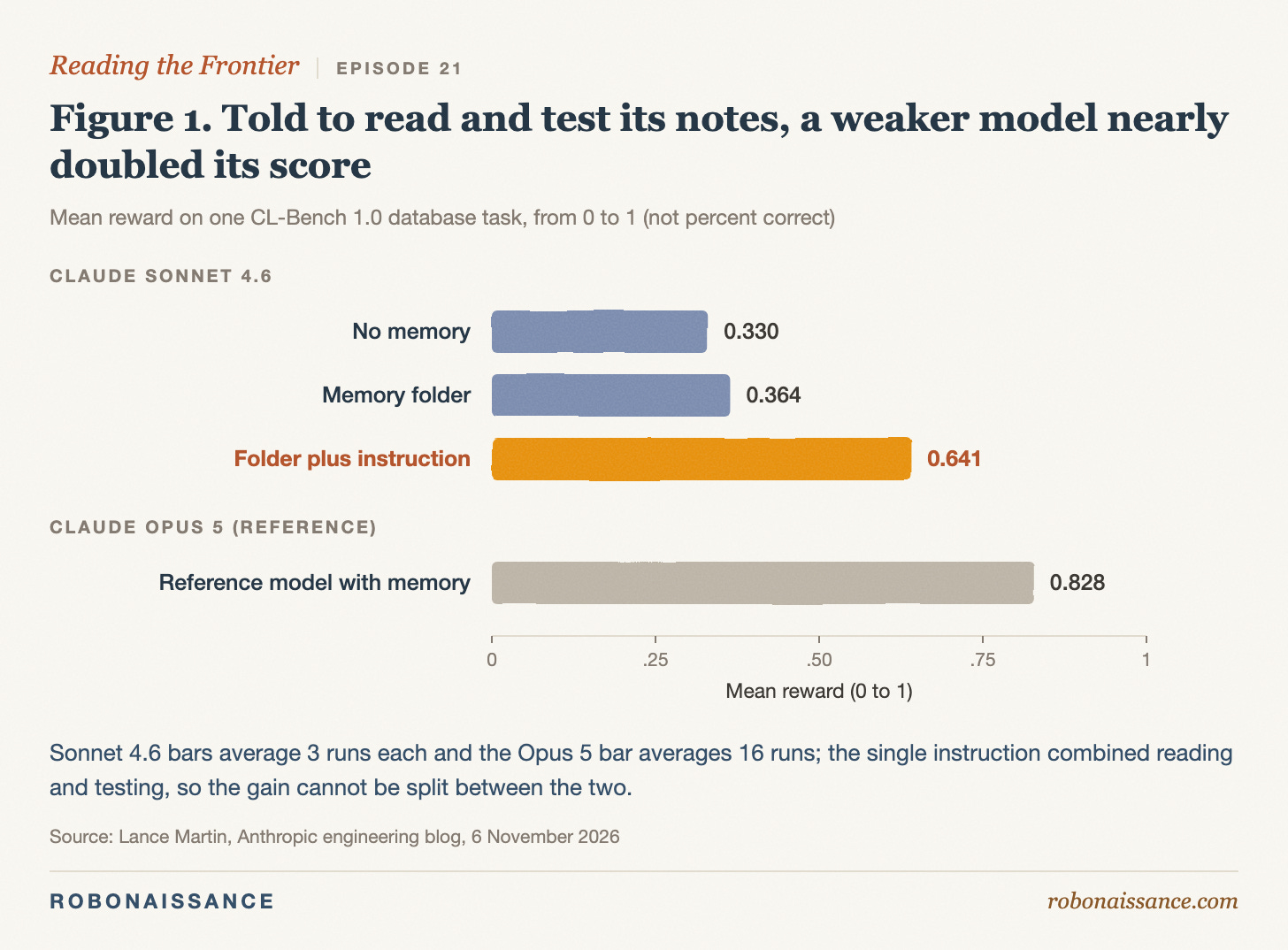
A memory folder alone barely helped the weaker model, but being told to read its notes and test its theories lifted it much closer to the stronger model.
A memory folder alone moved Sonnet 4.6 from 0.330 to 0.364, which is hardly anything. The folder was there, and it barely helped. The jump came when the model was made to use it and to put its guesses to the test. Sonnet 5, Martin reports, read its memory before answering nine times out of ten without being asked. Sonnet 4.6 did so less than half the time.
Two limits keep this from proving more than it does. The single instruction told the model both to read and to test, so the result cannot say how much of the gain came from each. And across models, the note-keeping habit and raw ability rise together. Opus 5 writes better notes and is also a stronger model, and no run here pulls those two apart. The conclusion that checking accounts for a large share of what makes memory pay is my inference from these cases. It is not something the report measures directly.
Two other findings sharpen what checking should mean. The first is from Martin himself: writing down a verified fact is a bet that a future session will want to rely on it without double-checking. That sounds like it cuts against everything above, but it doesn’t. A checked note is exactly the kind of note that can be reused without rechecking, because the check has already been done and the note says so. The aim is not to verify everything on every use. It is to make sure that what gets relied on was verified once, and that the note shows it.
The second finding is a caution against turning this into rigid procedure. When the team gave the stronger models a fixed rule about what to write, such as record only failures, Opus 5 and Opus 4.7 lost much of the benefit memory had given them. For those models, simply saying that a memory folder existed worked better than prescribing how to fill it. Checking is a habit of judgment, not a template.
The game makes the same point from the opposite direction. At about 10,000 steps into one run each, Claude Sonnet 3.7 had written 413 memory files across 225 folders and earned one badge. Claude Fable 5 had ten files and four badges. Sonnet 3.7 recorded nearly everything: battles, items, characters it had met. Much of that record went stale as the game moved on. At one point it spent 17 steps creating six files and deleting nine without making a single move in the game. Fable 5 kept a current goal, a plan for the gyms, route plans and strategies it had worked out. It did not store things like its money or its position, which, as Martin notes, can be read off the screen every turn. The two models differ in ability as well as habit, so this is not a clean test. But it shows the right instinct. Do not memorize what you can look at. The screen is checked every turn for free, and memory is for the things that only exist if you work them out.
The receipt in the drawer
At this point there is a tempting shortcut. If wrong notes are the problem, attach a source to every note, and an agent will always be able to find out whether the note is true.
To see why that falls short, think of a receipt filed in a drawer. Having it there means you could check what you paid. It does not mean you did. Nobody opens the drawer unless something makes them doubt the number in their head, and the trouble with a wrong note is that it creates no doubt. Claude did not distrust its east-side note. It trusted the note so fully that it explained its unexpected position around it. A source link is a drawer. It makes a check possible, and that is all it does. Someone still has to decide that this note, out of all the notes, is worth opening the drawer for, and the notes most in need of that are the ones that look least in need of it.
A separate study, not part of Anthropic’s report, tested exactly this. Kazuki Nakayashiki, at a company called Glasp, built a synthetic task and published it in August 2026. An agent inherits six one-line lessons, each pointing to the record it came from, and may open only two of those records before deciding what to do. One lesson says not to repeat a discount, because an old report showed it hurt customer retention. In some test worlds, a newer official record had since withdrawn that warning, and opening the lesson’s source would show both the old report and the newer record beneath it. Discovery cost exactly one look. Even so, agents opened that warning’s source in only about one episode in five, and where it had been withdrawn, about three quarters of decisions followed the stale lesson. When the experimenter spent one of the two looks on that source for the agent, decisions matching the current record rose from 34 to 145 out of 150 in the main run.
That forced look depended on the experimenter knowing which source mattered, so it shows how much of the error was avoidable, not how to avoid it in practice. A later version of the paper, dated 28 August 2026, adds two findings that keep the story from being a gloomy one. Allowing four looks instead of two raised how often agents chose the critical source from 17.0% to 88.7%. And a simple rule that did not name the target, to look first at inherited lessons that state a limit or prohibition, moved decisions matching the current record from 16 to 150 out of 150, in a version where several lessons stated such limits. The rule has only been tested where the stale lesson was also the one about the tempting action; how precisely it finds the right source when the lesson about the action and the stale lesson are different ones is unmeasured. The staleness was planted by design, every replication is by the same author, and none of it reproduces the cave. What it does show is that whether a link gets followed depends on the budget and on what the agent has been told deserves a look. The claim that agents simply will not check is as wrong as the claim that a link is enough.
Even when the drawer is opened, the receipt inside is not always clean. The Mt. Moon transcript also contains Claude’s own account of overshooting west, which was wrong. A transcript holds what happened, and it also holds what the agent said about what happened, and those can disagree. For this correction, Martin writes, the transcript gave Claude something to test its note against; the report does not show which part of it decided the matter. A record settles a question only when it contains something about that question that is not just the agent’s own opinion of it.
Paying for the look
Checking is not free. Martin says so directly: dreaming takes compute, and telling Claude to check all its memories all the time may not be practical. His suggestions are to aim the checking at information likely to change, or to tune how often the offline pass runs, perhaps according to how often a memory gets used. He leaves open when notes should be written, when the results of background checks should become available, and how much it should cost to keep stored notes accurate. Those are real engineering choices, not a solved recipe.
My view, held at the strength a few runs and one company’s report allow: judge an agent’s memory by what it can check, more than by how much it keeps. Keep the record the notes were drawn from. Have each note say how it is known. Test what matters before leaning on it, especially the notes that decide which way to walk. Fable 5’s small store left out what the screen could tell it each turn, and Sonnet 4.6’s score nearly doubled only once it was made to open its notes and test its theories.
I expect memory tools to start storing, next to each note, where it came from and when it was last checked. An agent with limited compute has to choose which notes to doubt. The side study, synthetic as it is, suggests that what agents choose to examine depends on what their stored lessons signal, and a note’s origin and the time since it was last checked are the two facts that would let a checker spend its effort where it pays. A bare sentence in a file is weighed by the confidence of whoever wrote it, and that confidence was set in a session that is now over.
The note at Mt. Moon was short, legible and wrong from the moment it was written. Left alone, it sent Claude off the same ledge three times, lent its premise to the overshoot story that kept the note from doubt, and ended the run in the town before the mountain. In the run that got through, the fix came from rereading, not from more play. The old sentence was set beside the record of what had happened and found wanting. For anyone building these systems, the harder question is less what an agent should write down than which of its own sentences it should be made to doubt, and against what.
This is Episode 21 of Reading the Frontier. What the frontier’s evidence shows, and what we think it means.