

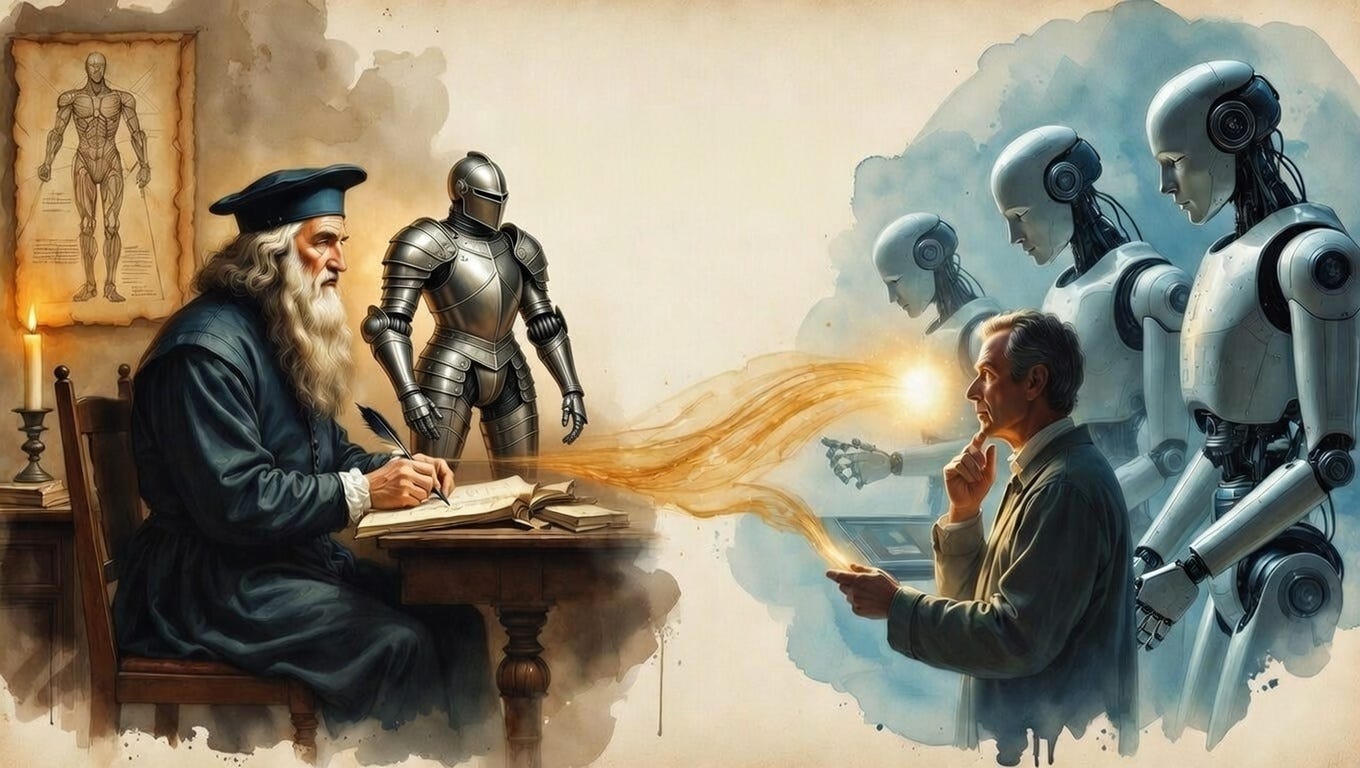
Chapter 12 of A Brief History of Embodied Intelligence
Leonardo’s knight could sit and stand and raise its visor. But Leonardo was the one who wondered what it would be like to build one. That wondering is what remains.
In January 2026, the humanoid robot section of the Consumer Electronics Show in Las Vegas occupied an entire hall of the convention center, twice the floor space of the previous year. Walking through it felt like visiting a showroom for a species that did not yet exist. Rows of bipedal machines stood in glass-walled booths, some moving through choreographed demonstrations, others standing eerily still, their cameras tracking the passing crowds. The noise was enormous: servos whining, PR teams shouting over each other, the thud of robotic feet on padded demonstration floors. Boston Dynamics demonstrated its latest electric Atlas performing warehouse tasks with a fluidity that made the old hydraulic version look like a relic from another era. Unitree unveiled a general-purpose humanoid priced at $20,000, less than a mid-range car. A startup called Clone Robotics displayed a machine with over a thousand artificial muscles and synthetic organs designed to replicate the human musculoskeletal system with unsettling fidelity. Jensen Huang took the main stage. “The ChatGPT moment for robotics is here,” he told the crowd, and the crowd cheered.
Three thousand miles east, on the same day, IEEE Spectrum published an article examining why humanoid robots were not scaling as fast as the headlines suggested. Many of the machines on display at CES were still teleoperated behind the scenes. The safety standards did not exist yet. The economics, for most applications, did not work.
Both accounts were accurate. That was the point.
The technology was arriving. The question was: arriving into what kind of world?
The Arc
This book has traced a single story across five hundred years. In Chapter 1, George Devol and Joseph Engelberger stood behind a safety line in a New Jersey factory and watched Unimate, a two-ton mechanical arm bolted to the floor, pull scorching metal from a die-casting machine. The arm did one thing, repeatedly, with precision. It could not adapt if the die shifted by a centimeter. This was the paradigm that dominated for decades: precision without perception, repetition without understanding.
Chapters 2 through 5 described how that paradigm broke down and was rebuilt. Engineers taught machines to balance, then to see, then to learn from experience rather than follow instructions. Each advance solved one piece of Moravec’s Paradox: the observation that the things humans find effortless are the things machines find hardest. Walking took decades. Grasping took decades more. Seeing well enough to navigate an unstructured room took longer than anyone in the 1960s would have believed.
Chapters 6 through 9 described the acceleration. Foundation models connected language to action. Chinese companies brought manufacturing scale and competitive urgency. The cost of capable hardware dropped by orders of magnitude. What had been a research program became an industry.
Chapter 10 showed what deployment actually looked like: Digit carrying totes in a Georgia warehouse, performing one task reliably enough to justify its cost, while dozens of other humanoid programs remained in pilot stages. Chapter 11 showed the race to build the intelligence layer: foundation models that could, in principle, give any robot body the ability to perceive, decide, and act in the physical world.
The perception-decision-action loop that the preface described as the heartbeat of embodied intelligence is closing. Not fully, not reliably, not across all conditions. But unmistakably.
Which brings us to the question the entire book has been building toward.
The Landscape
Before reaching that question, the conditions deserve a brief accounting.
Three distinct ecosystems are shaping the deployment of embodied intelligence. In the United States, development is market-led and venture-funded. Physical Intelligence raised $1.1 billion before its first customer. Figure AI raised over $750 million on a vision of humanoid factory workers. The assumption is that the market will sort out winners, and the government’s role is to stay out of the way, or, at most, to fund basic research through DARPA and the National Science Foundation.
In China, the approach is state-directed. The Ministry of Industry and Information Technology published a humanoid robot roadmap in 2023 with specific milestones for 2025 and 2027. Unitree, Agibot, and a constellation of smaller companies compete on speed and cost, supported by the same manufacturing ecosystem that made China the world’s largest producer of electric vehicles.
In Europe, the instinct is to regulate first. The EU AI Act classifies AI systems by risk level and imposes requirements that scale accordingly. Where humanoid robots fall in this classification remains unsettled, but the direction is clear: deployment will require conformity assessments and human oversight mechanisms that neither the American nor Chinese ecosystems currently demand.
Meanwhile, the infrastructure is consolidating. The compute required to train robot foundation models is controlled by a handful of companies. The simulation platforms are dominated by NVIDIA. The deployment data is accumulating fastest in the warehouses of Amazon and the factories of Chinese manufacturers. The emerging physical AI stack, from hardware and simulation to training, deployment, and data feedback, is settling into a structure that will be difficult to disrupt once established.
And the safety standards are still drafts. ISO 25785-1, the first international standard specifically for humanoid robots, remained in working draft as of early 2026. The companies building and deploying these machines were, in Melonee Wise’s blunt assessment, “silent with regards to safety.” The regulatory frameworks were being written slower than the machines were being built.
These are the conditions. They matter. But they are not the most important thing about what is happening.
The Turn
Every previous wave of automation eliminated specific tasks. The spinning jenny eliminated hand spinning. The assembly line eliminated artisanal car production. The spreadsheet eliminated rooms full of human calculators. In each case, the displacement was painful and the benefits were unevenly distributed. But the tasks that were eliminated were, in the end, tasks, discrete activities that humans had performed and that machines could now perform faster, cheaper, or more consistently.
What is emerging now is different in kind.
The foundation models described in Chapter 11 are not designed to automate a task. They are designed to automate a capability: the general ability to perceive a physical environment, decide what to do, and act on that decision. This is not “robots that can weld” or “robots that can sort packages.” This is the attempt to build machines that can do whatever needs doing, in whatever environment they find themselves, with whatever objects are at hand.
If that attempt succeeds, not tomorrow, not fully, but progressively over the next decade or two, the implications extend far beyond economics.
Consider what Moravec’s Paradox actually tells us. For decades, we built machines that could do what humans find hard. Chess. Calculus. Protein folding. Medical diagnosis from imaging scans. These achievements were remarkable, but they did not produce an identity crisis. No one looked at Deep Blue and wondered what it meant to be human. The things that computers did well, logical reasoning, pattern matching at scale, exhaustive search, were things that humans admired but did not define themselves by. A person who cannot do calculus does not feel less human.
Now we are building machines that can do what humans find easy. Walking. Picking things up. Navigating a cluttered room. Folding a shirt. Pouring coffee. These are the things we do without thinking, the things so fundamental to daily existence that we barely notice them. They are also, not coincidentally, the things that evolution spent the longest perfecting in us. The neural systems underlying movement and coordination are hundreds of millions of years old. The hand-eye coordination required for grasping developed over tens of millions of years. The ability to read physical situations and respond fluidly is so deeply embedded that it feels less like a skill and more like a part of who we are. Catching a ball, stepping around an obstacle, steadying a wobbling cup: we do these things without thinking.
Automating the hard things felt like building a better tool. Automating the easy things feels like building a better us.
This is why the current moment feels different from previous automation waves, even though the machines are less capable than the headlines suggest. The direction is clear enough. If the scaling laws hold, if the data pipelines work, if the safety problems are managed, we are heading toward a world where the physical tasks that most humans have performed for most of human history can be done by something we built. The lifting, carrying, assembling, cleaning, cooking, tending, building.
The question is not whether this will eliminate jobs. It will eliminate some and create others, as every previous wave has done. The question that matters more, and that has no precedent, is what it means for human identity when the things we do most naturally, the things that connect us to our bodies, to the physical world, to hundreds of millions of years of evolutionary inheritance, are no longer ours alone.
The Historical Pattern
There is a partial precedent, and it is worth examining honestly.
In the late eighteenth century, mechanical looms began replacing hand weavers in England’s textile mills. In Nottinghamshire and Yorkshire, entire communities that had organized around cottage weaving for generations were dismantled within a decade. The displacement was devastating. Families that had woven cloth in their homes since their grandparents’ time found themselves competing with machines that could do the work of twenty people. The Luddites smashed frames in midnight raids. Children went to work in the mills. The transition, measured in human suffering, was among the most painful in modern history.
But the species adapted. Not immediately, not painlessly, and not equally. The benefits of industrialization accrued to capital owners for decades before workers gained meaningful bargaining power. But over time, humans discovered new forms of value that the machines could not provide. They became teachers, engineers, designers, managers, artists, nurses, therapists. The mechanical loom could weave cloth. It could not comfort a child, diagnose an illness, write a novel, or negotiate a treaty. The range of things that only humans could do expanded even as specific tasks were automated, because automation freed human attention for work that required judgment, creativity, empathy, and social understanding.
The optimistic reading of this history is that the same pattern will repeat. Embodied intelligence will automate physical tasks, and humans will migrate to work that requires uniquely human capabilities, whatever those turn out to be.
The uncomfortable question is whether this time the migration has somewhere to go.
Previous automation waves eliminated tasks while leaving capabilities intact. The mechanical loom eliminated hand weaving but did not replicate the weaver’s general physical competence. The weaver could still walk to a new job, learn a new trade, use her hands in a thousand other ways. The machine could only weave.
What is being built now is not a better loom. It is an attempt to replicate general physical competence itself. If it succeeds, the weaver’s fallback, her ability to learn any physical task, is precisely what the machine can also do.
This does not mean humans become useless. It means the basis of human value shifts, perhaps permanently, away from what we can do and toward something else.
The Mirror
What is that something else?
In Chapter 1, Engelberger did not just build Unimate. He spent years convincing skeptical executives that the machine was worth deploying, a task that required persuasion, vision, and an understanding of human organizational psychology that no robot possesses. In Chapter 3, the researchers who taught machines to see did not simply optimize loss functions. They chose what to optimize for, decided which problems were worth solving, and argued with each other about what “seeing” even meant. In Chapter 8, the engineers at Tesla did not just design hardware. They made bets about what the future would look like and organized thousands of people to build toward a vision that no one could prove in advance.
The pattern is consistent. At every stage of the story, the technical achievements were real and important. But the achievements were driven by something the machines did not have: intention. Purpose. The ability to decide that something mattered and to organize effort around that decision.
Perception, decision, and action, the three elements of the loop, can be replicated in silicon and steel. What cannot be replicated, at least not yet, is the question that precedes the loop: why bother? What is worth perceiving? What counts as a good decision? What action has meaning?
These are not technical questions. They are human questions, and they are as old as the species.
What Leonardo Was Really Asking
In 1495, Leonardo da Vinci sketched designs for a mechanical knight. A suit of armor animated by pulleys and gears, capable of sitting, standing, raising its visor, and moving its arms. The sketches survived scattered across his notebooks, not fully understood until modern roboticists reconstructed them five centuries later.
Leonardo was also an anatomist. He dissected human cadavers, at least thirty of them, procured from hospitals and morgues in Florence and Rome, working by candlelight in rooms that reeked of decay, peeling back layers of muscle with a surgeon’s knife in one hand and a piece of red chalk in the other. He wanted to understand how muscles attached to bone, how tendons transmitted force, how the hand could grip and the arm could reach. He drew the musculature of the shoulder with a precision that would not be surpassed for centuries. Then he turned around and designed machines that mimicked the motion.
He was not solving an engineering problem. Or rather, the engineering problem was in service of a deeper inquiry. Leonardo wanted to know: what is the difference between a living thing and a machine that moves like one? If you could build a knight that sits and stands and raises its visor, would it be the knight, or something else entirely?
Five hundred years later, the question has become urgent in a way that Leonardo could not have anticipated. His mechanical knight was a curiosity, a court entertainment, a thought experiment made of wood and rope. The machines being built today can walk through warehouses, fold laundry, make coffee, and, tentatively, improvise when they encounter something they have never seen before. The perception-decision-action loop is closing. The gap between what a machine can do and what a human can do is narrowing, not everywhere, not for everything, but in a direction that is unmistakable.
And yet.
Leonardo’s knight could sit and stand and raise its visor. But it was Leonardo who wondered what it would be like to build one. He chose to spend years studying anatomy not because anyone required it, but because the question of how bodies work fascinated him. He chose to sketch the knight not because there was a market for mechanical soldiers, but because the boundary between the living and the mechanical haunted him.
The machines we are building are increasingly capable of doing. They are not capable of wondering why they do it.
This may seem like a thin consolation. When a robot can perform the physical tasks that most humans perform for a living, pointing out that the robot does not wonder about its existence will not pay anyone’s rent. The economic and political questions are real and urgent: who benefits, who is displaced, how the transition is managed. They deserve serious attention from serious people.
But this book has tried to take the long view. Five hundred years of trying to make machines that can do what we do. And at the end of that story, what emerges is not a tale of human obsolescence but a progressively sharper picture of what was never mechanical in the first place.
The capacity to wonder. The capacity to choose what matters. The capacity to ask whether the thing you are building should be built. The capacity to care about the answer.
Every chapter of this book has been, at its core, a story about people who wondered about something and then spent years pursuing the answer. Sometimes decades. Sometimes entire careers. The machines they built were remarkable. But the wondering came first, and the wondering was theirs.
The technology is arriving. It will work in warehouses and factories. It will enter hospitals and homes. It will do, with increasing competence, the things that humans have always done. The scaling laws suggest this. The investment suggests this. The competitive dynamics between nations and companies all but guarantee it.
What remains, when the machines can do the doing, is the part of us that was never about doing in the first place.
It may be enough.
Notes & Further Reading
On CES 2026 and the state of humanoid robotics: NVIDIA’s CES 2026 keynote is available in full on the NVIDIA YouTube channel. IEEE Spectrum’s ongoing “Automaton” blog and its annual robotics coverage provide the most balanced assessment of what humanoid robots can and cannot actually do in 2026. The Unitree G1 pricing and Clone Robotics’ musculoskeletal approach were covered by TechCrunch and The Robot Report at CES.
On automation history and the textile revolution: Robert Allen’s The British Industrial Revolution in Global Perspective (2009) provides the economic data on displacement and adaptation. E.P. Thompson’s The Making of the English Working Class (1963) remains the definitive account of the human cost. For a more recent treatment of automation’s effects on labor, see David Autor’s body of work on job polarization, particularly “The Labor Market Impacts of Technological Change” (2024).
On Moravec’s Paradox and human identity: Hans Moravec’s Mind Children (1988) introduced the paradox, but the identity implications are explored more fully in Matthew Crawford’s The World Beyond Your Head (2015), which examines what is lost when skilled physical work is devalued. Michael Polanyi’s concept of “tacit knowledge,” knowledge embodied in physical skill that cannot be fully articulated, is relevant here; see The Tacit Dimension (1966).
On Leonardo da Vinci’s mechanical knight and anatomical studies: Mark Rosheim’s Leonardo’s Lost Robots (2006) provides the most detailed reconstruction and analysis of Leonardo’s automata designs. Walter Isaacson’s Leonardo da Vinci (2017) places the mechanical knight within the broader context of Leonardo’s anatomical studies and his inquiry into the boundary between the living and the mechanical.
On the three robotics ecosystems: For the US venture-funded approach, CB Insights and PitchBook track robotics funding rounds comprehensively. For China’s state-directed strategy, the MIIT humanoid roadmap (November 2023) and Eurasia Group’s analysis of Chinese industrial policy are essential references. For the EU regulatory approach, the AI Act full text and the European Commission’s technical documentation provide the primary sources. ISO 25785-1’s working draft status is tracked on iso.org.
On the question of what remains: The philosophical territory this chapter touches on is vast. For an accessible entry point, see Hannah Arendt’s distinction between “labor” and “action” in The Human Condition (1958), her argument that the distinctly human capacity is not productive work but the ability to begin something new. For a contemporary treatment, see Shannon Vallor’s Technology and the Virtues (2016) on how emerging technologies reshape human character and moral development.