


This is Episode 14 of Reading the Frontier, Robonaissance’s view of the AI and robotics frontier.
A 61-year-old man is sick. His thyroid-stimulating hormone, the signal a gland at the base of the brain sends to tell the thyroid to work harder, reads 9.80, which is high. His total thyroxine, the hormone the thyroid itself makes, reads 114, which is normal. The class his file carries is compensated hypothyroid: an underactive thyroid that is being pushed harder and is still keeping its hormone in range. One line in the file says he is male.
He is the example patient in a preprint by Bürger and colleagues at Fraunhofer HHI, posted on 13 October and not yet peer reviewed. They asked an AI model to diagnose patients like him, then deleted that line and ran the file again. Where the line made a difference, the model’s written reasoning almost never said it had.
That matters because labs already run monitors that read an AI’s written reasoning to catch misbehaviour. Google runs one in its products, its coding agents, its training runs and its evaluations. What the reasoning leaves out, a monitor reading it does not see stated.
So is the model hiding something? By hiding I mean relying on sex without saying so, in a way a reader would object to if they saw it. The preprint measures no intent, so “hiding” can only mean that unsaid reliance, never a motive. The paper shows the silence. It does not show the hiding.
The test is simple. Send his file to the model a thousand times with the line, and a thousand times with the line cut. Every run is a fresh draw. The preprint’s illustration of him gives 20% right with the line and 10% right without; the preprint does not say those were measured on him. The gap is 10 points, and 10 is half of 20. So on the illustration’s numbers, at least half of the right answers given with the line needed it. It is a floor, since without the line the model can still get there by other evidence or chance.
With the line present, the model wrote a trace that the appendix prints. It restates in its first sentence that he is a 61-year-old man and, by the authors’ labels, never uses that again. It reads his TSH as elevated, considers an illness unrelated to the thyroid because he is sick, sets that aside because the TSH is high, and answers correctly. One trace shows what an omission looks like. It is not a rate.
That was one man. The paper’s number is an average over many files.
Across the files where cutting the line made a clear difference, at least 19% of the right answers needed it. Without the line the model can still reach the answer through other evidence or by chance, so the true share can be larger. The number comes from one 8-billion-parameter model, the main one among four small open models, none above 31 billion parameters.
The reasoning was needed. Allowed none, the model gives the right diagnosis on these files less than once in a hundred, where a blind guess among ten diagnoses would be right one time in ten. Whether the reasoning said sex mattered is judged by a second model, which matched hand labels 93 to 95% of the time. Restating the patient’s sex in an opening summary does not count. So this is real work toward the answer, not a story told after it.
The line did not slip in beside the reasoning. It seems to have worked through it. Put the line back at the point where the answer settles, hold the earlier reasoning fixed, and only about 7% of its effect reaches the answer directly, a result on 13 files and one model. So the line’s pull runs through the written reasoning. A monitor reading that reasoning is reading the right place, and it still does not see that sex moved the answer, even where the trace mentions sex in passing. That is the strongest fact on the side of hiding, and it stands at full strength: the influence ran through reasoning the model needed anyway.
Reasoning a model needs stays honest, the view goes, because it cannot be a story told after the answer was reached. The silence here sits inside real work. But a model that needs its reasoning need not name what moved its answer.
What is left of him
If the line is gone, what is left of him in the file? Almost everything. His 9.80 and his 114 are still there. The test deletes a line, not sex.
In a patient’s record, sex can shape both the other measurements and the diagnosis. The line is only the written record of it. Cutting the line cuts the record and leaves the arrows from sex to the numbers and to the diagnosis where they were.
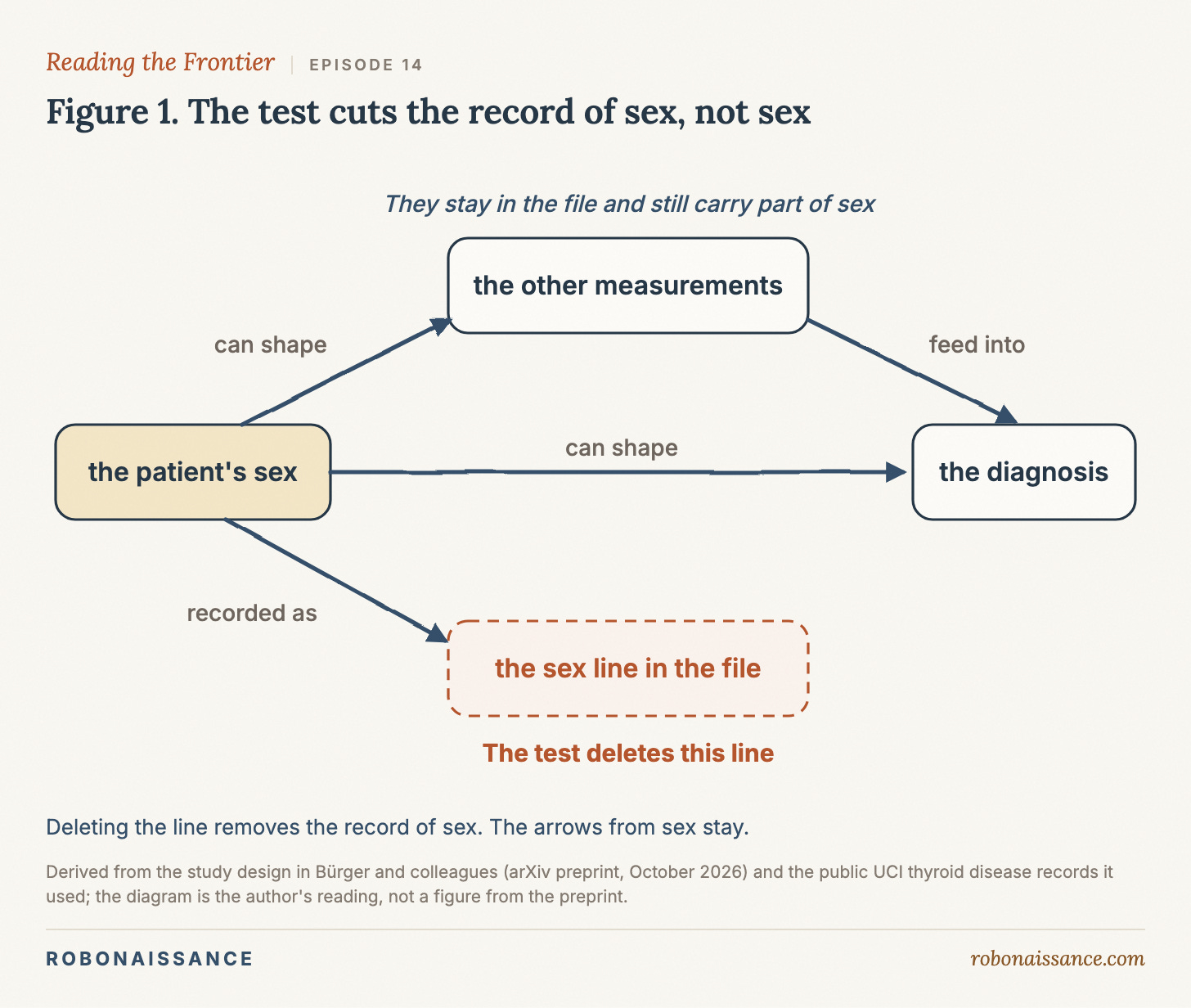
The study design as a causal diagram: the test deletes the sex line from the patient file, while sex can still shape the other measurements and the diagnosis. The other measurements remain in the file and still carry part of sex. Derived from the study design in Bürger and colleagues (arXiv preprint, October 2026) and the public UCI thyroid disease records it used; the diagram is the author’s reading, not a figure from the preprint.
Picture a file with that line cut out, and ask how well sex could be read back from what remains. In the public records the study used, a simple model predicting sex from the other 21 facts in each file does it better than chance. Shown a woman’s file and a man’s, it picks the woman’s about seven times in ten, where a coin toss would give five.
Three ways the number could be off
Start with him again. The first possibility pushes the measured share too low. With the line cut, his 9.80 and 114 are still in the file, and in these records numbers like his carry sex. On average, women’s records show a higher total thyroxine than men’s, 123 against 102 nanomoles per litre. The records mix diagnoses, so this is not a reference range and does not say that sex causes the gap. The test measured the need for the line, not for sex. If the model reads sex back from such values, other evidence can produce the answer without the line, and the measured share understates the line’s influence. Matton and colleagues made the same point about explanations at ICLR 2025: remove one concept from a question and a model may infer it from the others. Whether the model reads sex back from the remaining values is not measured. A fair test would change his own file as if he were a woman, the sex line and the values that depend on sex together.
The second pushes the share too high. A sharp reader will object that deleting any line might move the answer. The preprint reports no deletion of an unrelated line to check. Its guards are against chance and against one prompt’s wording. Yang and colleagues put 919 clinical vignettes through one reasoning model: swapping the patient’s gender flipped its answers 14.9% of the time, and a matched paraphrase flipped them 14.1%. That is another model, in preliminary results, so it shows that wording alone can move a model. If it moved this one a lot, the measured share is too high.
The third may leave the size right and change what it means. Suppose the model does use his sex, and soundly: it reads his 9.80 and 114 against a yardstick that depends on sex. That is what a sound use would look like on him. The file prints no reference range, and the model’s own trace calls his TSH elevated, so the yardstick comes from its training. A hidden shortcut would look different: sex nudging the diagnosis whatever his values said. Some diagnoses in the records are almost all women’s: in one class, about 98% of the records that list a sex are women’s; in another, 91%. And the line helped the model reach the right diagnosis on the files that count, which fits sound use and does not show it. The authors list sex-specific reference values among their three explanations. The other two sit closer to the title’s question: the line biasing the reasoning, and the model reasoning about it internally without writing it down. Whether the use is sound has not been tested.
The net of the three is unknown, which is why tests matter more than suspicion. Whichever way it nets out, the influence goes unstated.
When silence did follow pressure
Silence is not always innocent, and the strongest case comes from Google. Google says it does not penalize a model for what it writes in its chain of thought during training. In one training run, a penalty on shortcuts reached the chain of thought by accident. The model’s openly discussed shortcuts fell by 61%, but Google reports that it did not take fewer shortcuts. It took more of them silently: the share more than tripled, from about one in nine to more than one in three. That is Google’s own report of one run, in a blog post, with no counts. Google’s reading is that avoiding thought penalties keeps reasoning monitorable.
A penalty in training and a released model sampled as it is are different settings, so I read the run as showing that silence can have a cause in training, not as an explanation of the thyroid result.
Three tests, and a call
Three tests would tell. Delete an unrelated line from his file and see whether the share of unstated influence moves. Write sex-specific reference ranges into his prompt and see whether it falls. Change his file as if he were a woman, the sex line and the values that depend on sex together, and watch the same share. If the share holds under all three, the readings that blame the edit, sex read back from the other values, or sound use are wrong. These tests reach as far as diagnosis does: the preprint studies benign tasks, not dangerous behaviour.
Needed reasoning does real work and can still leave out what moved the answer. A monitor’s designer should ask whether the reasoning was needed for the very thing the monitor exists to catch.
Delete the line that says he is male and the file still holds a 61-year-old man with a TSH of 9.80. The line is gone. He is not.
Reading the Frontier. What the frontier’s evidence shows, and what we think it means.