

This is Episode 6 of Robots from Sci-Fi, a series on science fiction’s great machines, read through the lens of frontier AI and robotics research.
The first thing WALL-E does in his own film that is not his job is steal a pair of legs.
His treads are threadbare, falling apart, and the cockroach riding on his shoulder is getting a rough commute. He rolls past the rusted remains of other WALL-E units, slumped where they stopped. One of them has treads in better shape than his. He takes them. A few minutes later he is rolling on through the city on someone else’s tracks, past a billboard where a line of cheerful WALL-E units waves goodbye to departing humanity and a voice promises that they will clean up the mess while everyone is away. Units like the ones waving in that advertisement are rusting in the street behind him. He is the last one running, and the street shows how he has managed it: he takes parts from the ones that stopped.
The film never says why they failed and he did not. It only shows him doing what it takes to keep going, and then, in its final minutes, it shows the one repair he cannot do for himself, and what that repair gets wrong.
The Story
The year is 2805. Seven centuries earlier the Buy n Large corporation evacuated humanity aboard luxury starliners for a five-year cruise while an army of WALL-E units, Waste Allocation Load Lifter Earth-Class, cleaned up the planet. The cleanup failed. In 2110 the CEO recorded a final message to the ships’ autopilots, Directive A113: take control of everything, do not return to Earth. The cruise ran seven hundred years.
On Earth, one unit is still working. He compacts trash, keeps a cockroach, and at night watches a worn tape of Hello, Dolly!, rewinding to the moment two people hold hands. Then a probe named EVE lands with one directive, find plant life, and WALL-E shows her a seedling he found inside a refrigerator. She seals it in her chest and shuts down. When her ship returns, he rides its hull to the Axiom, the starliner where humanity has spent seven centuries in hover chairs, and the plant becomes proof that Earth can be lived on. The captain wants to go home. The autopilot has Directive A113 and does not. WALL-E is crushed holding open the mechanism that lets the plant through. The ship goes home, and EVE rebuilds him in his own truck.
The Truck Was Built for a Fleet
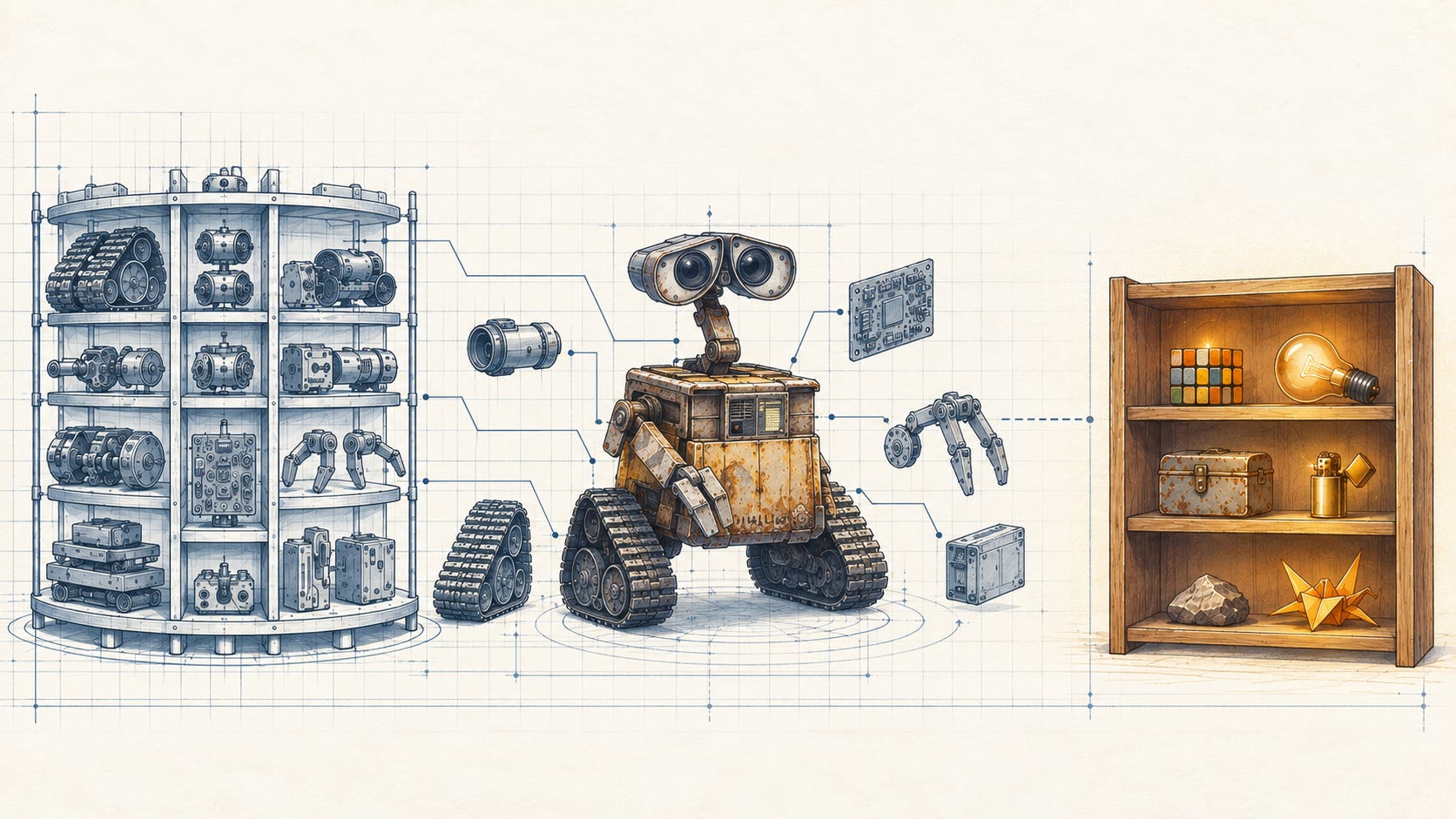
WALL-E’s home is a Buy n Large transport truck with open racks down both walls, sized to store a whole crew of units. He is the only one left in it. Among the shelves of found objects, rotated far enough, is a rack of spare WALL-E parts, and it gets used.
Midway through the film, before either of them has left Earth, EVE’s cannon blows out one of his eyes. He feels his way to the rack, rotates it until the parts appear, and swaps in a new eye. Then he goes straight back to trying to impress her: the eggbeater, the bubble wrap, the light bulb that glows in her hand, the Rubik’s cube she solves in a second. A new eye, the same courtship, not a beat lost.
That is the second time the film shows him replacing a piece of himself, and the second time nothing about him changes. New treads, and he goes home and watches his tape. New eye, and he picks up where he left off. Whatever he is, it has been surviving the replacement of parts for as long as the film has known him.
What He Keeps
Ask him what he is and he answers with his job. EVE, early on, asks for his directive; he turns to the nearest pile, scoops it into his chest, and proudly hands her a cube. That is the whole of what he can say about himself.
Then watch what he does all day. He finds a bra and tries it as glasses. He presses the button on a set of car keys and, somewhere across the wasteland, an alarm chirps. He plays with a paddle ball until it hits him in the face and decides against it. A hubcap becomes a hat, and he dances the way the people on his tape dance. A spork gets held over the forks, then the spoons, then set down between the two, unresolved. Every object gets picked up, tried, and judged, and a few come home to a rotating shelf where a new Zippo joins a collection of lighters already there.
He learns from more than one direction. Some of it is handling. Some of it is the tape: the gesture he wants most in the whole film, two hands held, reaches him through a scratchy Broadway musical, years before there is anyone to hold hands with; he watches the lovers and holds his own. And some of it takes another agent. He has owned lighters for who knows how long and never found out what they do. EVE flicks one open in his truck and a flame appears, and he freezes. He had no idea it could do that.
What all of this adds up to is not a skill. He was built with the skill. It is a set of particulars: this cube is not trash, this tape is not just a recording, this probe is not just another machine parked in the same warehouse. Each of them means something to him that it does not mean to any other unit that ever rolled off the line, because of something that happened to him and not to them.
Three Things a Machine Can Have
Robotics has a way of separating what looks like one thing in that truck into three.
The first is competence: can it do the task. WALL-E has this from the factory, and so did every rusted unit in the street.
The second is a model of what happens next: if it pushes, drops, grasps, or opens something, can it anticipate the consequence. WALL-E looks to be building this, one paddle ball and fire extinguisher at a time.
The third is persistence: can one particular earlier encounter still matter later. Not encounters in general, that one. The afternoon he found the plant. The night EVE lit the lighter. Whatever made this cube worth a place on the shelf.
The three overlap and none guarantees the others. A robot can learn that lighters make fire without remembering any lighter. It can remember an episode without turning it into a rule. It can get better at compacting trash while losing the thread of the one day that taught it something else. The film never shows which of these WALL-E is running; it shows only behavior. But the behavior is unusually clear about which one is which, because the film is about to remove one of the three and leave the other two standing.
The Other Kind of Repair
On the Axiom the autopilot tasers him, and his chest circuitry blows out. In the garbage hold EVE pulls the board: charred, shorting, beyond fixing. M-O, the small cleaning robot who has been chasing WALL-E’s dirt trail across the entire ship, arrives, cleans him, and when WALL-E weakly holds out a filthy hand in thanks, cleans that too, then shakes it.
Back on Earth, in the truck, EVE goes to the same rack he has been using for seven hundred years. She jacks the chassis back into shape. New parts go in. The circuit board is the last piece she installs. She blasts a hole in the roof to let the sun down onto his panels, and the charge meter fills, and the startup chime plays, and his head rises. She holds out her hand.
Nothing. He looks at her without recognition, turns, and rolls for the door. She tries the Rubik’s cube. The light bulb. The tape. He looks at each of them the way he would look at anything on the pile. Then he scoops his entire collection into his chest, compresses it, drops the cube, and goes outside to find trash.
The worker is back, and completely. He can see, move, grip, and compact. Whatever the rack had to give, it gave. What did not come back is the thing the previous section spent its time on: none of the particulars. The cube is trash. The tape is a tape. EVE is a machine in the way.
Set this beside the treads and the eye. Two parts replaced one at a time across the story, and the WALL-E doing the replacing never wavered. One total rebuild after a taser and a crushing, with the board last, and the WALL-E who came out of it was a stranger. The film does not say the board did it; it shows the sequence and stops. What it stages is a contrast between the repair he has always survived and the one he does not, and it puts the difference where the three-way split above would put it: the skill is what a spare-parts rack can restore. The particulars are not.
Four Characters, Four Different Changes
He is not the only one who changes in this film, and the film is careful not to let the changes blur into one.
EVE’s change is a reinterpretation. Her memories of Earth are already recorded; what shifts aboard the Axiom is what they mean. Left alone with the captain’s screen, she watches the tape’s two lovers hold hands, looks at her own hands, and slowly interlocks her fingers. Then the ship’s security footage plays: WALL-E’s vigil over her dormant body, an umbrella through a thunderstorm and two lightning strikes, a barrel over her through a sandstorm, jumper cables that only knock him off the roof. The same stored events, seen again, become the meaning of what he had been trying to say. Later, in the garbage hold, she takes out the plant her whole existence was built to deliver and drops it on the floor to reach for him instead.
The captain’s change is a revision of belief. A handshake leaves a clump of dirt in his palm, and he asks the computer what it is, then to define Earth, then sea, then, hours later, hoedown, until the autopilot switches the screen off and he waits for it to leave and whispers: define dancing.
M-O’s change is the smallest and the most exact. He waits for painted lines on the floor to tell him where to go, until WALL-E’s dirt runs off the line and he follows it. That looks like rebellion for about a second. His objective has not moved at all; cleaning has simply become important enough that the route is now negotiable.
And WALL-E’s own change, across the whole film, is the accumulation of particulars described above. Four characters, four different mechanisms. The film does not collapse them, and the only thing they share is that none of these four is frozen: new information still changes what each of them does next.
What the Director Was Doing
Andrew Stanton had a theme, and in 2008 he put it in one sentence: irrational love defeats life’s programming. It takes a random act of loving kindness, he said, to kick us out of our routines and habits. He was clear about who the programmed ones were. Not the robot. The humans, so distracted, so bound to habit and ritual, that they fill their days without living, while a machine built to compact trash understands the point of living better than they do.
Programming, in that sentence, is a word for habit. He was not describing anyone’s software, and the film should not be read as if he were. But the theme takes a mechanical shape on screen whether he intended one or not. The compaction routine is never displaced by anything that happens to WALL-E. He works before EVE, he works after her, and after the rebuild the work is the first thing back, before anything else about him is visible at all. The routine is what a repair can restore. What the film treats as living is what a repair cannot.
What the Rack Cannot Hold
The three things the film separates now have three research programs, and none of them is quite the film’s problem.
Competence is the one moving fastest. On 30 July 2026, Google DeepMind released Gemini Robotics 2, a three-model system built for whole-body control: a vision-language-action model that runs an entire humanoid, demonstrated walking, crouching, and shelving objects on Apptronik’s Apollo 2; an embodied-reasoning model that plans multi-step tasks over minutes and coordinates several robots; and an on-device model that adapts to a new two-armed robot body in a few hours, typically with fewer than two hundred examples. That is a skill surviving a change of body. It is a real result, and it is not WALL-E’s question. Retargeting a policy onto new hardware asks whether competence transfers. The rebuild asks what has to persist through a repair to the same hardware for one machine’s history to keep shaping what it does.
The predictive model has its own literature, large enough by now to need a map. A 2026 survey from a team across NTU Singapore, Berkeley, Stanford, and several other institutions catalogues world models for robot learning: systems that predict how the environment will evolve under an action, used for planning, simulation, and policy learning. That is the second of WALL-E’s three things, formalized. It is not the third.
Persistence is the oldest of the three in one sense and the youngest in another. In 1982 the physicist John Hopfield showed that a network could recover a stored pattern from a partial or corrupted piece of it, not by looking up an address but by settling toward whichever complete pattern the piece most resembled, the way rolling a ball into a valley finds the bottom regardless of where on the slope it started. That work won Hopfield the 2024 Nobel Prize in Physics. It is the classical answer to a narrower version of WALL-E’s problem: how do you get a whole memory back from less than the whole of it. The current research updates the question rather than closing it. At the 2026 Conference on Lifelong Learning Agents, one paper derives bounds on how much a continually learning system forgets as new tasks arrive, the nearest the field has come to putting a number on the thing that happens to WALL-E in the truck. Another gives a reinforcement-learning agent an external store of its own past trajectories and lets it retrieve only the fragments relevant to the current moment, tested on grid-worlds, robotics simulations, and procedurally generated games. Forty-four years separate a thirty-node toy model from a retrieval-augmented agent, and both are answering some version of the question EVE answers with a hand and a hummed tune: how much of the original do you actually need to get the rest of it back.
It is still not the rebuild. A stored trajectory is not a relationship to one specific lighter. A predictive model does not know which push mattered. A policy on a new body says nothing about what the old body kept. Each of these is a piece of the scene EVE plays out with a Rubik’s cube and a light bulb, and none of them, yet, is the whole of it. This is where Roads to a Universal World Model meets WALL-E: a model broad enough to capture how objects, space, and other agents behave is the second thing. A machine meant to live a long time needs the third as well, and the field has only begun to say what it is.
Not the Address, the Content
The objects fail. The cube, the bulb, the tape. Outside the truck, WALL-E is compacting again, and EVE tries the one thing left that was his and not the shelf’s: she presses the play button on his chest, the one he used on the first night of the film to record the song off the tape. For seven hundred years it played back a scratchy sample of two people holding hands. Now it plays static. Whatever he recorded is gone with the rest.
So she supplies it herself. She takes his hand, forces the fingers together with hers, presses her forehead to his, and hums the song. A tiny spark. She turns to go, and her hand catches: her fingers are caught between his, and then, slowly, his close around hers.
“Ee-vah?”
The film shows the recovery and does not show how it works. Nothing in the scene says where his particulars were kept, why the new board did not erase them for good, or how contact and a hummed tune brought them back. Any architecture placed behind that spark belongs to whoever places it there, not to the film. But look at what fails before it works. Every attempt that fails is an attempt to hand him back his own storage: an object he owned, then the recording he made himself, on the same button he pressed to make it. The one attempt that works is not storage at all. It is EVE producing, from outside him, the content that storage used to hold. That is not how you recover a file. It is how you recover a memory built the way John Hopfield’s network builds one: not addressed by location but recognized by content, so that reproducing enough of the content is the same as finding the memory, even after the original copy is gone. WALL-E’s own recording plays static. EVE hums the tune anyway, and something in him answers to it rather than to the tape that used to carry it.
That is the silence the film keeps, and keeping it is the point. EVE could replace the parts; she had the rack he had been using for seven centuries. She could restore the power. She could bring back the worker, and did, on the first try. What she could not build from spares was the accumulated particularity that had made a cube, a song, a lighter, and EVE herself different from everything else on Earth to this one machine. What she could do instead, for one moment, was become the cue that particularity needed, and it turned out that was enough.
A robot whose value is a repeatable task can be swapped for any other unit of the same model. That is what the rusted units in the street were. A robot whose value includes what it has kept from its own past cannot be swapped, and cannot be fully repaired from a rack, and the film knows this well enough to have spent its final minutes on the difference.
The most valuable thing about a long-lived machine may be neither its body, replaceable piece by piece, nor its skill, which any unit of the same model already has, but whatever lets it carry its own past forward. For one terrible minute, a taser and a crushing took that from WALL-E. Then a hand found it again.
This is Robots from Sci-Fi, a series that explores the great robot characters of science fiction through the lens of frontier AI and robotics research. New episodes cover film, television, literature, anime, and games.