

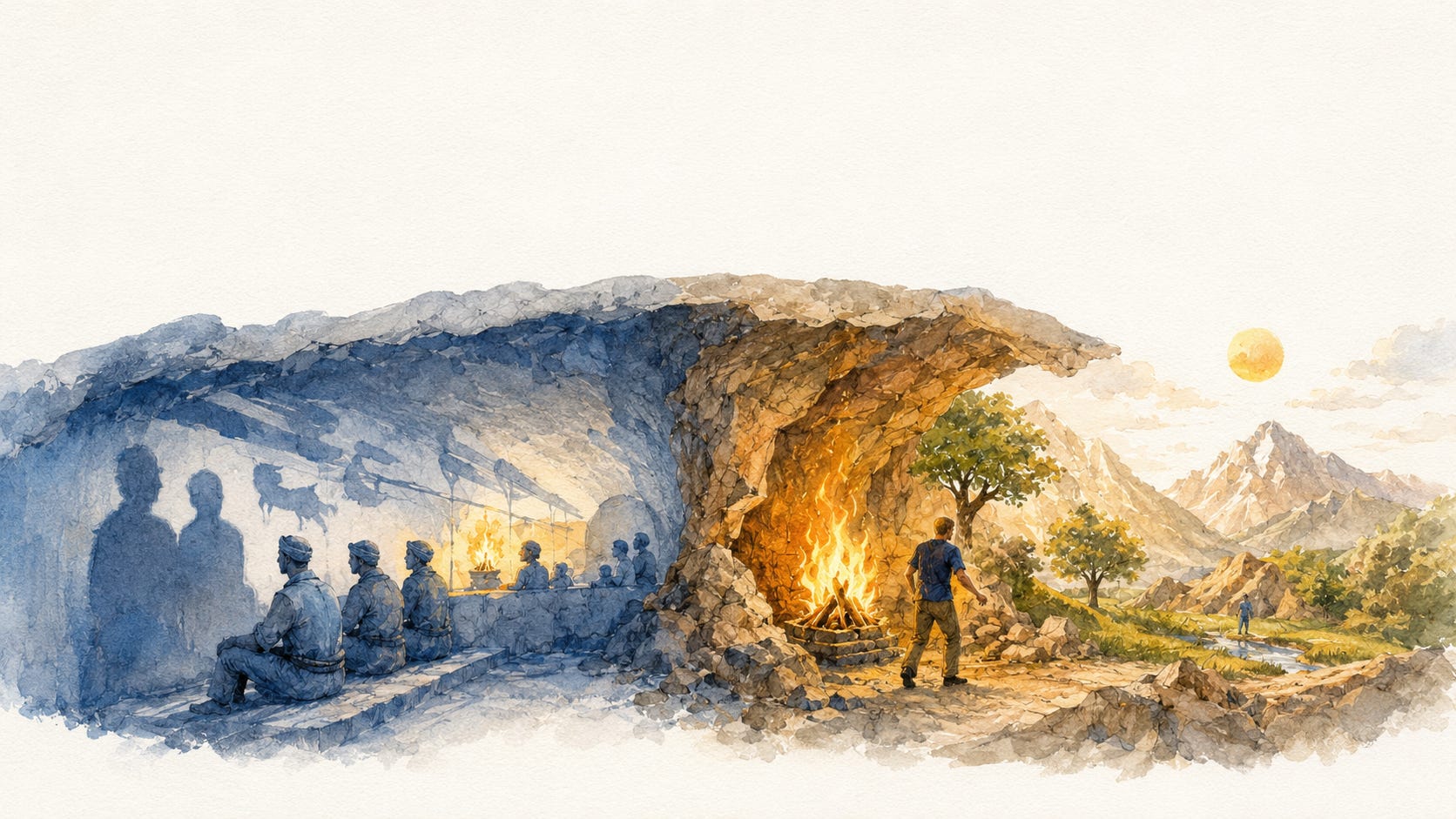
“To them, the truth would be literally nothing but the shadows of the images.” — Plato, Republic
A fourteen-month-old reaches for a cup on a kitchen table. She wraps her fingers around it, pulls it toward the edge, and pauses. Then she pushes it off. The cup falls. It hits the floor. Milk explodes in every direction.
She is not surprised.
She did not need to see the cup fall to know it would fall. She did not need to feel the impact to know there would be one. Somewhere in her developing brain, a model of the world predicted the outcome before it happened. Gravity pulls things down. Unsupported objects drop. Liquids splash. She tested her model against reality, and reality confirmed it.
This is a world model: an internal representation of how things work that lets you predict what will happen next. A dog chasing a ball anticipates where it will bounce. A crow dropping a nut onto a road predicts that a passing car will crack it open. A human catching a ball thrown at an unexpected angle computes, in milliseconds, the trajectory, adjusts the hand, and intercepts. No equations. No conscious reasoning. Just a model running silently in the background, simulating physics faster than physics itself unfolds.
Now consider the most advanced AI systems in the world. They can write code, pass medical licensing exams, and hold conversations that feel indistinguishable from a human's. But ask a robot to crack an egg into a bowl it has never seen before, in a kitchen it has never entered, and you will watch it struggle with something a three-year-old does without thinking. Not because it lacks data. Because it lacks a model of the world.
This is the gap. And closing it is arguably the most consequential open problem in artificial intelligence right now.
Shadows on the Wall
The question of how to build an accurate picture of reality from incomplete information is not new. It is, in fact, one of the oldest questions in philosophy.
Around 380 BC, Plato described what is now known as the allegory of the cave. Prisoners chained inside a cave, facing a blank wall. The chains fixed their heads in place so they could not turn around. Behind them, a fire cast shadows of objects passing between the flame and their backs. The prisoners had never seen the objects themselves. They knew only the shadows: flat, flickering, incomplete projections of a three-dimensional reality they could not access.
For Plato, this was a metaphor for the human condition. We perceive shadows, not reality. Understanding comes from escaping the cave.
Twenty-four centuries later, this metaphor maps with eerie precision onto the central problem of AI world models. A robot perceives the world through sensors: cameras capture pixels, force sensors measure pressure, encoders track joint angles. These are shadows on the wall. They are projections of a richer, deeper reality: the causal structure of the physical world, with its gravity, friction, momentum, elasticity, and ten thousand other regularities that govern what happens when you push a cup off a table.
A world model, as AI researchers currently conceive it, is an attempt to infer the world outside the cave from the shadows. The disagreement is over how.
Some researchers believe you can learn the structure of reality by becoming very, very good at predicting shadows. Train a model on enough video, enough pixels, enough frames of cups falling and balls bouncing, and the patterns in the shadows will eventually encode the physics of the objects casting them. Others believe this is fundamentally misguided. No amount of shadow prediction, they argue, will ever teach you that the lead ball and the plastic ball behave differently, because they look identical in silhouette. These researchers want to skip the shadows entirely and learn directly in a more abstract space: the physical properties of objects, the forces between them, the causal structure that generates the shadows but is not visible in them.
Still others propose different escapes from the cave. One group says: build a mental model of the shadow theater and practice inside your own imagination, learning by rehearsing actions and observing their imagined consequences. Another says: forget the shadows, write down the mathematical laws that govern the objects directly, and simulate from first principles. And a third says the only honest path is to turn around, leave the wall, and touch the objects: learn physics not by watching but by making contact with the real world, one grasp at a time.
This is not a philosophical debate. It is an engineering question that the largest technology companies and the most ambitious startups on earth are racing to answer. Are we modeling the world, or its shadows? Five research traditions are placing different bets. This series explores each of them, traces where they are starting to converge, and asks what the future of world models might look like.
A Very Old Idea, a Very New Moment
The concept of machines building internal models of reality has its own history, and it starts not in Silicon Valley but in wartime Cambridge.
In 1943, a Scottish psychologist named Kenneth Craik published a slim book called The Nature of Explanation. In it, he proposed something radical for his time: that the brain works by constructing “small-scale models” of the external world, then running those models forward to predict what will happen next. “If the organism carries a ‘small-scale model’ of external reality and of its own possible actions within its head,” Craik wrote, “it is able to try out various alternatives, conclude which is the best of them, react to future situations before they arise.”
This was not a metaphor. Craik meant it mechanistically. The brain, he argued, is a prediction machine, and its predictions are generated by internal models that mirror the structure of reality. You do not need to build a physical bridge and wait for it to collapse to know whether the design is sound. You build a model, in your head or on paper, and test it there.
Craik died in 1945, struck by a car while cycling in Cambridge. He was thirty-one. His idea survived him. It passed through cybernetics and cognitive science, through control theory and robotics, gathering different names and different formalisms along the way. In 1991, Richard Sutton built Dyna, an AI architecture where an agent learned a model of its environment and used it to “dream” about possible futures. In 2018, David Ha and Jürgen Schmidhuber published a paper titled, simply, “World Models,” in which an agent learned to race cars by first learning a compressed representation of the game world, then training entirely inside its own imagination.
But for decades, the idea remained more promise than practice. Learned world models were fragile. Small errors compounded. The imagined world diverged from the real one after a few steps, making the model useless for anything beyond the near future. The concept was elegant. The execution was brutal.
What changed? Three things converged in the 2020s.
First, scale. The transformer revolution that powered large language models also provided architectures capable of learning rich, high-dimensional representations of visual and physical data. The same attention mechanisms that let GPT predict the next word could, in principle, learn to predict the next frame of video, the next state of a physics simulation, or the next consequence of a robot’s action.
Second, data. The explosion of video on the internet created an enormous corpus of implicit physics lessons. Every video of a ball bouncing, a door closing, a liquid pouring, or a car turning contains information about how the world works. No one labeled this data. No one annotated the physics. But it was there, waiting for models powerful enough to extract it.
Third, necessity. Language models hit a ceiling. They could process and generate text with remarkable fluency, but they had learned language, not physics. The same was true of their multimodal descendants. Even the most advanced vision-language models were fundamentally language-first systems: vision entered at the encoder, then got routed into a language backbone. Most of their parameters were allocated to knowledge, recognizing that a pattern of pixels is a coffee mug. Very few encoded what would happen if you knocked it off the table. For AI to move beyond language, into robotics, autonomous driving, manufacturing, and scientific discovery, it would need to understand physics. It would need a world model.
Next-word prediction built the first generation of foundation models. Next-world-state prediction may build the second.
Five Roads, One Destination
This series traces five distinct paths toward a universal world model. Each grew from a different tradition. Each makes a different bet about what matters most. And each reveals something the others miss.
The Dreamer's Road begins in reinforcement learning, with the idea that an agent can learn faster by imagining possible futures. From Sutton's Dyna to Hafner's Dreamer 4, this road asks: what if you could practice inside your own imagination? Its arc bends from agents that dream about grid worlds to agents that learn physics from watching video, then train entirely inside their own dreams. The key insight it offers is that a world model does not need to be photorealistic. It needs to capture the structure that matters for action.
The Physicist’s Road starts from first principles. If you know the equations governing a system, you can simulate it precisely. From flight simulators to NVIDIA’s Omniverse, this road builds the world from physics up. Its key insight: simulation gives you infinite data and perfect control, but it breaks at the boundary of the known. You can simulate a world you understand. You cannot simulate one you don’t.
The Cinematographer’s Road emerges from video generation. When models trained to predict the next frame of video began obeying physics, shadows falling correctly, liquids pouring realistically, objects persisting behind occluders, researchers realized that video prediction might be a backdoor to world understanding. This is the shadow prediction strategy taken to its extreme: learn from billions of hours of visual data until the patterns encode the physics underneath. The key question this road raises: is this real understanding, or sophisticated pattern matching?
The Roboticist's Road is the hardest. Robotics imposes constraints that no other domain does: real physics, real-time feedback, real consequences for errors. A video model can fake gravity. A robot cannot. Where other roads observe the world from a distance, this one turns around and touches it. This road's key insight: a world model without action is incomplete. Predicting what will happen is fundamentally different from predicting what will happen if I do something.
The Architect's Road starts from a premise that none of the other roads share: a machine should learn to understand the world before it learns to act in it. The Dreamer learns what helps it score higher. The Roboticist learns what helps it grasp objects. The Cinematographer learns what helps it predict the next frame. Each couples understanding with a task from the start. The Architect says: learn the structure of reality first, from observation alone. No task, no reward, no action. Not yet. The bet is that if a machine gets this step right, everything else becomes easier.
After tracing each road, the final part explores the convergence. Why are these separate traditions starting to use the same ingredients? What would a true universal world model actually look like? And how far are we from building one?
What This Series Is and Isn’t
This is not a survey paper. It is not a catalog of every world model published in the last five years, organized by architecture and benchmark score.
It is a narrative. It traces the ideas, the people, and the decisions that brought us to this moment. It argues that the convergence happening now is real and significant, but that the path forward is far less clear than the hype suggests. It aims to give readers, whether they are engineers, investors, researchers, or simply curious, the conceptual framework to evaluate what they read next about world models. Not just “what is this?” but “why does it matter, and what are the bets it’s making?”
The toddler who pushed the cup off the table did not need a PhD in physics. She did not need ten billion training examples. She built a model of the world through a few months of reaching, grasping, dropping, and watching. That model is imperfect, incomplete, and constantly being updated. But it works.
Building something like that in a machine is the goal. We are closer than we have ever been. We are also further than most headlines suggest. Understanding why both of those statements are true is what this series is about.
What of the Umwelt road and distributed robotic ecologies?
The Recursive Cave
There is a striking recursion here. Human language is already a model of a model: perceptual experience becomes concept; concept becomes speech or text; text becomes training data; training data becomes distributed parameters; parameters become a new generated description.
Each stage can preserve important structure, but each can also discard it. The LLM’s cave is therefore built from human caves—our perceptual and conceptual projections, compressed once more into language.
Yet the same condition gives LLMs an unusual power. They can integrate shadows cast by millions of observers, instruments, disciplines, and historical periods—far beyond the experiential range of a single person. The challenge is to bind that immense inherited map to mechanisms for calibration, experimentation, and responsible action, so that it remains corrigible by the territory rather than becoming an eloquent archive of the map.