

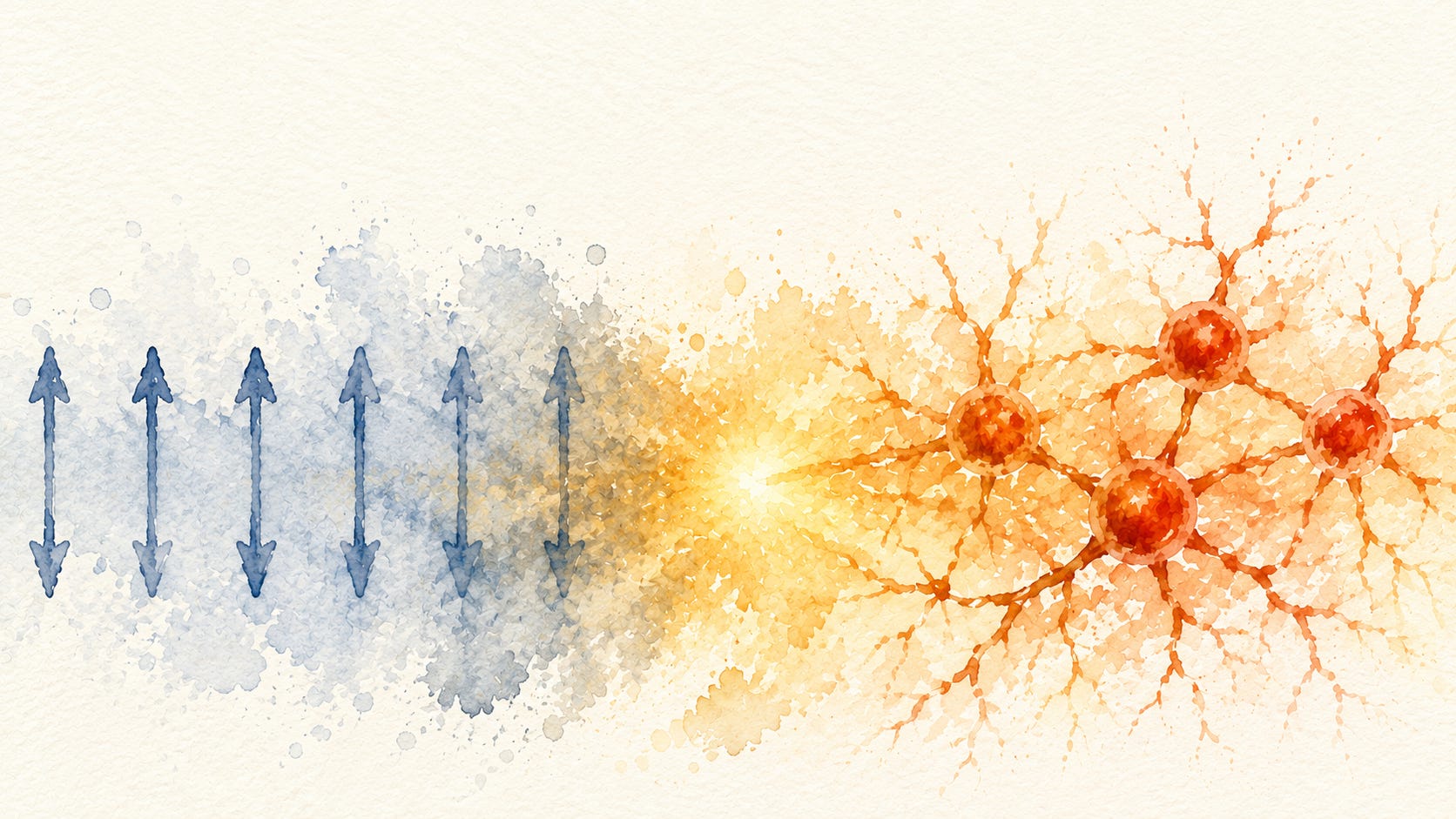
The overture to The Thermodynamics of Intelligence. When statistical mechanics met neural networks: a forty-year story of a discipline claiming its own.
In October 2024, the Nobel Prize in Physics went to John Hopfield and Geoffrey Hinton, two men most of the world knew, if it knew them at all, as computer scientists. The Nobel committee’s citation did not call their neural network work an application of physics. It called it physics. The equation Hopfield wrote down in 1982 to describe how a network of neurons settles into a memory is, term for term, the equation that describes how a magnet settles into a state of order.
That is the claim this series takes seriously, more seriously than the field usually does. Statistical mechanics is not a metaphor lending AI some borrowed vocabulary, energy, temperature, phase transition, dressed up for a machine-learning audience. It is the same mathematics, doing the same work, on a substrate nobody in the 1970s had in mind when they wrote it down. Every part in this series runs the same three questions on whatever physics-and-AI pairing it takes up that week: what quantity marks the moment something qualitatively new has happened, what external knob is being turned, learning rate, data, temperature, parameter count, and where, specifically, in a real experiment or a real figure in a real paper, the transition can be pointed at. Rhetoric about a transformative moment does not pass. A number does.
The story runs forty years, from a physicist’s 1982 detour into neuroscience to a 2024 prize that told the field, officially, that the detour was never a detour. Along the way it passes through a decade Hinton spent on a machine almost nobody could train, a theory of the brain built to explain everything, and a live argument over whether a model’s sudden new ability is a real threshold or a trick of how it was measured. The claim under every part is the same one the Nobel committee made in October 2024: this was never borrowed language. It was a discipline recognizing its own equations, decades late.
Nine Valleys
Nine parts, in the order the physics builds, all filed under The Thermodynamics of Intelligence:
Part 1: A Magnet That Remembers: why 2024’s Physics Nobel went to two AI researchers, and the magnet equation that makes the prize make sense.
Part 2: Memories That Never Happened: the attractor dynamics that let a network recall a memory it was never given in the first place.
Part 3: The Speed Limit Nobody Obeys: a decade Hinton spent on a machine almost nobody could train, and the physics trick that finally made it fast.
Part 4: The Theory That Cannot Fail: a theory of the brain built to be unfalsifiable on purpose, and why that is not the insult it sounds like.
Part 5: How to Miss a Phase Transition: the observable moment a model suddenly understands something, and how easily it gets mistaken for nothing happening at all.
Part 6: An Exact Mapping, Approximately: the physics tool built to zoom out of a magnet, turned on the depth of a neural network instead.
Part 7: The Stall Every Neural Network Hits First: the 1995 equations for why every network stalls the same way before it breaks through.
Part 8: The Emergent Ability That Might Not Be There: the measurement fight over whether a model’s sudden new skill is a real threshold or an illusion of the ruler.
Part 9: What Thinking Actually Costs: if intelligence can be measured in the units of physics, the question that survives after the measuring is done.
If This Is You
If you use neural networks daily and have never seen why the 2024 Physics Nobel went to two researchers from your own field, start with Part 1: A Magnet That Remembers. The correspondence it shows you is literal mathematics, not a metaphor borrowed for effect.
If Hinton’s decade with the Boltzmann machine has always been a footnote you skipped past, Part 3: The Speed Limit Nobody Obeys is the part that makes it the main event.
Maybe you have watched a model suddenly click on a capability with no warning and wondered whether that was a real event or a trick of your benchmark. Part 5: How to Miss a Phase Transition and Part 8: The Emergent Ability That Might Not Be There are this series’ two answers, four parts apart, and they do not agree with each other as cleanly as you would expect.
If Friston’s free energy principle has always sounded too convenient to be falsifiable, Part 4: The Theory That Cannot Fail takes that suspicion seriously instead of arguing around it.
And if you want the whole story, physics to neural network and back, start at Part 1: A Magnet That Remembers and read straight to Part 9: What Thinking Actually Costs, where the series closes on the one question a physics of intelligence cannot answer for you.
Nine valleys, one landscape. Roll in wherever the slope catches you.