

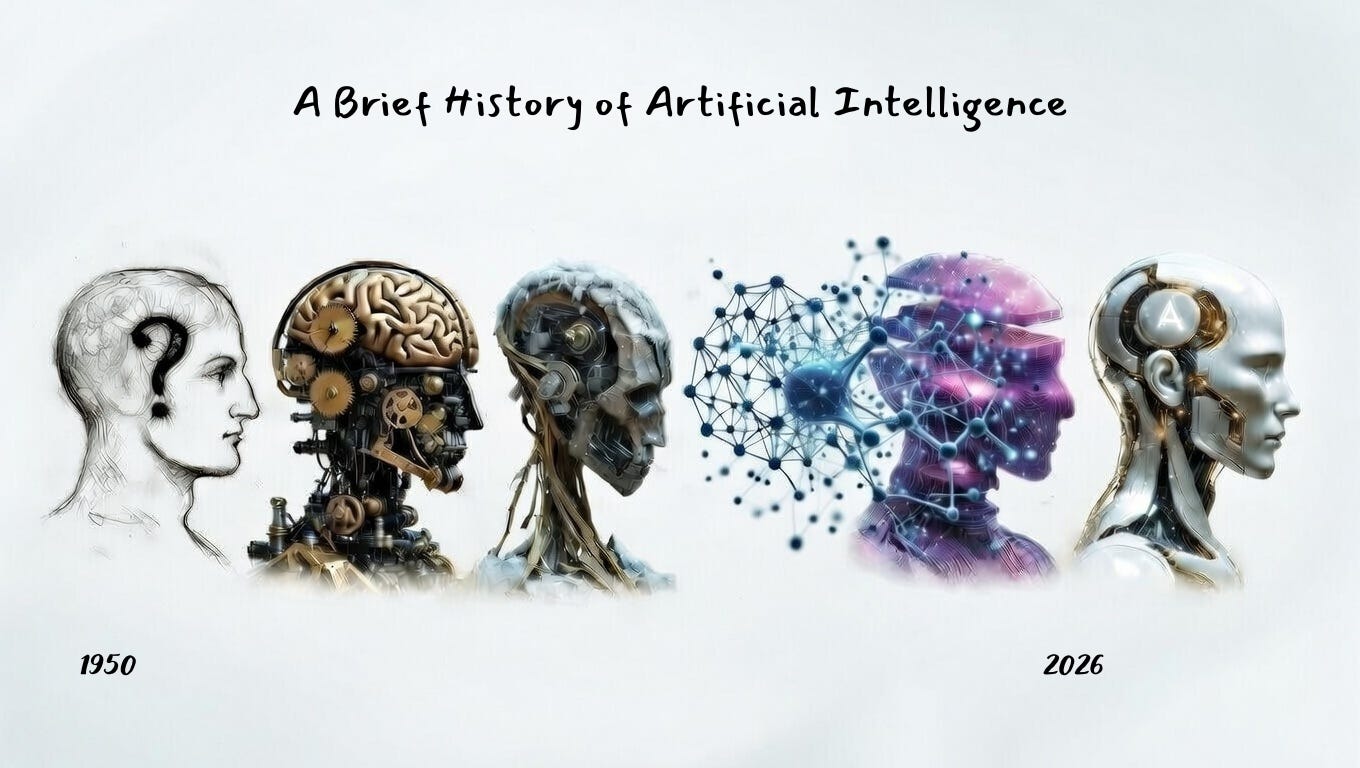
“We can only see a short distance ahead, but we can see plenty there that needs to be done.” — Alan Turing, “Computing Machinery and Intelligence” (1950)
In 1950, Alan Turing asked a question he couldn’t answer: Can machines think?
Seventy-five years later, we still don’t have a definitive answer. But we’ve learned to build machines that behave intelligently: ChatGPT writing essays and code, self-driving cars navigating city streets, humanoid robots like Optimus learning to fold laundry and sort objects. Whether these machines truly “think” remains philosophically contested. That they perform tasks we once believed required human intelligence is no longer in doubt.
This book tells the story of how we got here.
It’s a story of spectacular failure and stubborn persistence. Of brilliant ideas that turned out to be wrong, and abandoned ideas that turned out to be right. Of researchers who kept working through winters when funding disappeared and colleagues moved on. Of breakthroughs that came from unexpected places: from video games and image labels and the sheer scale of the internet.
It’s a story about how we sometimes build things that work before we understand why they work. About how practice can precede theory, and how the universe occasionally rewards those who try things that shouldn’t succeed.
And it’s a story that matters. Urgently. Because these machines we’re building, these systems that learn rather than being programmed, are already reshaping how we work, create, communicate, and think. They’re going to shape everything that comes next.
We’re living through the most significant transformation in the history of computing. Perhaps in the history of technology. Perhaps in the history of intelligence itself.
Understanding how we got here is essential to navigating where we’re going.
Let’s begin.
The Journey Ahead
The book is structured into five parts and fifteen chapters.
Part I: Origins (Chapters 1-3)
The age before learning
How we tried to build intelligence without learning, and why it failed. You’ll understand Turing’s foundational insight, the confidence of early symbolic AI, and the collapse that forced a reckoning.
Chapter 1: Can Machines Think?
How Turing made intelligence visible for the first time, and why visibility didn’t equal reproducibility.
Chapter 2: The Age of Symbolic AI
Why early AI believed logic was intelligence, and why that confidence was both justified and catastrophically wrong.
Chapter 3: The First AI Winter
What happened when the money ran out and the promises failed. What failure taught that success never could.
Part II: The Revolution (Chapters 4-6)
The paradigm shift
How learning replaced programming as the path to intelligence. You’ll discover why showing examples beats writing rules, how the world became training data, and why learning representations matters more than learning facts.
Chapter 4: The Paradigm Shift
The turning point. Why showing examples beats writing rules, and how the paradigm shifted from specification to training.
Chapter 5: The World as Training Data
How reality itself became the teacher. Why “more data” often beats “better algorithms,” and what the scaling hypothesis revealed.
Chapter 6: Representations That Transfer
How neural networks learn internal representations that let them handle unseen cases. Why good representations make hard problems easy.
Part III: Modern Foundations (Chapters 7-9)
How today’s AI works
The technical breakthroughs that created modern capabilities. You’ll grasp what transformers actually changed, how reinforcement learning creates agency, and why scale unlocks capabilities we can’t predict.
Chapter 7: The Transformer Revolution
How Attention Became “All You Need”. What transformers really changed. Why context became computation.
Chapter 8: Agents That Act
Why reinforcement learning points beyond language. The difference between knowing and doing, prediction and action.
Chapter 9: Scaling Laws and Emergence
Why bigger becomes different. How capabilities emerge unpredictably at scale, and where scaling hits its limits.
Part IV: Human Mirror (Chapters 10-12)
Understanding what we’ve built
What AI reveals about intelligence and about us. You’ll explore the gap between performance and understanding, why intelligence is compression, and how alignment steers capability toward usefulness.
Chapter 10: Intelligence as Performance
The imitation game revisited. What it means when machines pass tests without necessarily understanding them.
Chapter 11: Intelligence as Compression
Why prediction requires compression, and compression requires understanding. What information theory reveals about intelligence.
Chapter 12: Alignment as Translation
How we steer raw capability toward useful behavior. Why alignment is an ongoing challenge, not a solved problem.
Part V: Futures (Chapters 13-15)
Where this leads
Emerging frontiers and open questions. You’ll discover how AI is learning to model the world, why embodiment matters for physical AI, and what the path toward AGI might look like.
Chapter 13: World Models
How AI is learning to model how things work, not just what they look like. Why causal understanding matters more than statistical patterns.
Chapter 14: Physical AI
When learning meets reality. How embodied intelligence differs from digital, and why the physical world grounds understanding.
Chapter 15: Towards AGI and Beyond
What we’ve learned, what we don’t know, and where the path leads. Why intelligence is a direction, not a destination.
Each chapter:
Stands alone (you can read out of order)
Builds on previous chapters (reading in sequence is rewarding)
Includes historical context, key insights, and human stories
Ends with notes and further reading
Who This Book Is For
You don’t need to be an AI expert. This book is written to be accessible to anyone with curiosity and intelligence. Technical terms are explained. Algorithms are described in terms of what they do and why they matter, not implementation details.
But if you are technical, you’ll find depth here. This isn’t dumbed down. It’s carefully explained. There’s a difference. You’ll understand concepts at a level that reveals not just how things work but why they work the way they do.
This book is for you if:
You use AI tools and want to understand what’s actually happening under the hood
You’re trying to make sense of AI news and distinguish substance from hype
You’re curious about the history of ideas and how paradigm shifts happen
You want to understand where AI might be heading by understanding where it came from
You’re a student, professional, or decision-maker who needs AI literacy
You simply find intelligence, both human and artificial, fascinating
This book is NOT:
A programming tutorial (though you’ll understand key concepts)
A comprehensive technical reference (though it’s technically accurate)
A manifesto about AI safety, ethics, or policy (though it provides context for those discussions)
A prediction of the future (though it helps you think more clearly about possibilities)
What You’ll Gain
By the end of this series, you will:
Understand the fundamentals:
Why early AI pursued symbolic approaches and why they failed
What learning machines actually learn and how they learn it
Why neural networks work (at least, as well as anyone understands it)
What transformers changed and why language understanding unlocked
How scaling laws govern modern AI development
Why representations enable generalization
Think more clearly about AI:
Distinguish genuine capability from hype
Recognize the difference between narrow and general intelligence
Understand why some tasks are easy for AI and others remain hard
See where AI is likely to succeed or fail
Ask better questions about AI’s future
Evaluate claims about AGI with appropriate skepticism
Grasp the deeper implications:
What intelligence means (or might mean)
How learning differs from programming
Why compression and prediction are connected
What AI reveals about human intelligence
How practice can precede theory
Why embodiment might matter for true understanding
Navigate the conversation:
Evaluate AI news and announcements more critically
Understand technical discussions without being an expert
Contribute to debates about AI policy, ethics, and safety from an informed perspective
Make better decisions about using, building with, or regulating AI
Recognize when someone is oversimplifying or overhyping
Yet little of it may be relevant
https://www.youtube.com/watch?v=vZ1B-MvGMgw