

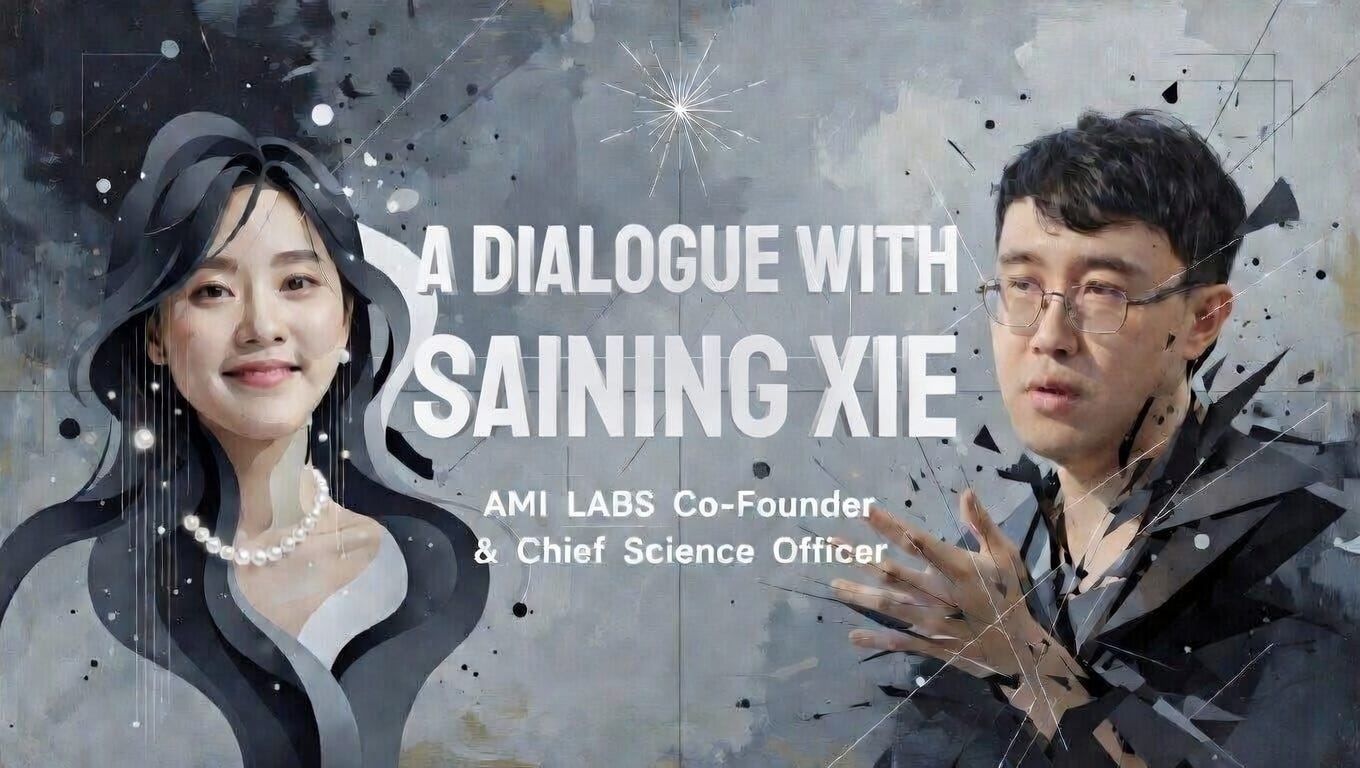
This is the overture to Language Is Poison, a series built from a seven-hour interview with Saining Xie, chief science officer of AMI Labs, and the argument he is making against the paradigm that made his own work famous.
In December 2025, Yann LeCun left Meta, the company where he had spent over a decade as chief AI scientist, to start something new. Three months later, the company he built, AMI Labs, announced a $1.03 billion seed round at a $3.5 billion pre-money valuation. It was the largest seed round in European history. The company had twenty-five employees. It had shipped no product. What it had, instead of a product, was Saining Xie: the researcher who co-authored the diffusion architecture behind Sora, now serving as AMI’s chief science officer and arguing that the technology making his own past work famous is built on a mistake.
The mistake, in Xie’s telling, is treating language as a thinking tool when it is, at root, a communication tool, built by humans, for humans, to move intent from one mind to another as efficiently as possible. That efficiency has a cost. “A cup fell and broke” tells you everything a listener needs and nothing about the physics of the fall, the material of the cup, or the exact sequence in which one object became several. Language was never built to carry that. It was built so you wouldn’t have to.
Xie’s claim is that the entire industry making its biggest bets on scaling language models has confused the tool for the mind. Worse, he argues, using language as a stand-in for physical reasoning does not just fail to help. It actively prevents a system from developing the reasoning it is standing in for, the way a crutch good enough to lean on forever is the one piece of equipment guaranteed to keep a leg from ever bearing weight on its own. Add language to vision, he says, and you get something that looks smarter and understands less.
This is not a contrarian’s provocation for its own sake. Xie spent four years at Meta FAIR before following LeCun out the door, and his name sits on some of the architecture the current paradigm runs on. What follows takes his argument at full strength: where it holds, where the money says otherwise, and what happens to an industry built on scale if the crutch is the whole problem.
The Four Parts
Four parts, all sitting on the Language Is Poison shelf.
Part 1: World Model, Not Word Model: why the co-creator of the technology behind Sora just helped raise the largest seed round in European history to argue against the idea that made him famous.
Part 2: The Bitter Lesson, Revisited: the essay Silicon Valley treats as license to scale everything turns out to say something closer to the opposite of what gets quoted.
Part 3: Everyone Is Heading to the Same Place: five companies use the same two words for five different bets, and the disagreement hiding under the shared vocabulary is the real story.
Part 4: Find the Story: before the billion-dollar round and the partnership with Yann LeCun, there was a teenager who wanted to direct films. What became of that ambition explains more about AMI Labs than any funding chart.
If This Is You
If you have started to suspect that scaling laws describe one kind of data rather than a law of nature, Part 2 is where that suspicion gets a name and a citation. Xie’s rereading of the Bitter Lesson is the sharpest challenge here to the story the industry tells itself about why bigger keeps working, and it names the point at which that story stops applying.
Maybe you build or study world models yourself, in which case the pull is less about being convinced and more about being tested. Part 1 lays out the technical case against routing physical reasoning through tokens, and Part 3 maps where that case sits against Fei-Fei Li’s World Labs, the video-generation labs, and the large language model companies who insist their systems already are world models. Readers who followed Roads to a Universal World Model will recognize the terrain, and find Xie’s taxonomy sharpening lines that piece left deliberately soft.
If what interests you is where the money is going and whether it should, Part 1 is the entry point: a company with no product and twenty-five employees just took in more seed capital than almost anyone in Europe ever has, on the strength of an argument rather than a demo. Part 3 is the follow-up question, since AMI is one bet among several that all claim the same destination.
If none of the technical stakes move you and you are here for the people, Part 4 is the one to read first. It has less to do with tokenization and more to do with a scientist who once wanted to make movies, and with the phone call in which Yann LeCun told him, before either had said a word about business, that he had already decided to leave Meta and build this outside it.
And if you are not sure which of these is you, that uncertainty is itself a reasonable place to start. The argument threading all four parts is short enough to state once: language was built to communicate, not to think with, and an industry that has stopped noticing the difference is spending real money on the confusion.
The crutch works. That is exactly the problem Xie is betting on.