

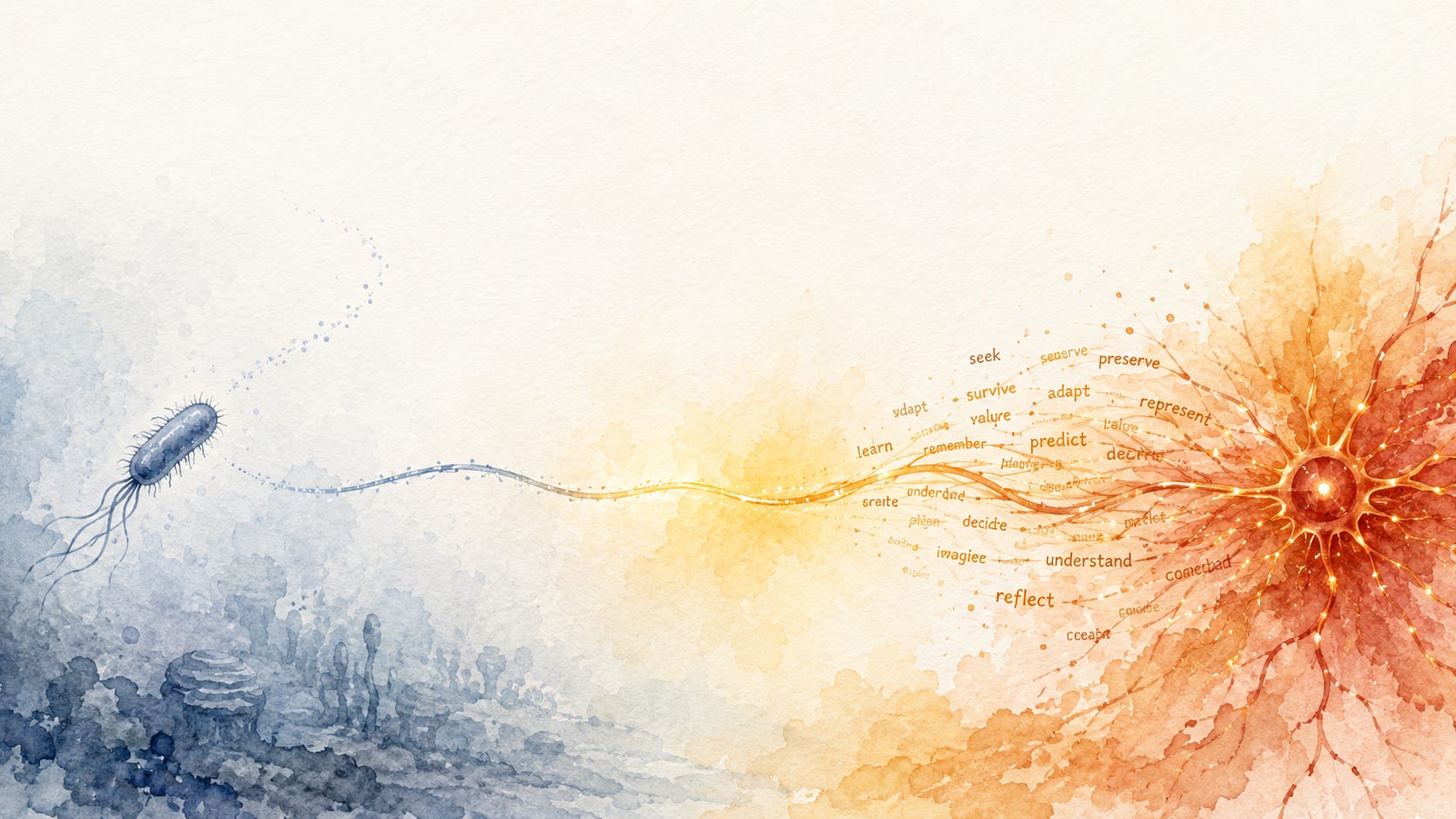
This is the overture to An Unfinished History of Intelligence, a series that follows a single thread, the one problem life, mind, and machine all solve, from the first living cell to the machines we are building now. Each installment stands on its own and connects to the deeper technical series across Robonaissance.
Somewhere in your gut right now, a bacterium is swimming up a sugar gradient it cannot see, using a memory that lasts about two seconds to decide which way is upstream. It has no brain. It is, by any definition an engineer would recognize, running a complete reinforcement-learning loop: sense the world, compress what matters, act to keep the good gradient coming. Four billion years later, a very different system, no protein anywhere in it, is doing a version of the same thing to answer this sentence.
That is not a metaphor and it is not a stretch. It is the literal claim this series makes: life, mind, and machine are three solutions to one problem, how to model a structured world well enough to stay ahead of it. The substrate changes every time, protein to synapse to symbol to parameter. The problem being solved never does.
This series does not argue that a bacterium and a language model are the same kind of thing. It argues they are answering the same question, and that watching how the answer gets reinvented, and what each new substrate can do that the last one could not, tells you something true about intelligence that neither biology nor computer science tells you alone.
In 1943, a physicist named Erwin Schrödinger gave a set of lectures at Trinity College Dublin asking what life is, thermodynamically. His answer, that a living thing survives by locally and expensively holding off the universe’s drift toward disorder, is where this series’ particular way of looking begins. It is a physicist’s lens, not a biologist’s: which regularity is being tracked, what it gets compressed into, what the tracking buys. Applied consistently, cell to cortex to transformer, that lens is the entire method.
Eight parts follow that thread from the first living cell to the frontier labs building the machines we are living alongside right now. The thread does not end at Part 7. It is not supposed to. The most honest thing this series says about itself is in its own title.
The Whole Thread
Eight parts, in the order the argument builds, all filed under An Unfinished History of Intelligence:
Part 0: The Thread: the single claim the other seven parts never contradict, that life, mind, and machine are three answers to one problem.
Part 1: Chemical Intelligence: a complete learning loop with no brain, no neurons, and a memory that lasts about two seconds.
Part 2: The Invention of the Neuron: why a signal that crosses a bacterium in a hundredth of a second needed the better part of two weeks to cross a single centimeter, and the invention that fixed it.
Part 3: The Rewiring Brain: what a reflex cannot do that a synapse can, and why evolution never solved that problem on the reflex’s own terms.
Part 4: The Inner World: the invention that made mistakes free, and the rat you can watch making them for free right now.
Part 5: The Words That Escaped the Skull: the channel that let one mind’s model become another mind’s inheritance, for the first time in four billion years.
Part 6: The Mind That Models Minds: the difference between simulating a corridor and simulating a rival, and why the second one is so much harder.
Part 7: The Next Chapter: why the honest way to end a history that is not finished is to say so.
If This Is You
If you want the single clearest statement of what this whole flagship series is claiming, start with Part 0: The Thread. Everything that follows is that one claim, tested against a different substrate each time.
If your background is biology or neuroscience rather than AI, Part 1: Chemical Intelligence through Part 4: The Inner World cover four billion years of the story before a single machine shows up, and each one points forward to where its AI parallel lands.
If you came for the AI side and are tempted to skip the biology, Part 2: The Invention of the Neuron is the one part built to change your mind. Real-time internal models did not start with computers.
Maybe language and symbolic AI are your actual interest. Part 5: The Words That Escaped the Skull is where the series gets there, and it treats language’s rise and symbolic AI’s collapse as one continuous argument, not two separate stories.
And if you want to see how this series closes without pretending the story itself has closed, Part 6: The Mind That Models Minds and Part 7: The Next Chapter are where that happens, one mind modeling another, then four frontiers, embodiment, autonomy, the social, and integration, still reconverging in real time. Wherever you start, you are tracing the same thread.
The problem is still open. So is the thread. Pick it up wherever it finds you.